

Classic Solitaire Engagement Rings vs. Halo and Pavé: Choosing Your Signature Setting
Somewhere between "which ring do I like" and "which ring is actually me," most women get stuck. Not because the options are bad — because there are too many good ones, and nobody tells you that the real question isn't which ring, but which setting. Solitaire. Halo. Pavé. Pick the wrong lens and you'll spend years second-guessing a ring that photographs beautifully and still doesn't feel like yours.
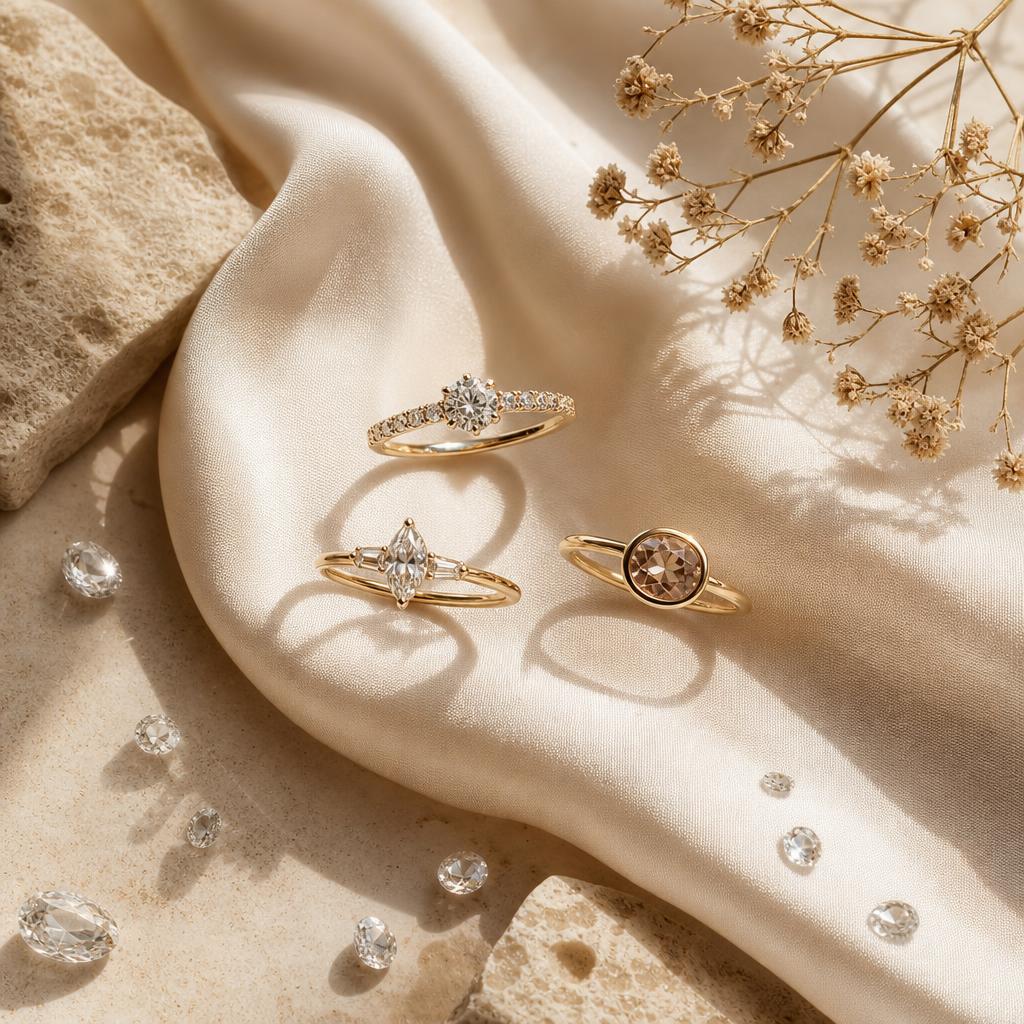
Here's the part no one explains at the jewelry counter: a setting isn't just a structural choice, it's a personality. Once you know which one is actually you, every ring you look at afterward gets easier to judge. Start with a spread of styles built around the three core philosophies.


Why "signature setting" is the smarter way to shop
Most buying guides sort rings by stone shape — oval, round, cushion, pear — as if the cut is the whole decision. It isn't. Two ovals can look nothing alike depending on what surrounds them: a clean four-prong mount reads completely differently from a stone ringed in smaller diamonds. The setting is what actually determines whether a ring looks quiet or loud, modern or vintage, restrained or maximalist. Decide your setting first, and the stone shape becomes a much smaller decision underneath it.
There are three core philosophies worth knowing before you shop: solitaire (a single stone, no embellishment), halo (a ring of smaller stones framing the center), and pavé (tiny stones set continuously along the band itself). Each sits at a different point on the quiet-vs-sparkly spectrum, and knowing where you naturally land on that spectrum is the actual shortcut everyone skips.
The solitaire: one stone, zero apology
Search for classic solitaire engagement rings and the options multiply fast, but the appeal underneath all of them is the same: one stone, held up, no distractions. The Odette Ring makes this case in oval form: a 3–4ct simulated diamond in a clean four-prong mount, with nothing else competing for attention. This isn't a smaller decision than a halo — it's a more confident one. Anyone can add stones. Choosing to let one stone stand entirely on its own takes more conviction, not less.
The woman who gravitates here usually isn't chasing maximum sparkle. She's after clarity — a ring that photographs the same in five years as it does today, that never reads as trend-driven, and that says exactly what it means without extra noise. If that's you, the case for one stone, no distractions only gets stronger the longer you wear one.
Halo settings: more presence, same stone size
A halo setting surrounds the center stone with a ring of smaller accent stones, and the effect is immediate — the center reads larger, the whole ring throws more light, and the silhouette gets noticeably bolder without changing the actual carat weight underneath. It's the setting for buyers who want a hidden halo engagement ring's extra sparkle now, not later, and who'd rather the ring do some of the talking for them.
Not every halo looks the same, though, and that's worth knowing before you assume you've seen them all. Traditional halos sit visibly around the stone; hidden halos tuck that same ring of accent stones underneath the center, invisible from above and only catching light from the side. The Duchess Ring uses the hidden version doubled — a cushion-cut center with pavé accents woven through the gallery, so the sparkle builds gradually the longer someone looks. It's a quieter way to get a halo's presence without the halo's obvious frame.

Duchess Ring
A cushion-cut center wrapped in a hidden halo and pavé, for a ring that reveals more sparkle the closer you look.
Shop Duchess Ring →Between the two, there isn't a wrong answer — only a better fit. Among the different types of halo ring settings, the traditional version suits someone who wants the sparkle read instantly, while a hidden halo suits someone who'd rather it be discovered. Isabella, our pear-cut pick, splits the difference nicely: a visible halo paired with a pavé band, so the drama stays proportional to the elongated shape rather than overwhelming it.
Worth knowing: A hidden halo doesn't make the center stone measure larger on paper — the extra sparkle comes from the accent stones catching light at the base, not from added surface area up top. It's a perception shift, not a carat one, and it's a genuinely useful trick if you want more visual weight without sizing up.
Pavé: sparkle as a continuous surface
Where a halo concentrates its accent stones around the center, pavé spreads them along the band itself — tiny stones set close together so the metal nearly disappears beneath the shine. It's the setting behind most pave engagement rings you'll see described as looking "more expensive than they are," because the effect compounds: every angle catches something. The Camilla Ring shows the idea at its most graceful, a round-cut center on a gently twisted, pavé-lined band that keeps the sparkle moving instead of static.

Camilla Ring
A round-cut center on a graceful twisted band, fully lined in pavé for sparkle that moves with the hand.
Shop Camilla Ring →Pavé rewards the buyer who wants sparkle everywhere, not just at the center — someone who'd rather the whole hand catch light than just one focal point. It also layers beautifully, which matters if you already know you'll want to stack rings eventually. A pavé band gives future additions something continuous to sit against, instead of competing with a plain shank.
✦ Pro tip: If you're torn between two settings, look at your hands the way you actually use them — typing, gesturing, resting on a table. A solitaire disappears into stillness; pavé and halo settings keep working even when your hand isn't posed for a photo.
Solitaire vs. halo vs. pavé, side by side
| Setting | Visual effect | Best for | Everyday wear |
|---|---|---|---|
| Solitaire | Clean, singular focus | Buyers who want restraint and longevity | Effortless, snag-free |
| Halo | Larger, bolder presence | Buyers who want maximum visual impact | Slightly more to keep clean |
| Pavé | Continuous, moving sparkle | Buyers who want sparkle from every angle | Layers well, stacks easily |
How to actually decide
The honest answer is that your signature setting is less about the ring and more about how you already move through the world. If you gravitate toward one great piece over five good ones, a solitaire will always feel more like you than a halo ever could. If you're the person who adds one more layer to every outfit until it feels finished, pavé or halo will make more sense than a lone stone ever will. Neither instinct is more sophisticated than the other — they're just different, and how to make the call based on your hand, your style, and your budget is really a question of which one you recognize in yourself first.
What matters more than the answer is asking the question at all. Buying a ring because it's the shape everyone else picked is how women end up with something beautiful that still doesn't feel like theirs. Buying it because you actually understand why a setting works for you is how you end up wanting to choose one aesthetic and commit to it across every piece you buy afterward, rings included.
Quick Takeaways
- Setting, not stone shape, is what actually defines a ring's personality — decide this first.
- Solitaire settings suit buyers who want restraint and longevity over maximum sparkle.
- Halo settings add visual size and presence without changing the underlying carat weight.
- A hidden halo delivers a halo's sparkle with a solitaire's clean top-down look.
- Pavé settings spread sparkle continuously along the band and layer easily into a future stack.
Frequently Asked Questions
What's the actual difference between a halo and a hidden halo setting?
A traditional halo sits visibly around the center stone, so the extra sparkle is obvious from directly above. A hidden halo tucks that same ring of accent stones underneath the center, invisible from the top and only catching light from the side — a quieter, more discovered kind of sparkle.
Is a pavé setting more delicate than a solitaire?
Not meaningfully. A well-set pavé band holds each stone securely along the shank, and daily wear doesn't put more strain on it than a solitaire's prongs. Both hold up fine with normal care — the difference is aesthetic, not structural.
Does a halo actually make the center stone look bigger?
Yes, visually. The ring of accent stones extends the sparkle outward, so the eye reads the whole cluster as one larger shape, even though the center stone's actual size hasn't changed. It's a genuine perception shift, not a marketing claim.
Which setting is easiest to wear every day?
Solitaires tend to be the lowest-maintenance choice — fewer surfaces to catch on clothing or clean around. Pavé settings run a close second and layer well into a stack. Halo settings sit slightly higher and wider, which some buyers love for presence and others find gets in the way at a keyboard or gym.
Should I choose a hidden halo or no halo at all?
It comes down to whether you want the extra sparkle to be immediately visible or something only you know is there. A hidden halo vs no halo decision is really a question of whether you want your ring to announce itself from across the room or reward a closer look.
Whichever setting you land on, the point isn't to pick the most popular one — it's to pick the one that already sounds like you when you describe it. That's the actual signature. Indistinguishable from a diamond, passes diamond testers, and finally set the way you'd have chosen it yourself.


