

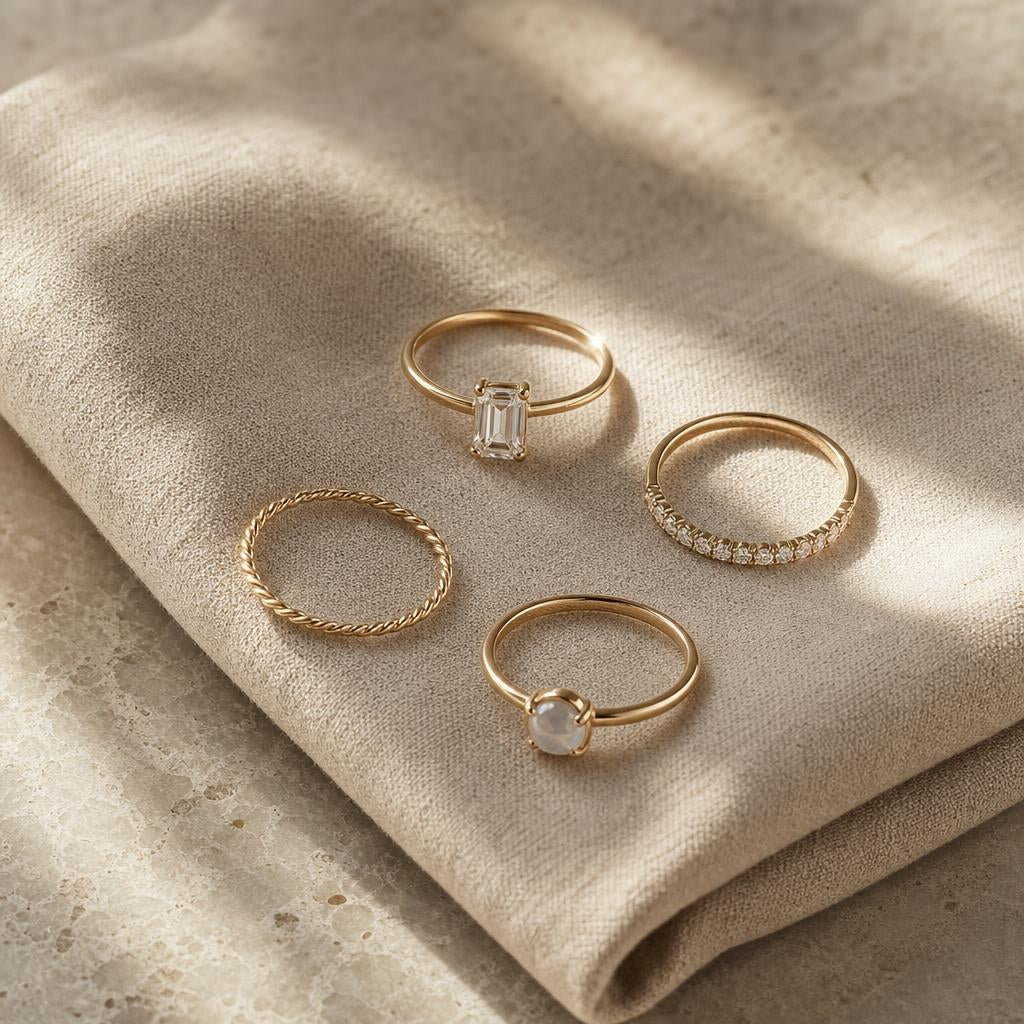
Building a Signature Ring Look: Your Jewelry Capsule Wardrobe
Most women don't buy rings one at a time. They accumulate them — a gift here, an impulse buy there, something that caught the light in an ad — until the jewelry box is full of pieces that have nothing to say to each other. A signature ring look works differently. It starts with a decision about what you actually like, and every ring after that is chosen to support it.
That's the difference between a drawer of jewelry and a jewelry capsule wardrobe: one is a collection of purchases, the other is a point of view. And building one doesn't require spending more — it requires spending on purpose.


Why "one of everything" doesn't actually work
It feels safe to buy across every style — a solitaire this year, a halo next, something vintage-inspired the year after that. But a hand wearing five unrelated aesthetics doesn't read as versatile. It reads as undecided. The women whose hands you actually notice — the ones whose rings look expensive, intentional, unmistakably theirs — have almost always committed to a single point of view and let it repeat.
That repetition is the whole trick. A cushion-cut hidden halo next to a round pavé band doesn't stack. A cushion-cut hidden halo next to another hidden halo, in a slightly different size or metal, does. Building a jewelry capsule wardrobe means every future purchase gets easier, not harder, because you're no longer starting from zero each time — you're adding to something that already has a shape.
Start by naming what you're actually drawn to
Before you buy anything else, look at what you already reach for — not just in rings, but in clothing, in the rest of your jewelry box, even in your closet. The aesthetic categories tend to break down into a few honest camps:
| If you're drawn to... | Your signature is likely | Start with |
|---|---|---|
| Clean lines, single stone, no clutter | Solitaire minimalism | Stella, Odette |
| Maximum sparkle, stone looks bigger than it is | Halo & pavé maximalism | Ophelia, Duchess |
| Sharp edges, geometric symmetry | Architectural | Astrid, Morgan |
| Elongated, dramatic silhouette | Movement & drama | Isabella, Paris |
Notice that none of these require a large budget or a rare stone — they're about setting and shape, which is exactly why a simulated diamond collection can build a convincing aesthetic just as well as a fine jewelry one. The visual language comes from the silhouette, not the price tag.

Ophelia Ring
The oval hidden halo that anchors an entire maximalist aesthetic — the kind of ring people assume runs $15,000 or higher. It isn't a dupe of that look. It's 925 sterling silver and a stone that passes diamond testers, built to be the centerpiece everything else in your collection answers to.
Shop Ophelia Ring →The three-piece rule for starting a capsule jewelry collection
You don't need ten rings to have a look. You need three that were chosen to agree with each other:
✦ Pro tip: One anchor (your most-worn, most-defining piece), one supporting piece in the same family of shapes, and one quiet piece — a plain band or slim solitaire — that can sit next to either without competing. That's a working aesthetic, not just three purchases.
This is also the fastest way to avoid the most common mistake in building a jewelry collection: buying reactively. A ring that photographed beautifully on someone else's hand can still break your aesthetic the moment it's on yours, sitting next to pieces it was never designed to complement.
Metal consistency matters more than people think
You don't have to wear a single metal tone forever, but within one "era" of your collection, consistency does more visual work than any single ring's cut or carat. A platinum-toned solitaire and a rose gold halo can both be beautiful on their own and still read as clutter together. If you're not ready to commit to mixed metal as its own intentional statement, pick one tone and build three or four pieces inside it before you branch out.

Astrid Ring
An asscher-cut three-stone silhouette with the kind of clean, stepped geometry that reads as considered rather than decorative — the ring for a woman whose aesthetic is precision, not sparkle for its own sake.
Shop Astrid Ring →Timeless jewelry pieces to invest in first
If you're starting from nothing, resist the urge to buy the most unusual piece first. Novelty settings are fun as a third or fourth ring, once your aesthetic is established enough to carry something unexpected. But the earliest pieces in a collection should be the ones that will still make sense to you in five years — a well-proportioned solitaire, a clean halo, a side-stone setting in a shape you already know flatters your hand. Those are the pieces that anchor everything that comes after, and they're the ones you'll reach for even after your taste has otherwise evolved.
Worth knowing: A signature look isn't the same as a limited one. You can still own a statement piece for occasions and a quieter everyday ring for work — the point isn't fewer rings, it's fewer unrelated rings. Every piece should feel like it was chosen by the same person.
When it's time to break your own rule
Once an aesthetic is genuinely established — once four or five pieces already agree with each other — a single deliberate outlier can sharpen the whole collection instead of diluting it. The mistake isn't owning a dramatic pear-cut ring next to a minimalist stack. The mistake is buying the dramatic piece first, before there's anything for it to contrast against.

Isabella Ring
A pear-cut halo with genuine movement — the outlier piece worth owning once your everyday aesthetic is already settled. Elongating, a little unexpected, and confident enough to hold its own next to a quieter collection.
Shop Isabella Ring →Building it without overspending
A minimalist jewelry collection is, by definition, the cheapest kind to maintain — fewer pieces, chosen well, worn constantly. But even a fuller aesthetic doesn't require a fine jewelry budget. Because every Gemiros ring is 925 sterling silver with rhodium, 18k gold, or rose gold plating and a stone that's indistinguishable from a diamond to the naked eye, building a considered, cohesive collection is a matter of choosing shapes on purpose — not a matter of what you can afford to risk on a single piece.
Think of it the way you'd think about a capsule wardrobe: not "how many pieces can I acquire," but "how few pieces does it take before this looks unmistakably like mine." Most women get there faster than they expect.
Quick Takeaways
- Pick one aesthetic family — solitaire, halo/pavé, architectural, or dramatic — before you buy your next ring
- Start with an anchor piece, a supporting piece, and one quiet piece that pairs with either
- Stay in one metal tone until your aesthetic is established, then mix on purpose
- Buy timeless shapes first; save the unusual pieces for once your look is already defined
- Consistency, not carat size, is what actually makes a collection look expensive
Frequently Asked Questions
How do I actually figure out what my ring aesthetic is?
Look at what you already wear and keep coming back to — not just rings, but the rest of your jewelry and even your wardrobe. If you gravitate toward clean, single-stone pieces, you're likely a solitaire minimalist. If you're drawn to sparkle and scale, you're closer to halo and pavé maximalism. The aesthetic is usually already visible in your existing choices; building a signature look just means buying toward it deliberately instead of by accident.
What's the difference between a jewelry capsule and just owning a lot of rings?
A capsule is chosen as a set, even when the pieces are bought months or years apart — every ring is selected because it works with what's already there. A drawer full of rings bought independently, with no relationship to each other, is just accumulation. The visual result is the difference between a hand that looks curated and one that looks cluttered.
Is there a simple rule for how many rings I actually need?
A useful starting ratio is one anchor piece, one supporting piece in the same aesthetic family, and one quiet, simple piece that can sit next to either without competing. That's enough to establish a recognizable look. Everything you add after those three should be chosen specifically because it strengthens that same point of view.
Do all my rings need to match metal tone exactly?
Not forever, but early on it helps. Mixed metal can look intentional and modern once a collection is established, but it's a harder trick to pull off as your very first purchases. Staying in one metal tone for your first three or four rings makes the collection read as considered rather than accidental — you can always introduce a second tone deliberately once that foundation exists.
The women whose rings look expensive aren't necessarily the ones who spent the most. They're the ones who stopped buying reactively and started buying toward something. Pick your aesthetic, choose the pieces that support it, and let every future ring earn its place next to the ones you already love.


