

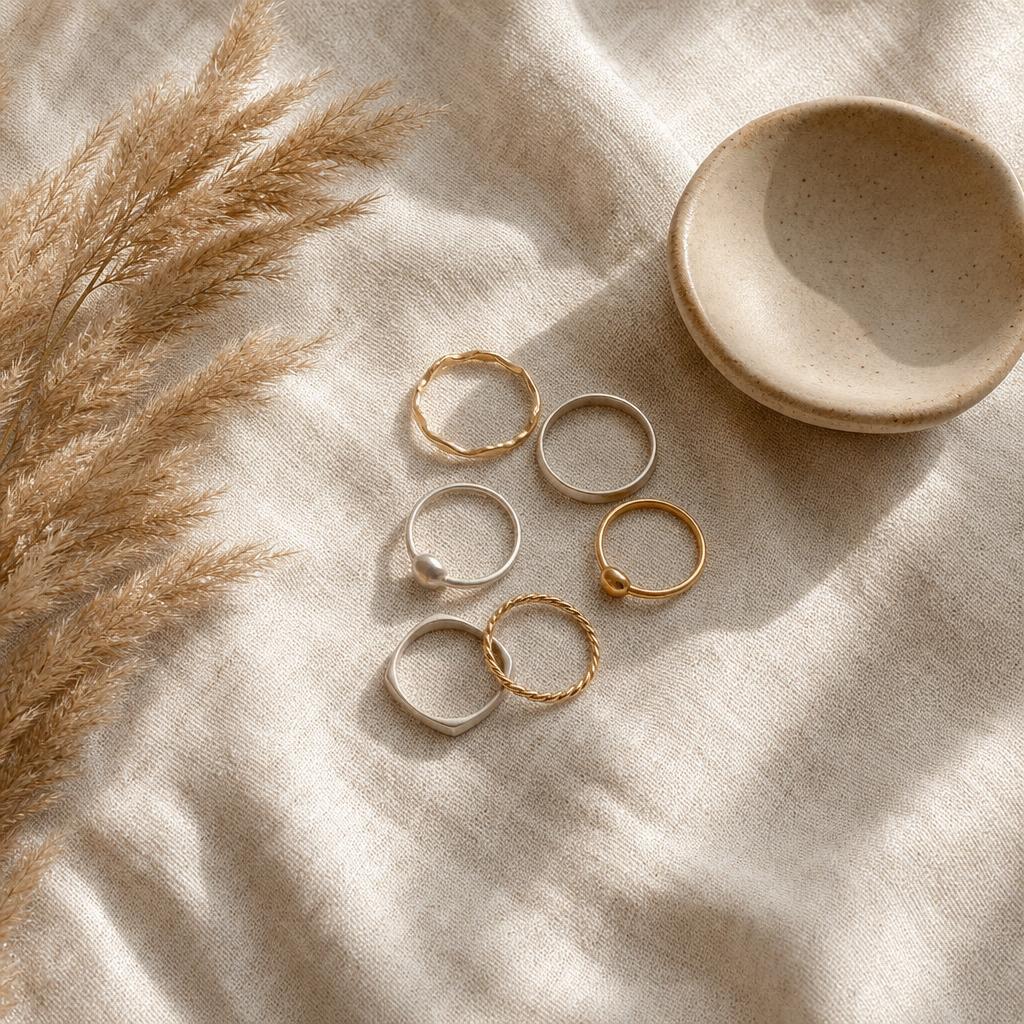
How to Build a Jewelry Wardrobe That Makes Sense — Without Overspending
Somewhere between "I'll just get one nice ring" and a jewelry box that no longer closes, there's a version of ring ownership that actually makes sense — a small, considered collection where every piece earns its place instead of just adding to the pile.
Building that kind of collection isn't about buying more. It's about buying in the right order, for the right reasons, so that every ring works with the ones you already own instead of competing with them.


Why "Jewelry Wardrobe" Beats "Ring Collection"
The word "collection" implies you're gathering — one of everything, in every finish, until the drawer is full. A wardrobe works differently. Nobody buys clothes by grabbing whatever's on sale in whatever size fits that week. A good wardrobe is built piece by piece, with each item chosen because it does something the others don't.
Rings deserve the same logic. A jewelry wardrobe isn't a bigger version of your jewelry box — it's a smaller, more deliberate one. The goal isn't ten rings. It's the right four or five, worn in rotation, none of them fighting for attention.
Worth knowing: Most women who build a ring collection they actually love describe it the same way — not as a series of purchases, but as one purchase that made the next one obvious.
Start With One Foundation Piece
Every wardrobe needs a piece that works with everything else you'll add later — a neutral you build around. In rings, that's usually a solitaire or a clean, single-stone silhouette. It's simple enough to wear alone on a plain day and structured enough to anchor a stack once you're ready for one.
This is the ring to buy first, and it's worth resisting the urge to make it your most dramatic piece. A foundation ring that's too bold leaves nowhere to go — every ring you add afterward either has to compete with it or defer to it, and neither makes for an easy collection to wear.
The Échelon Ring
A sharp, architectural Asscher cut in a clean solitaire setting — the kind of ring that reads as finished on its own but leaves plenty of room underneath for a band later. It's a genuinely good starting point precisely because it doesn't ask to be the only ring you ever wear.
The Second Purchase: A Layering Piece, Not a Second Statement
Once the foundation is in place, the instinct is often to buy another eye-catching ring. Resist it. The second purchase that actually builds a wardrobe is a layering piece — something quieter, narrower, and built specifically to sit alongside what you already own rather than replace it.
This is where a lot of collections go wrong early. Two statement rings worn together usually look like an accident, not a wardrobe. A statement piece and a layering piece worn together look intentional almost by default.

The Cherish Ring
A bezel-set eternity band that reimagines the classic stacking ring with individually rubbed-edge stones — low-profile enough to sit flush against a solitaire without competing with it, and durable enough for daily wear.
Shop The Cherish Ring →A bezel-set band like this is also one of the most forgiving pieces to build around, since the smooth edge won't snag on the setting of whatever sits beside it — which matters more than most first-time buyers expect once a stack actually starts to grow.
Metal Tones: One System or Two?
This is the question that trips up more collections than anything else. Do you commit to a single metal tone across every ring, or is it acceptable to mix gold and silver tones on the same hand?
The honest answer is that mixed metal stacking works when it's deliberate and fails when it's accidental. A collection built entirely in one tone is the safer, faster path to a wardrobe that always looks pulled together. But a second metal tone, introduced carefully — usually through a single warm gold piece against a base of silver — can make a collection feel layered rather than matched, which is exactly the effect a real jewelry wardrobe is going for.

The Beloved Ring - Gold
A vintage-inspired eternity band in warm gold, with a row of brilliant pavé stones. Introduced deliberately against a silver foundation, it's the kind of single warm-tone piece that reads as intentional rather than mismatched.
Shop The Beloved Ring - Gold →If you're not sure which camp you fall into, start with one metal tone and stay there for your first three purchases. It's far easier to introduce a second tone once a collection is established than to correct a stack that already feels scattered.
Sequencing Purchases Without Blowing the Budget
A jewelry wardrobe doesn't require a large budget — it requires a sequence. The mistake most people make isn't spending too much on any single ring; it's buying pieces in a random order, so that nothing coordinates and every purchase feels like it's starting from scratch.
A more useful approach treats each purchase as a small, planned decision rather than an impulse buy: foundation piece first, layering piece second, and only then a second statement piece once the first two are actually in rotation together. Spacing purchases this way also means each ring gets properly worn in and evaluated before the next one is chosen — you'll know exactly what's missing from the collection instead of guessing.
✦ Pro tip: Before adding a new ring, wear your current collection for two full weeks and note which finger or which combination feels underused. That gap — not a sale or a trend — is what should decide your next purchase.
How Many Rings Is Actually Enough?
There's no fixed number, but most well-worn collections settle somewhere between three and five pieces: one foundation ring, one or two layering bands, and a single statement piece reserved for when you actually want the attention. Beyond that, a collection tends to become a rotation problem rather than a styling one — pieces get left in the drawer not because they're wrong, but because there are simply too many to wear at once.
A statement piece like an oval solitaire with side stones earns its place precisely because it isn't worn every day — it's the ring you reach for when the foundation and layering pieces alone feel too quiet.
When to Retire a Ring From the Rotation
A jewelry wardrobe also means being honest about what's no longer working. A ring that hasn't left the drawer in six months isn't part of your collection anymore, whatever the receipt says. Retiring it — moving it to a keepsake box, gifting it, or simply setting it aside — isn't wasteful. It's the same instinct that keeps a clothing wardrobe from turning into storage.
Quick Takeaways
- Buy a foundation piece first — simple, wearable alone, and easy to build a stack around later
- Your second purchase should be a layering piece, not a second statement ring
- Pick one metal tone and stay there for your first three purchases before introducing a second
- Space purchases out so each ring gets properly worn in before the next decision
- Three to five well-chosen pieces beats a drawer full of rings you rotate through by guilt
Frequently Asked Questions
What's the very first ring I should buy for a jewelry wardrobe?
A simple, single-stone solitaire in whichever metal tone you plan to build around. It should be striking enough to wear alone, but understated enough to leave room for a stacking band later.
Is it better to buy cheaper rings so I can own more, or fewer expensive-feeling pieces?
Fewer, better-considered pieces almost always win out. A wardrobe of three rings you actually reach for beats eight you don't, regardless of what any individual piece cost.
Can I mix silver and gold rings in the same collection?
Yes, as long as it's deliberate. The safest approach is a silver foundation with one warm gold piece introduced on purpose, rather than an even split that can read as unplanned.
How long should I wait between adding new rings?
Long enough to actually live with what you already own. Most people find a few months of regular wear is enough to know what the collection is missing, rather than what a sale is telling them to buy.
Do I need a special occasion to start building a ring collection?
No. Plenty of women start a jewelry wardrobe entirely on their own terms, buying the foundation piece simply because they wanted one — no proposal, anniversary, or gift occasion required.
A jewelry wardrobe isn't built in an afternoon, and it isn't supposed to be. It's built ring by ring, each one chosen because it earns a place next to what you already wear — which, in the end, is what makes the whole collection feel like yours.


