

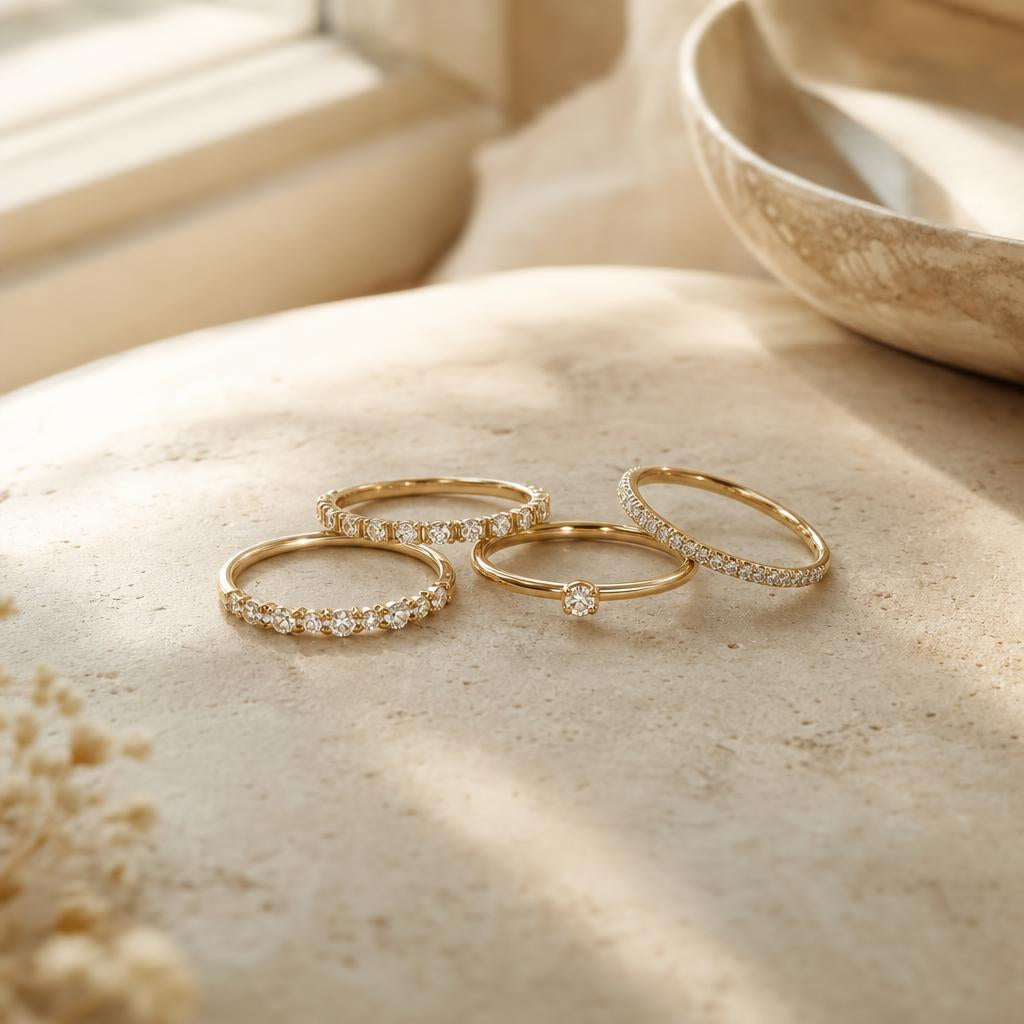
One Ring, Then a Stack: How to Build a Ring Collection That Actually Makes Sense
Nobody sets out to buy a jewelry collection. It happens one ring at a time — a piece you fell for on a hard day, an engagement ring, a gift you never take off — until one day you notice your hand looks fuller than it used to, and you can't quite remember buying the third ring, only that it belonged there the moment it arrived.
That's the real order most collections happen in: one ring you love completely, and then, months or years later, the quiet decision to build around it. If you're standing at that second stage right now, wondering what actually comes next, here's where we'd start.


Why the One-Ring Phase Matters More Than It Seems
There's a temptation, once you know stacking is a thing, to skip straight to a five-ring hand. Resist it. The one-ring phase isn't a waiting room before the "real" collection starts — it's where you actually learn what you like. Do you reach for your ring more when it's quiet and understated, or when it catches the light across a room? Do you like the way a halo makes a smaller stone read bigger, or do you find yourself wishing for something cleaner? None of that is obvious until you've worn one ring, alone, for a while.
This is also the stage where buying yourself a ring tends to happen — not as a placeholder for someone else's proposal, but as the actual first move in a collection you're building on your own terms. The ring you choose first sets the tone for everything that comes after it, so it's worth choosing something you'd be happy to build a whole hand around, not just something that felt safe.
The questions worth asking before ring two
Before you add anything, it helps to get specific about what your first ring is actually doing for you. A halo ring like the Isabella reads as romantic and a little formal — a second ring that echoes its pavé detailing will feel cohesive, while something in a completely different finish can feel like it's competing rather than complementing. Ask yourself whether you want your stack to look like one considered idea, or a collection of interesting individual pieces. Both are valid. They just call for different next purchases.
Worth knowing: Most customers who eventually build a five-piece stack didn't plan it that way from the start. They bought one ring they loved, wore it for six months to a year, and only then started noticing gaps — a plain band here, a bit more texture there. Let your hand tell you what it wants before you commit to a whole plan.
What to Buy Second — And Why It's Rarely a Twin of Your First Ring
The most common mistake in early stacking is buying a near-identical version of the ring you already own. It feels safe, but it tends to read as redundant rather than intentional. A better second move is a ring that shares one design language with your first piece — metal tone, stone shape, or setting style — while doing something different structurally. If your first ring is a solitaire or halo, your second is almost always a band: something slim enough to sit beside it without competing for attention.
This is where a classic pavé eternity band earns its keep. The Everlasting works precisely because it doesn't try to be a second statement ring — it's a continuous, quiet line of sparkle that sits happily next to almost anything. It's the ring most people reach for as their true "ring two," because it does its job without asking your first ring to share the spotlight.

The Infinity Ring
A flowing, crossover line of pavé stones that reads as more sculptural than a straight eternity band — a strong choice if your first ring already has clean, geometric lines and you want the second piece to bring a little movement instead of repeating them.
Shop The Infinity Ring →Building a Stack That Reads as Intentional, Not Accidental
Once you're past two rings, the goal shifts from "does this piece look nice on its own" to "does this collection make sense as a whole." This is genuinely a skill, and it's one you build through trial and adjustment rather than getting right on the first try. If you want a fuller breakdown of specific combinations that work, we've mapped out five stacking combinations that look intentional, not accidental — but the underlying principle is simple: vary texture and width, keep the metal tone consistent, and let one ring stay the visual anchor while the others support it.
Width is the detail most people underestimate. A stack made entirely of 1.5mm bands looks thin and a little forgettable, no matter how much sparkle each one carries individually. A stack made entirely of bold, wide bands can overwhelm a smaller first ring. The stacks that photograph best — and feel best day to day — usually mix at least one substantial piece with one or two slimmer ones, so your eye has somewhere to land.
Texture is doing more work than you think
Pavé, bezel, and channel settings each catch light differently, and mixing them is what keeps a stack from reading as flat. A bezel-set band like the Cherish brings a smooth, architectural edge that contrasts beautifully against a pavé piece's softer sparkle — the two together look considered in a way that two pavé bands side by side simply don't.

The Devotion Ring
A continuous circle of channel-set baguette stones — a structured, geometric counterpoint to a rounder, softer first ring. It's often the third or fourth piece people add once they've decided their stack needs a bit more edge.
Shop The Devotion Ring →Should You Build Around Your Engagement Ring?
If the ring you already own is an engagement ring rather than a self-bought piece, the same logic applies, with one extra layer: you're not choosing a starting point, you already have one, and it may not have been chosen with stacking in mind. That's completely fine. We've written a full guide on how the engagement ring you already own becomes the starting point for everything you add next — the short version is that almost any engagement ring can anchor a stack, provided the bands you choose respect its width and metal tone rather than fighting it.
One thing worth deciding early: are you stacking to wear every day, or building pieces you'll mix and match depending on occasion? Daily stackers tend to gravitate toward slimmer, more durable combinations they don't have to think about. Occasion stackers have more room to experiment with bolder, more textural pieces they can add or remove depending on the outfit or the event.
✦ Pro tip: If you're not sure whether two rings will sit flush together, try them on stacked before you buy the second one. A ring that looks perfect in a product photo can still gap or twist against a specific first ring — comfort on the hand matters more than how the pairing looks in an image.
Metal Tone: The One Rule Worth Actually Following
Of everything in this guide, metal tone consistency is the closest thing to a hard rule. Combining gold tones in the same stack can look wonderful, but it takes a confident hand and usually more than two rings to pull off well. If you're still early in your collection — one ring, maybe two — matching metal tone across every piece is the fastest way to guarantee your stack looks cohesive rather than accidental. Save the mixed-metal experiments for once you have three or four pieces and a clearer sense of your own taste.
Quick Takeaways
- Wear your first ring alone for a while before deciding what comes next — it teaches you more than any guide can.
- Your second ring should complement your first structurally, not copy it.
- Vary texture and width across your stack; uniformity reads as flat, not polished.
- Keep metal tone consistent until you have three-plus rings and real confidence about mixing them.
- There's no fixed timeline — the best collections are built slowly, piece by piece, as you actually notice what's missing.
Frequently Asked Questions
How long should I wait before buying my second ring?
There's no set rule, but most people find it useful to wear their first ring for at least a few months before adding to it. That gap gives you time to notice what you actually reach for, rather than buying based on how a stack looks in a photo.
Do all the rings in a stack need to be the same brand or collection?
Not at all. What matters is that the pieces share a metal tone and a compatible width, not that they came from the same line. A considered stack is built around consistency of look, not source.
What's the most common mistake people make when starting a ring collection?
Buying too many similar pieces too quickly, before they understand what their hand actually needs. A stack built slowly, with each ring solving a real gap, almost always looks better than one bought all at once.
Can I start a stack around an engagement ring instead of a ring I bought myself?
Yes — the same principles apply. Choose bands that respect your engagement ring's width and metal tone, and build outward from there rather than trying to match it exactly.
However your collection starts — a ring you bought yourself on an ordinary Tuesday, or one that came with a proposal — the path from there is the same. One ring you love, worn long enough to understand it, and then a second piece chosen to answer a real question rather than fill an imagined gap. Everything after that is just time.


