

Should Your Jewelry Match? Why Coordinated Beats Matching
Somewhere along the way, jewelry picked up a rulebook: the necklace must match the earrings, the earrings must match the ring, and anything less looks like you got dressed in the dark. Here is the more useful truth. The women with the most considered jewelry rarely match. They coordinate.
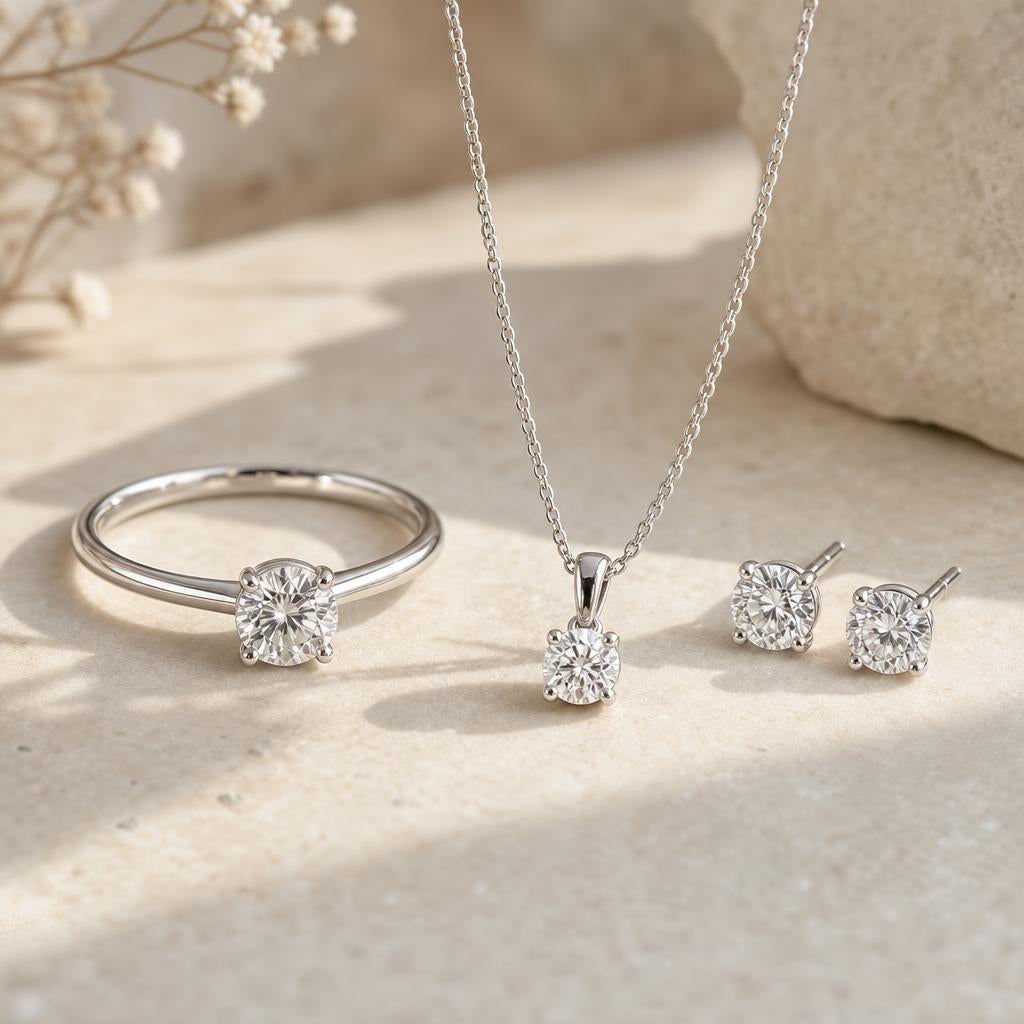
Matching is a shortcut someone sold you. Coordinating is a decision you make, and it is the reason a ring, a pendant and a pair of studs can look chosen together even when they were bought a year apart. These four pieces show the idea in practice: one design family, three categories, no cloning.


Should Your Jewelry Match? The Short Answer
No. It should relate. Those are two different standards, and confusing them is why so many "complete" looks feel flat.
Matching means identical: the same stone, the same setting, the same motif repeated on every piece. Coordinating means shared logic: the pieces agree on a few decisions and are free to differ on the rest. Matching asks nothing of you except a credit card. Coordinating asks you to have a point of view, which is exactly why it reads as taste.
The Three Things That Actually Need to Agree
You do not need ten rules. You need three decisions, made once, that every piece in the look respects.
| Decision | What "agreeing" looks like | What can still vary |
|---|---|---|
| Metal tone | One dominant tone, repeated at least twice across the look | A second tone as an accent |
| Stone character | The same kind of sparkle, such as bright white round brilliance | Shape: oval ring, round studs |
| Visual weight | One piece leads, the others support | Size and length of each piece |
Notice what is missing from that table: identical designs. When metal tone, stone character and weight agree, the eye reads one intentional look. When only the motif repeats, the eye reads a catalog page.
Why a Perfectly Matched Look Can Fall Flat
Every strong look has one focal point. Put an oval centerpiece on your hand, a matching oval pendant at your collarbone and matching oval drops at your ears, and you have created three focal points competing for the same attention. Nothing leads, so nothing lands.
Worth knowing: The pieces that look most expensive together are almost never the ones that look most alike. They are the ones where one item is clearly the star and the rest are clearly cast to support it.
This is also why a glittering ring and a pair of small studs work so well together. The studs frame your face, the ring lives in your hands, and neither asks for the spotlight the other already holds.
How to Match Jewelry Across a Ring, Necklace and Earrings
Start with the metal. Pick the tone you wear most, then repeat it. If your ring is platinum-toned, a platinum-toned pendant and studs will carry the look even if all three are different shapes. Gold can enter as one accent, as long as it appears more than once so it reads as a choice rather than an accident. There is a longer walkthrough in our guide to mixing metals across the whole collection.
Then choose your stone character. Bright, white, high-fire sparkle is the common thread across Gemiros: Gemiros® Signature Simulated Diamonds and moissanite, both indistinguishable from a diamond to the naked eye, and both set in 925 sterling silver with rhodium or 18k gold plating. Keep that character consistent and you can vary shape freely. Our breakdown of how to coordinate moissanite across a ring, necklace and earrings shows where the line between cohesive and overdone sits.

The Éclat Moissanite Necklace
A six-prong round brilliant moissanite solitaire on a delicate chain. It shares its design language with the Éclat studs, so the pair reads as a family without being a literal set.
Shop The Éclat Moissanite Necklace →Design Families: The Clever Middle Ground
Between "identical" and "unrelated" sits the option most women overlook: buying from a design family. The Ophelia ring, necklace and stud earrings share a name and a design signature, but they are three different pieces doing three different jobs. Wear all three and the look is cohesive. Wear one and it still stands alone.
That flexibility is the real advantage. A true set locks you into wearing everything together. A family lets you build over time, add one piece when it suits you, and rewear each piece in combinations the original set never imagined.
When a True Set Is the Right Call
Sets earn their place in a few specific situations: a wedding, a milestone gift, a day when you want zero decisions. If that is you, it is worth reading whether a full three-piece set is actually worth it, and what matching should actually cost so you are not paying extra for a box. Outside those moments, coordinated beats matched almost every time.
Three Mistakes That Make Coordinated Look Accidental
Mixing everything. Two metals and three shapes is a look. Four metals and six shapes is a drawer spilled onto a person. Limit yourself to one dominant tone and one accent.
Letting two pieces lead. A bold ring and bold earrings on the same day split attention. Choose one to be the star and let the other play support.
Forgetting the neckline. The necklace has to live with what you are wearing, not just with your ring. A high neckline can hide a pendant that a V-neck would showcase, so decide your focal point after you choose the outfit.
A Four-Step Method for Coordinating Your Look
- Choose the leader. Decide which piece is the star today: the ring, the pendant or the earrings. Only one gets to lead.
- Set the metal tone. Repeat your dominant tone at least twice. Add a second tone only as an accent.
- Keep the sparkle consistent. Same stone character, free choice of shape.
- Scale the supporting pieces down. If the ring is bold, keep the studs small and the pendant fine.
✦ Pro tip: Photograph your look in a mirror before you leave. If your eye bounces between three pieces, one of them needs to step back. If it travels smoothly from hand to neck to ears, you have it.

The Soleil Ring
A round-cut pavé solitaire that makes a confident lead. Pair it with quieter studs and a fine pendant and the whole look follows its sparkle.
Shop The Soleil Ring →
The Belle Stud Earrings
Stud earrings that frame your face without competing with a statement ring. A natural supporting player when your hands are doing the talking.
Shop The Belle Stud Earrings →
The Vivara Moissanite Huggie Hoop Earrings
Pavé moissanite huggies for the days you want a different earring shape while keeping the same bright sparkle as your ring and pendant.
Shop The Vivara Huggies →What Coordinated Jewelry Says About You
Matched sets say you followed instructions. A coordinated look says you made decisions. You looked at the rulebook, understood why it existed, and kept only the parts that serve you. That is the same instinct that led you past the jewelry-store markup in the first place.
And because every Gemiros stone is a moissanite or simulated diamond that passes diamond testers, the question is never whether the sparkle holds up. It is only how you want to arrange it. For a related read on keeping everything in tune, see whether your ring should match your watch too.
Quick Takeaways
- Matching means identical. Coordinating means a few shared decisions.
- Agree on metal tone, stone character and visual weight. Let everything else vary.
- Give each look one focal point so nothing competes.
- Design families give you cohesion without locking you into a set.
Frequently Asked Questions
Should you wear earrings and a necklace together?
Yes, as long as one of them leads. Pair small studs with a more visible pendant, or a bolder earring with a fine chain. They only need to agree on metal tone and sparkle, not on shape.
Do my earrings have to match my ring?
No. They need to agree on metal tone and stone character. A pavé oval ring and round solitaire studs can look like they belong together because the sparkle and the metal match, even though the shapes do not.
Can I mix gold and silver tones in one look?
Yes. Choose one dominant tone and repeat it at least twice, then use the second tone as an accent. Repeating a tone is what makes the mix look deliberate.
Is a jewelry set ever the better choice?
For a wedding, a gift or a day with no time to decide, a set is a sound choice. For everyday wear, building from a design family gives you more combinations from the same pieces.
Stop asking whether your jewelry matches. Ask whether it agrees. When it does, no one will be counting stones. They will just notice that you look put together, and that you clearly knew exactly what you were doing.


