

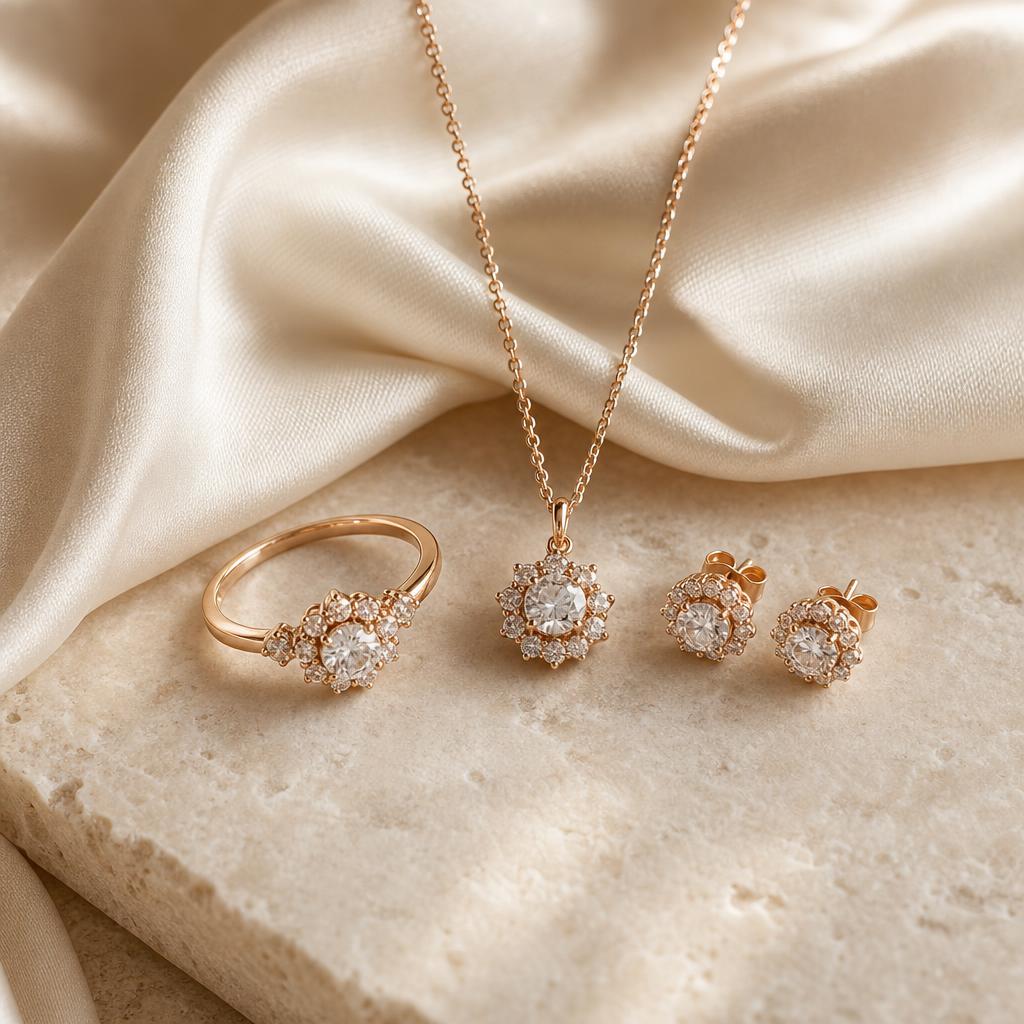
Ring, Necklace and Earring Sets: Is a Full Three-Piece Jewelry Set Worth It?
A jewelry box full of pieces that don't quite go together is its own kind of clutter. You reach for the ring, then stall out on which earrings actually work with it, then give up and wear the same three studs you always wear. A ring, necklace and earring set promises to solve that in one purchase — but is buying three pieces at once actually smarter than building your own, or is it just a tidier way to spend more than you meant to?
The honest answer depends less on the set itself and more on how you actually get dressed. Before you decide, it helps to see what a genuinely well-built set looks like — and where the pieces can come from.


What Actually Counts as a "Jewelry Set"?
The term gets used loosely, so it's worth being precise. A true set shares a deliberate design language — the same stone shape, the same setting style, the same metal tone — across a ring, a necklace, and a pair of earrings. It isn't three items that happen to be silver. It's a trio built so that wearing any two pieces together reads as intentional, not coincidental.
That distinction matters because it's the whole reason a set is worth considering in the first place. Matching necklace and earrings built around the same round-cut solitaire, for example, do something a coat of random pieces can't: they remove the daily guessing game entirely. You put on the necklace, you put on the earrings, and they were never going to clash — because they were never separate decisions.
The Real Case for Buying Pieces as a Set
The strongest argument for buying pieces together has nothing to do with getting a deal and everything to do with cognitive load. Getting dressed well every day is a series of small decisions — outfit, shoes, bag, jewelry — and every decision you don't have to make is energy saved for something that actually matters. A coordinated trio removes one of those decisions permanently.
There's also a real styling upside. Matched pieces photograph consistently, which matters more than it used to now that most of what you wear ends up in a photo somewhere. And a coordinated set gives you a default — a "this always works" combination you can fall back on for the days you don't want to think about it, alongside the pieces you mix and match on days you do.

The Isabella Ring
A graceful pear-cut center stone in a halo and pavé setting — built to sit naturally next to the Isabella Stud Earrings above without a single detail fighting between the two.
Shop The Isabella Ring →That's the version of a set worth paying attention to: pieces designed around each other, like the Isabella Ring and Isabella Stud Earrings, where the halo, the pavé, and the pear-shaped silhouette repeat across both pieces on purpose.
When a Three-Piece Set Isn't the Right Call
None of this means every set is automatically the smarter buy. If your existing jewelry already leans toward a specific stone shape or metal tone, a full three-piece set can genuinely fight what you own instead of adding to it. Buying a matched trio you'll only wear as a full trio — never split up, never mixed into your existing rotation — is a narrower purchase than it looks.
Sets also assume you want all three categories at once. Plenty of women have a ring collection they're happy with and actually need is one more necklace, or the reverse. In that case, a matching jewelry set is solving a problem you don't have — you'd be paying for two pieces you don't need to get the one you do.
✦ Pro tip: Before buying a full set, lay your current jewelry out and check which category is actually thin. If you already own three good pairs of earrings, buy the necklace and skip the third pair — even if it comes bundled.
How to Build Your Own Set Without Buying a Boxed One
You don't need a single SKU labeled "set" to get the benefit of one. The more flexible approach — and often the smarter one — is choosing a shared design language and buying into it one piece at a time, in whatever order your existing collection actually needs.
Pick one repeating element and let it anchor everything: a stone shape, a setting style, or a metal tone. A round-cut solitaire in a 6-prong setting, worn as a necklace one week and paired with matching studs the next, functions exactly like a boxed set — it's just assembled on your own timeline and budget, one piece at a time instead of one purchase.

The North Star Moissanite Necklace
A single radiant moissanite set at the center of a sleek starburst pendant — distinctive enough to wear alone, and versatile enough to sit next to almost any earring shape you already own.
Shop The North Star Moissanite Necklace →A piece like this one works precisely because it doesn't demand a matching ring and earrings to look finished. It's a strong enough standalone that it earns its place in your collection on its own terms — and if you later add a piece that shares its shape or setting, the "set" builds itself.
What to Look For Before You Buy a Ring, Necklace and Earring Set
A handful of practical checks separate a set worth buying from one that just looks coordinated in a product photo.
- Check the stone size relationship, not just the shape. A ring with a dramatically larger center stone than its matching earrings can look unbalanced on the hand-to-ear scale, even when the cut matches perfectly.
- Confirm the metal matches, not just the color name. "Silver" and "silver-toned" aren't always interchangeable claims — 925 sterling silver behaves differently over years of wear than a thin plated finish.
- Think about resale of attention, not resale value. A set you'll wear together for years earns its cost back in every outfit it simplifies — that's the actual return, not what it could sell for later.
- Buy the ring size separately from the visual. Ring sizing is the one variable a set can't solve for you; confirm it before you commit to the full trio.
Worth knowing: An affordable jewelry set doesn't mean a compromise on how it reads. Moissanite and 925 sterling silver are indistinguishable from mined diamonds and solid gold to the eye — and pass diamond testers. No one across the room, or across the table, is checking receipts.
Rings, Necklaces and Earrings: Buying the Trio vs. Building It
There's no universal right answer here — only the right answer for what's already in your jewelry box. A genuinely coordinated pairing earns its place when you're starting a category from zero, or when you want one dependable, no-thought combination on your busiest mornings. Building your own version, piece by piece around a shared stone shape or setting, earns its place when you already have opinions about what you own and just need the gaps filled.
Either way, the goal is the same: jewelry that works together because you decided it should, not because a listing told you it does.
Quick Takeaways
- A true set shares a stone shape, setting style, and metal tone across all three pieces — not just a matching color.
- Sets save decision-making energy and give you a dependable default combination.
- Skip the full trio if one category of your collection is already well-stocked.
- You can build your own set piece by piece around one repeating design element.
- Always confirm ring size and metal composition before committing to a full three-piece purchase.
Frequently Asked Questions
What is a three-piece jewelry set called?
Most retailers call it exactly that — a three-piece set, built from one ring, one necklace, and one pair of earrings sharing a design. Some listings also call a necklace-and-earring pairing alone a two-piece set, without the ring.
What do you call matching necklace-and-earring pieces?
It's typically called a demi-parure — a smaller matched grouping of two pieces that skips the ring or bracelet. It's the most common way to buy into a coordinated look without committing to a full trio.
What is the 2:1:1 rule in jewelry?
It's a rough styling guideline for layering: two thinner pieces to one medium piece to one statement piece, so a stack never has too many competing focal points. It applies just as well to a ring, necklace and earring set — the ring can be your statement, the necklace your medium, and simple studs your quiet anchor.
Can you wear a necklace and earrings from different sets together?
Yes — as long as the stone shape, setting style, or metal tone repeats somewhere between them, they'll read as coordinated even if they were never sold as a pair. That shared detail is doing the same job a boxed set does; it just came from two separate purchases.
Is it cheaper to buy pieces together or individually?
It depends on whether you actually need all three categories. Buying pieces together can cost less per item than buying three separately, but only if you were going to buy all three anyway — otherwise the "savings" are on a piece you didn't need.
Whichever direction you choose, the goal isn't a jewelry box that looks complete on paper. It's one where every piece has a reason to be there — and where reaching for a ring, necklace, or earrings on a Tuesday morning is never a decision that costs you five extra minutes.


