

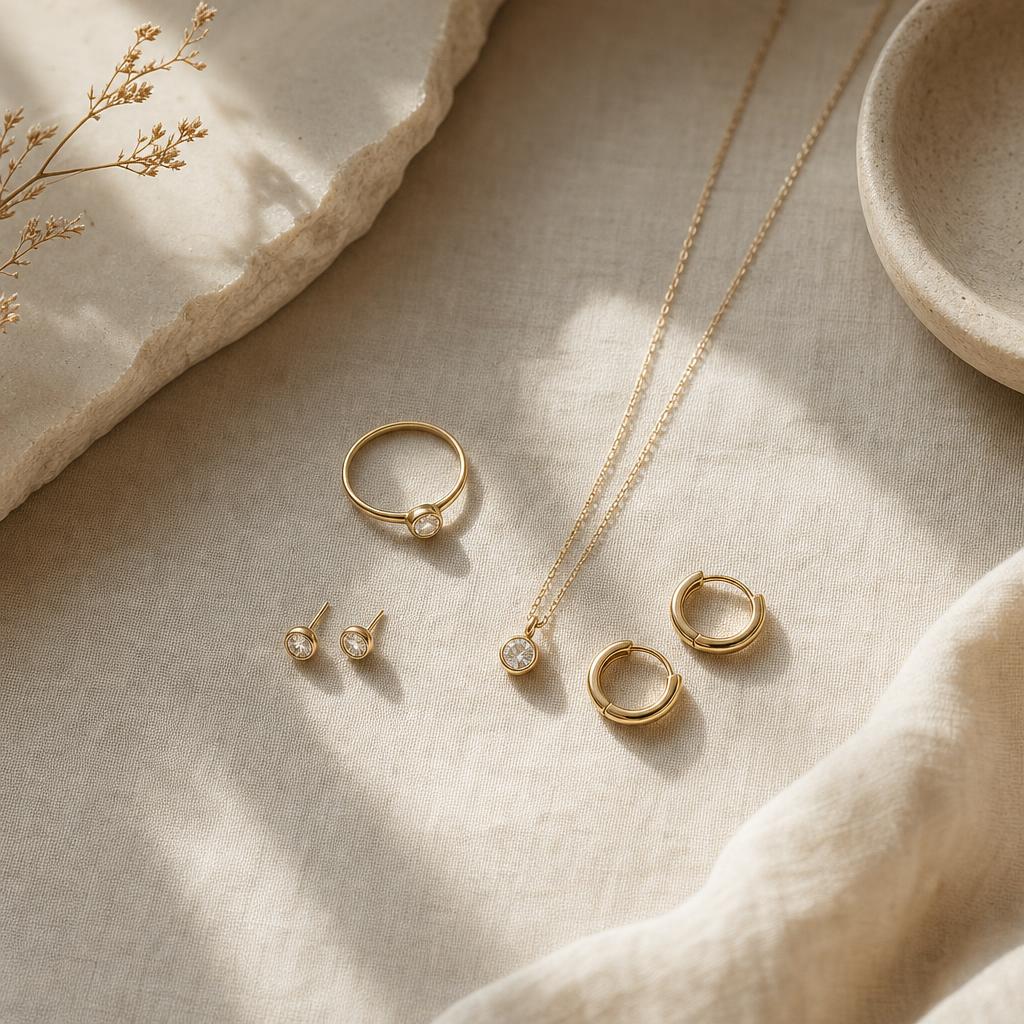
How to Build a Capsule Jewelry Collection: The Only Five Pieces You Need
Most jewelry boxes are full of things you don't wear. A capsule jewelry collection is the opposite problem, solved on purpose: five pieces, chosen well, that actually earn a place on your body instead of a drawer.
You don't need forty pieces to look put together — you need the right five, worn on repeat. Here's where to start.


What a Capsule Jewelry Collection Actually Is
It's a small, deliberate set of pieces built to work with everything you already own, instead of a growing pile of one-off buys that only match one outfit. The idea borrows from the capsule wardrobe — fewer things, chosen with more intention, each one pulling its weight. Applied to jewelry, it means five pieces that cover every occasion you actually have, not the occasions you imagine you might have someday.
This isn't a minimalism lecture. It's a buying strategy. Most women don't wear less jewelry because they prefer bare skin — they wear less because half of what they own doesn't go with anything, doesn't fit right, or turned green after two showers. A capsule fixes the actual problem: too much noise, not enough signal.
The five roles below aren't arbitrary. They cover your hand, your neck, and both of your ears — the three places jewelry actually lives day to day — with one deliberate exception built in for the days that call for more.
The Five Pieces
1. The Ring
Your capsule needs exactly one ring that isn't tied to an occasion — not the engagement ring, not a gift, just a piece you chose because you liked it. A clean solitaire does this best: one stone, no distractions, nothing to explain. It reads as intentional whether you're wearing a blazer or a T-shirt, which is the entire point of a foundation piece.

The Aura Ring
If your foundation ring is already a quiet solitaire, this is the one to add when you want a little more presence — a radiant-cut center with a side halo, still restrained enough to wear on a Tuesday.
Shop The Aura Ring →Moissanite and 925 sterling silver do the actual work here. A simulated diamond ring worn every day for a year should still look the way it did on day one — indistinguishable from a diamond, passing diamond testers, with no plating to wear thin at the edges. That's not a claim you have to take on faith; it's what the stone and the setting are built to do.
2. The Necklace
One delicate chain or solitaire pendant, worn alone or as the anchor under something longer. This is the piece that should survive being slept in occasionally and still look fine the next morning — which rules out anything fussy or precious. A round-cut solitaire on a fine chain covers a work meeting, a dinner, and a Tuesday with equal ease.
Skip anything that requires you to think about it. The whole appeal of a capsule necklace is that you stop noticing it's there.
3 & 4. The Two Earrings
This is where most jewelry collections go wrong — women tend to buy one pair of earrings at a time, in whatever style catches their eye that week, until the drawer is full of pairs that don't talk to each other. A capsule earring strategy is simpler: one pair of studs, one pair of hoops, and nothing else until those two have earned their keep.

The Stella Stud Earrings
The pair you put in and forget about — round-cut simulated diamonds in a classic setting that works from a 7am video call to a dinner reservation, no swap required.
Shop The Stella Stud Earrings →Studs handle the quiet days — the ones where you want sparkle without asking anyone to notice it. Hoops handle everything else: they read as slightly more finished, slightly more "I got dressed on purpose," without tipping into statement territory. Huggies in particular sit close enough to the ear that they survive a scarf, a hood, or a full day of headphones without catching on anything.

The Stella Huggie Hoops
The upgrade from studs without the commitment of a full statement earring — close-set round stones along a huggie hoop that catches light without catching on your hair.
Shop The Stella Huggie Hoops →Both pairs should be nickel-free and genuinely comfortable for full-day wear — not just marketed that way. If an earring makes you check the time so you can take it out, it was never going to make the capsule anyway.
5. The One Extra
Every capsule needs exactly one piece that isn't strictly necessary — the one you added because you wanted to, not because a checklist told you to. This is the permission slip built into the whole system: four pieces solve function, and the fifth exists purely because it makes you feel like yourself.
Worth knowing: The "extra" is the piece most women skip when they're building a collection on a budget — and it's usually the one they regret leaving out. A five-piece capsule that's all function and no personality stops feeling like your collection and starts feeling like a uniform.

The North Star Moissanite Necklace
A second necklace worth the exception — a starburst pendant with a radiant moissanite center, meant to be layered under your everyday chain or worn solo on the days that call for a little more.
Shop The North Star Necklace →Your extra doesn't have to be a necklace — it could be a second ring for stacking, a pair of drop earrings for evenings, or a pendant with real meaning attached to it. The only rule is that it has to be chosen, not defaulted into. Buy the first four pieces because you need them. Buy the fifth because you want it.
How to Buy the Pieces in the Right Order
Building a five-piece collection from scratch rarely happens in one purchase, and it shouldn't. Buying five pieces over five months, in a deliberate order, gives you time to notice what you actually reach for — which tells you more about your own taste than any style quiz.
✦ Pro tip: Buy the stud earrings and the ring first. They're the two pieces you'll wear the most, which means they're also the two pieces where quality matters most — you'll notice a cheap setting in a stud earring within a week, worn against your skin every single day.
After that, add the necklace, then the second earring pair, then the extra. By the time you're choosing your fifth piece, you'll already know your own patterns — whether you reach for silver or gold, whether you actually wear hoops or just think you should, whether your neck likes a short chain or a longer drop. Buying in this order means every later purchase is informed by real evidence instead of a guess.
What Not to Put in Your Capsule
The fastest way to break a capsule is to treat it like a wish list instead of a working set. A few things to leave out on purpose:
- Trend pieces with an expiration date. If a style only works because of a specific moment, it's not capsule material — it's a separate, occasional purchase.
- Anything you have to think about before wearing. Fussy clasps, pieces that snag on sweaters, settings that need constant checking — all disqualifying.
- Duplicates disguised as variety. A third pair of round studs isn't a new role in the capsule; it's just a spare.
- Pieces bought to match one specific outfit. A capsule piece should work with your closet, not one dress in it.
A tight five-piece collection built from 925 sterling silver and moissanite or simulated diamonds holds up to this kind of daily rotation in a way that costume pieces simply don't. You're not choosing between "looks expensive" and "actually durable" — with the right materials, you get both, which is the whole reason the capsule approach works at this price point instead of only at fine-jewelry prices.
Building on the Capsule Later
Five pieces is a floor, not a ceiling. Once your capsule is in place and you've worn it long enough to know it works, expanding it — a stacking band, a second necklace for layering, a statement earring for evenings — is easy, because you're adding to something that already has a shape instead of guessing at one from scratch.
The women who end up with the most coherent jewelry collections aren't the ones who bought the most pieces. They're the ones who built a five-piece foundation first and only added from there, on purpose, one piece at a time.
Quick Takeaways
- The five-piece approach means one ring, one necklace, two earrings, and one extra — not a drawer full of one-off buys.
- The ring and the two earring pairs get the most daily wear, so start there and let the necklace and extra come later.
- 925 sterling silver with moissanite or simulated diamonds holds up to daily rotation without the upkeep or price tag of fine jewelry.
- The "one extra" piece isn't optional filler — it's what keeps a functional capsule from feeling like a uniform.
- Build in order, watch what you actually reach for, then expand once the foundation is proven.
Frequently Asked Questions
What pieces belong in a capsule jewelry collection?
Most collections like this are built around five roles: one everyday ring, one delicate necklace, two pairs of earrings (typically studs and hoops), and one "extra" piece chosen for personality rather than function. The goal is coverage — your hand, your neck, and both ears — without excess.
How many pieces of jewelry should you actually own?
There's no universal number, but five well-chosen pieces will get you further than twenty scattered ones. A five-piece capsule covers every day-to-day occasion; anything beyond that should be added deliberately, not accumulated by accident.
What is the 2:1:1 rule in jewelry?
It's a rough styling guideline suggesting two smaller pieces (like stud earrings), one medium piece (a necklace or ring), and one statement piece worn together at any one time — a way to avoid either under- or over-accessorizing. It's a useful sense-check, not a rule to follow rigidly.
Should every piece in a jewelry capsule match?
Not exactly — matching metal tones across your capsule makes it easier to wear pieces together, but the pieces don't need to be from the same collection or design family. Consistency in metal tone matters more than uniformity in style.
Building a jewelry capsule isn't about owning less for the sake of it — it's about owning five pieces that actually get worn, instead of twenty that mostly get looked at. Start with the ring and the studs, let the rest follow, and you'll end up with a collection that works harder than anything you could buy all at once.


