

Earring Closure Types Explained: Push-Back, Screw-Back & More
Nobody tells you, when you buy your first real pair of earrings, that the backing matters more than the front. You research the stone. You research the setting. Then you lose an earring in a cab three weeks later because the little metal disc holding it in place was never built for how you actually live.
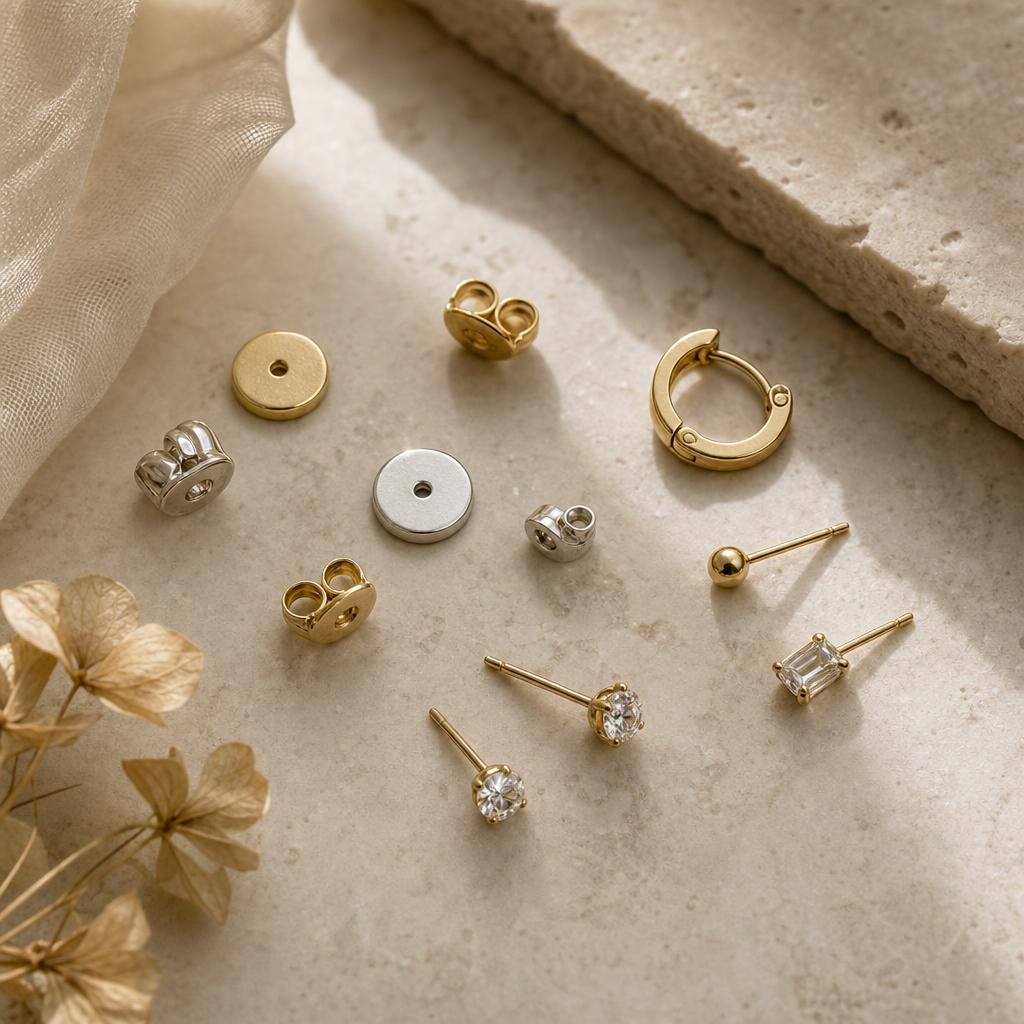
That detail has a name, and once you know what you're looking for, you stop leaving it to chance. Here's a spread of Gemiros studs and hoops worth knowing before we get into the mechanics.


Earring Closures: Why This Detail Actually Matters
An earring closure is simply the mechanism that keeps the front of the earring where you put it: through your ear, and nowhere else. It sounds mundane until you've bought a pair with the wrong one — a heavy stud on a flimsy friction back, a hoop with a latch that pops open every time it catches on a scarf. The stone was never the problem. The hardware was.
If you've gone looking for the different earring closure types and come back with more jargon than answers, that's because most guides describe the mechanics without ever telling you which one actually fits your life. So here's the plain-language version, sorted by what each one is actually for.
Push-Back (Butterfly) Closures
This is the default on most stud earrings, including nearly every pair in this collection: a smooth, straight post that a small friction clutch — the "butterfly" — slides onto and holds in place. It's fast on, fast off, and it's the right choice for daily studs you're taking in and out often. The tradeoff is exactly what you'd expect from something built for convenience: it can work loose over hours of wear, which is why it's a better match for lighter earrings than for anything with real weight to it.
Screw-Back Closures
A screw back replaces the friction clutch with a threaded post and a backing that twists on. It takes longer to put on, and that's the entire point — it isn't coming off by accident. This is the closure worth choosing for a stud you plan to wear for days at a stretch, or for anyone who has ever lost an earring in bedsheets and decided never again.
Latch-Back Earrings: The Hoop Closure You've Probably Wondered About
Latch-back earrings use a hinged post that clicks into a small groove or catch, forming a closed loop. You'll find this construction on huggie hoops most often, because the whole point is a seamless line with no visible gap and no dangling wire. It's a genuinely secure system, and it's why huggies have a reputation for staying put through a full day, a workout, and everything in between.
Lever-Back Earrings: Built for Dangle, Not Just Hoops
Lever-back earrings work on a similar hinge principle, but the wire itself is longer and curved, closing shut against a small lever at the back. It's the standard choice for drop and dangle styles because it distributes weight evenly along the ear instead of concentrating it on one small point — which is also why it tends to feel more comfortable than a friction back once an earring has any real movement or drop to it.
Flat-Back Closures
A flat back swaps the usual clutch for a smooth disc that sits flush against the back of the lobe, with the front stud snapping or threading into place. It's the closure of choice for anyone who sleeps in earrings or stacks multiple piercings close together, since there's no post end poking into the neck or catching on a pillow.
Omega and French Wire Closures
Two closures worth knowing but less common in an everyday rotation: an omega back is a hinged, curved piece that presses gently against the lobe to support heavier button or clip-style earrings, and a French wire is simply an open curved hook that passes through the piercing with nothing to fasten at all. Both show up more on vintage and drop styles than on modern studs and huggies.
Worth knowing: "Butterfly," "push back," and "friction back" all describe the exact same closure. Different sellers, different names, identical mechanism.
Replacing a Lost or Worn-Out Back
Backs wear out long before the earring itself does — a friction clutch loosens with repeated use, a screw thread can strip if it's forced, and a hinge can fatigue after enough opening and closing. None of that means anything is wrong with the earring. Replacement backs are inexpensive, widely available in sterling silver, and one of the few jewelry fixes you can genuinely do yourself in under a minute. The only real rule is matching the post gauge: measure the post before you buy a replacement, since a back that's slightly too loose defeats the purpose entirely.
It's also worth checking your existing pairs every so often rather than waiting for one to fall off unnoticed. A quick pinch test — does the back still hold firm resistance against the post, or does it slide with almost no pressure — takes a few seconds and tells you everything you need to know before a night out, not after.
A Quick Comparison
| Closure | Security | Best For |
|---|---|---|
| Push-back (butterfly) | Moderate | Everyday studs, quick on/off |
| Screw-back | High | Long wear, active days, sleep |
| Latch-back | High | Huggie hoops |
| Lever-back | High | Dangle and drop earrings |
| Flat-back | High | Sleeping, multiple piercings |
| Omega / French wire | Low–Moderate | Vintage and clip-style pieces |

The Éclat Moissanite Stud Earrings
A six-prong round moissanite solitaire in 925 sterling silver, built for exactly the kind of daily rotation a secure closure is meant to protect.
Shop The Éclat →Choosing the Right Closure for Your Life
The right answer isn't the most secure option by default — it's the one that matches how you actually wear earrings. If you're someone who takes studs out every night, a push-back is fine and arguably more practical than fighting with a screw thread twice a day. If you've genuinely lost earrings to sleep or gym bags before, that's the signal to size up in security, not a reason to assume something's wrong with how you wear jewelry.
Sensitive ears complicate the picture less than most people expect. The closure type matters far less here than the metal it's made from — a screw back in a metal your skin tolerates will always beat a push-back in one it doesn't. Gemiros earrings are set in 925 sterling silver, nickel-free by construction, so the material itself isn't the variable working against you. That's worth knowing before anyone tells you to avoid an entire closure type for a problem that was never about the closure.
✦ Pro tip: When you're comparing the different types of earring backs for studs, check the post gauge too — a thicker post paired with a well-fitted backing outlasts a thin post with an expensive-sounding closure every time.
Hoops, Huggies, and Which Closure Actually Holds
Hoop earring closure types split roughly into two camps: hinged systems, where a small clasp snaps the circle shut, and endless wires, where the hoop's own tension holds it in place with no separate mechanism at all. Hinged hoops go on and off faster and stay more reliably closed through a full day; endless hoops sit flatter to the ear but ask a little more patience to thread through. Neither is wrong — it's a genuine preference call, not a quality signal.

The Poise Moissanite Stud Earrings
A pavé balance-beam design pairing moissanite with a pearl accent — understated enough for a closure you barely think about once it's on.
Shop The Poise →None of this is about spending more for security you don't need, or settling for less than what actually fits your day. It's the same rational math that makes the rest of a jewelry collection make sense: know what you're buying, and stop paying — in lost earrings or irritated ears — for a detail nobody explained to you the first time.
What Actually Changes on Travel Days
Airport security, packed toiletry bags, and hours of movement all put more strain on an earring closure than a normal day at a desk does. This is where the more secure options — screw-back, flat-back, latch-back — genuinely earn their keep, since the last thing anyone wants mid-trip is patting down a hotel bedspread looking for a stud that worked loose on the flight. If a favorite pair only comes with a standard push-back, a set of replacement screw or locking backs is a small, practical addition to a travel jewelry case rather than a reason to leave the earrings at home.
The same logic applies to anything with real movement built in — workouts, long travel days, a wedding where you'll be on your feet for six hours straight. Match the closure to the day you're actually having, not the one you had when you bought the earrings.
Quick Takeaways
- Push-back (butterfly) closures are fastest for daily studs but the least secure over long wear.
- Screw-back and flat-back closures are the two best choices for sleeping in earrings or wearing them for days at a stretch.
- Latch-back closures are standard on huggie hoops; lever-back closures are standard on dangle and drop styles.
- Sensitive ears are almost always a metal issue, not a closure issue — 925 sterling silver is nickel-free regardless of which backing you choose.
- Match the closure to how you actually wear earrings, not to whichever one sounds the most secure.
Frequently Asked Questions
Is a screw-back earring actually worth it over a push-back?
If you wear a pair for more than a day at a time, yes. The threaded post takes a few extra seconds to fasten, and in exchange it won't work loose the way a friction clutch can over hours of movement.
Which earring closure is the most secure for everyday wear?
Screw-back and flat-back closures both outperform a standard push-back for security, since neither relies on friction alone. For hoops specifically, a latch-back closure is the more secure of the two hinge styles.
What's the 2/3 earring rule?
It's a rough styling guideline, not a hardware rule: an earring's visual weight should feel proportionate to roughly two-thirds the length of your earlobe, so it reads as intentional rather than overwhelming the ear.
How do lever back earrings actually work?
A curved wire passes through the piercing and closes against a small hinged lever at the back, forming one continuous loop. It's the reason dangle earrings with this closure feel more stable in motion than ones on a simple open hook.
What's the best earring closure for sensitive ears?
Any closure works if the metal against your skin is one you tolerate. Look for nickel-free sterling silver or similar hypoallergenic metals first — the backing style is a secondary decision, not the source of most irritation.
Buying earrings without asking about the closure is like buying a ring without asking about the setting — you're judging the part you can see and ignoring the part doing the actual work. Now you know which question to ask.


