

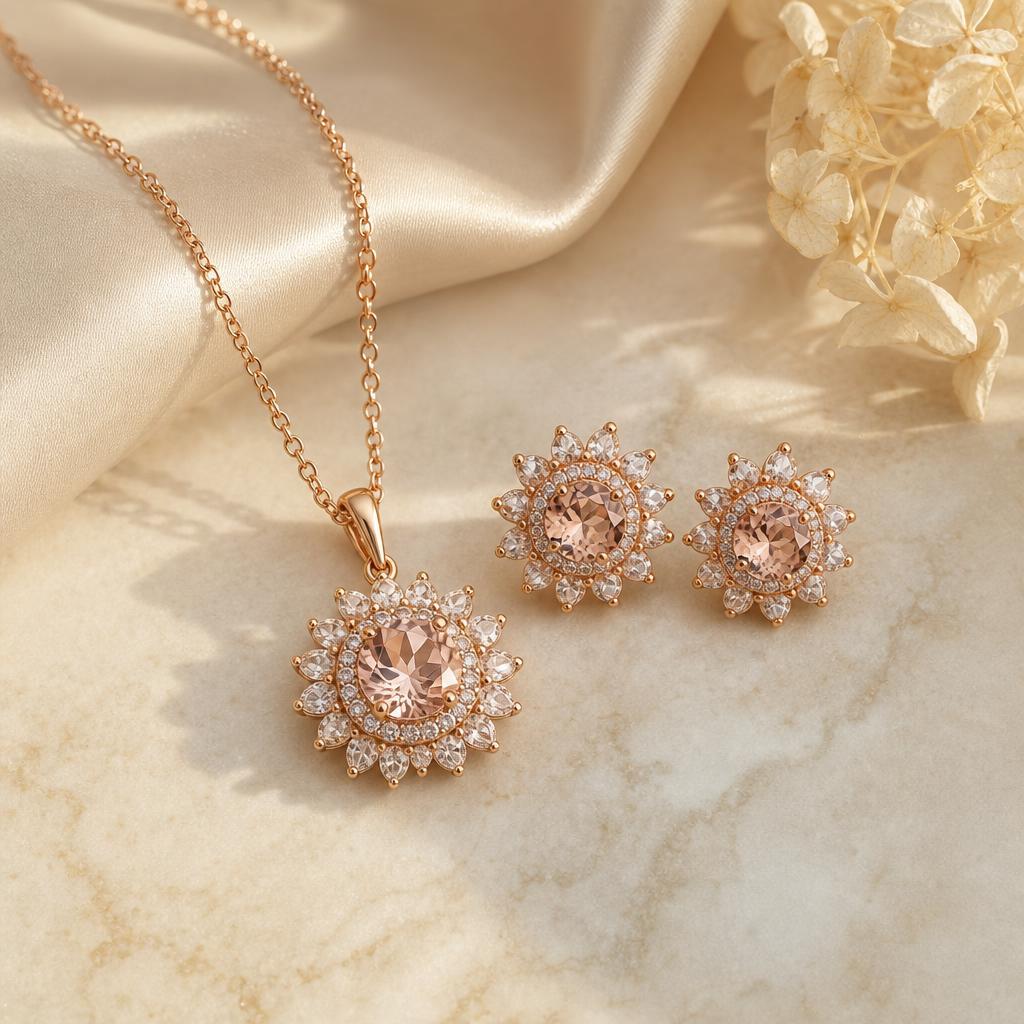
Affordable Jewelry Sets: What "Matching" Should Actually Cost
Somewhere along the way, "matching jewelry set" became code for something you'd wear once and quietly retire to a drawer. Cheap metal, stones that dull within a season, a necklace and earrings that only look related because they shipped in the same plastic pouch. None of that is what a set is supposed to feel like — and none of it is what you actually have to settle for.
A genuinely good jewelry set does one simple thing: it makes getting dressed a decision you've already made. The pieces are designed together, not bundled together, so you're not standing at the mirror trying to figure out if your necklace and earrings are fighting each other. Below are a few coordinated pairings worth knowing, followed by an honest breakdown of what "affordable" should actually mean when the word "set" is attached to it.


What "Affordable" Should Actually Mean on a Jewelry Set
"Affordable jewelry sets" is one of the more honest phrases in online shopping, because it admits upfront that not every set is worth the same amount of trust. On one end, you've got fast-fashion bundles that tarnish before the tags come off. On the other, department-store sets that charge a premium simply for the word "matching," as if pairing two pieces together justifies tripling the price of either one alone. Neither extreme is actually about the jewelry.
The middle ground — the one that's actually worth your money — is a set built from real materials, designed as a pair from the start, priced without a markup for the marketing term. That means 925 sterling silver instead of plated base metal, moissanite or a simulated diamond cut and set with the same care as a solitaire, and a design language that repeats intentionally between the necklace and the earrings rather than being loosely "coordinated" by color alone.
Worth knowing: A necklace and earrings don't have to come from the same box, be sold under the same SKU, or even ship together to count as a real set. What actually matters is whether the stone cut, the metal finish, and the setting style genuinely echo each other. Everything else is packaging.
Matching Set vs. Coordinated Set: The Difference That Actually Matters
Retailers use "matching jewelry sets" loosely, but there's a real distinction worth knowing before you shop. A true matching set uses the same stone shape, the same setting style, and the same metal tone across every piece — a solitaire necklace paired with solitaire studs, for instance, both round-cut, both six-prong. A coordinated set relaxes that rule: the metals agree, the general mood agrees, but the settings might differ — a halo necklace next to a plain stud, say.
Neither approach is wrong. A true match reads as more deliberate and more formal — the kind of thing that photographs well and never looks accidental. A coordinated pairing feels a little more relaxed and gives you more mixing room with the rest of your jewelry box. The mistake is buying a "set" without knowing which one you're actually getting, then being surprised when the pieces don't sit together the way the product photo implied.
The Éclat necklace and stud earrings above are a true match — identical round-cut moissanite, identical six-prong setting, scaled proportionally between a pendant and a pair of studs. The Leighton pair matches the same way, built around a cushion-shaped halo that repeats from the necklace to the earrings without any translation required. That's what "matching" is supposed to look like: not a marketing label, but an actual, checkable fact about the design.
Building Your Own Set Instead of Buying a Bundle
Here's the thing most jewelry sets for women don't tell you: you don't need to buy the packaged bundle to get a matching result. Choosing a necklace and a pair of earrings separately — as long as you're matching stone cut and setting style yourself — gets you the exact same coordinated look, minus whatever premium the retailer charges for pre-pairing two products in one listing.
This is where a lot of shoppers overpay without realizing it. A bundled "set" often costs more than its two components would individually, simply because bundling reads as convenience. If a necklace and a pair of earrings from the same design line already share a cut and a setting, buying them as two separate purchases costs the same — sometimes less — and gives you the freedom to size the earrings or necklace independently, or to skip a piece you already own.

The Morgan Pendant Necklace
A princess-cut simulated diamond in a clean, squared silhouette — the kind of geometry that reads as more architectural than a round stone, without sacrificing any of the sparkle.
Shop The Morgan Necklace →
The Morgan Stud Earrings
The earring half of the same princess-cut story — matched proportionally to the necklace above, so the two read as a single considered choice rather than two separate impulse buys.
Shop The Morgan Earrings →When a Bundled Set Genuinely Makes Sense
There are real cases where buying the packaged version, rather than assembling it yourself, is the smarter move. Gifting is the obvious one — a necklace and earrings arriving together, gift-ready, removes a step you'd otherwise have to manage yourself. Jewelry sets for bridesmaids fall into the same category: when you're outfitting several people at once, buying pre-matched pairs saves the real cost, which is time spent cross-referencing five different product pages to make sure every pairing actually coordinates.
The other case is simply not wanting to think about it. If matching stone shapes and settings isn't a project you want to take on, a genuinely well-designed set — one built as a pair from the start, not bundled after the fact — does that work for you. The Éclat and Leighton pairings above exist for exactly that reason.
✦ Pro tip: If you're shopping for a bridesmaid or friend and don't know her exact taste, a solitaire set — one clean stone shape, no halo, no accent stones — is the safest match. It's the jewelry equivalent of a neutral gift: harder to get wrong.
What to Actually Check Before You Buy
Price aside, a few practical checks separate a set worth owning from one you'll replace within the year. First, the metal: 925 sterling silver, not a thin plating over base metal, is what determines whether a piece tarnishes your skin or holds up to daily wear. Second, the stone: a genuinely well-cut moissanite or simulated diamond is indistinguishable from a mined diamond to the eye — and passes diamond testers — so there's no reason to accept a dull, poorly faceted stone in the name of a lower price. Third, check whether the earrings are actually hypoallergenic and nickel-free, not just labeled that way; sensitive ears will tell the difference within a day.
Sterling silver earring sets in particular are worth scrutinizing closely, since earrings sit directly against skin for hours at a time. A set that skips proper plating or uses a base alloy under the silver will show green or gray within weeks. None of this is complicated to check — it just requires reading past the word "set" to what the listing actually says about materials.
Quick Takeaways
- A true matching set repeats the same stone cut and setting across every piece — check for that specifically, not just similar colors.
- Buying pieces from the same design line separately often costs the same as a bundled "set," with more flexibility on sizing and timing.
- Bundled sets earn their price when gifting, outfitting a bridal party, or simply skipping the matching work yourself.
- 925 sterling silver, well-cut moissanite or simulated diamond, and genuinely hypoallergenic settings matter more than the word "set" ever will.
Frequently Asked Questions
What is a matching jewelry set actually called?
There's no single official term, but "matching set" usually means every piece shares the same stone cut and setting style, while "coordinated set" describes pieces that share a metal tone or general mood without matching exactly. Knowing which one a listing means before you buy avoids surprises.
Do your earrings and necklace actually need to match?
No — matching is a choice, not a rule. A true match photographs as more formal and deliberate, while pairing a statement necklace with simpler studs (or vice versa) reads as more relaxed. The only real mistake is an accidental mismatch, where two competing focal points fight for attention.
How much should you actually pay for a sterling silver jewelry set?
The honest answer depends on the stone and the number of pieces, but the metal itself shouldn't be where you overpay. Genuine 925 sterling silver is a mid-range material, not a luxury one — the price difference between a good set and an overpriced one almost always comes down to the stone quality and the setting work, not the silver.
Is sterling silver a good choice for a jewelry set you'll wear daily?
Yes. 925 sterling silver is durable enough for daily wear, doesn't discolor skin, and — unlike plated pieces — doesn't wear thin to reveal a different metal underneath. It's the material that lets an affordable set actually earn the word "durable," not just "affordable."
The word "set" shouldn't be doing the selling on its own. Whether you buy two pieces bundled together or choose them separately from the same design line, what actually makes a jewelry set worth owning is the same thing that makes any single piece worth owning: real materials, a stone cut with care, and a design intentional enough that it doesn't need the word "matching" to prove it.


