

Rings for People Who Talk With Their Hands: Styles That Don't Fly Off Mid-Gesture
You talk with your hands. You always have — mid-story, mid-laugh, mid-explaining-something-important, your hands move before you've even decided to let them. Which is exactly the problem with certain rings: the ones that shift when your palm opens, that catch on a scarf when you gesture wide, that you've quietly stopped wearing to dinner because you don't trust them to stay put through a whole conversation.
It's not really about the ring being wrong for you — it's about the ring being wrong for how you actually move. Some settings are built to sit still on a hand that stays still. Others are built for a hand that's constantly in motion. Here's where to start.


Why Some Rings Feel Precarious When Your Hands Are Never Still
Most engagement ring guides are written around a hand that's holding still for a photo. But that's not how hands actually behave. Yours points, claps, talks through a story with sweeping gestures, drums on the table while you're thinking, grips a subway pole, flips through papers, holds a coffee cup at a weird angle without looking. Every one of those small, constant movements puts a different kind of stress on a ring than a hand posed still on a velvet cushion ever will.
The rings that feel "off" for an expressive hand usually share the same structural issues: stones or settings that sit high above the band, prongs positioned where they catch on fabric, thin bands that twist under lateral pressure, or delicate accent stones with edges exposed to knocks. None of that makes them bad rings — it just means they were designed for a different kind of day.
What Actually Makes a Ring Feel Secure in Motion
Security isn't really about how tightly a ring is sized, though fit matters too. It's about geometry — how the setting distributes contact, how much of the stone sits proud of the band, and whether there are any sharp or raised edges for fabric, hair, or another hand to snag on.
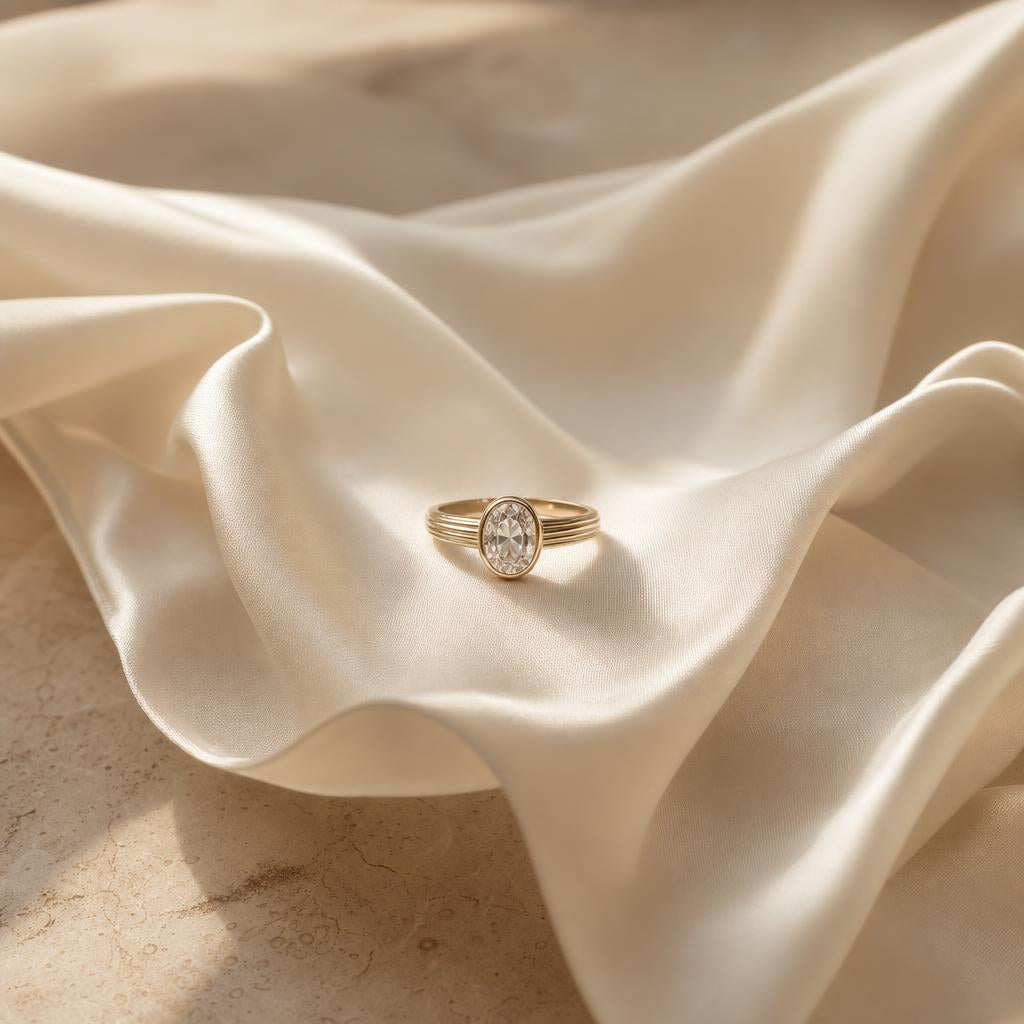
Bezel settings remove the catch points entirely
A bezel setting wraps a rim of metal fully around the stone's edge instead of holding it with prongs. There's nothing raised to snag a sweater sleeve or a seatbelt, and nothing thin enough to bend if you knock it against a doorframe mid-gesture. It's the closest thing to a "forget it's there" setting — which, for a hand that's never still, is exactly the point.

The Duchess Ring
A cushion-cut center stone with a double hidden halo tucked beneath it, so the extra sparkle sits low and close to the finger instead of stacking height on top. The 2.2mm pavé band keeps the whole silhouette flat and unobtrusive against fabric.
Shop The Duchess Ring →Channel and flush settings keep the surface smooth
Channel-set stones sit recessed between two rails of metal rather than perched on top of the band, so the entire surface reads as smooth rather than textured. There's no single prong tip to catch, and the continuous line of stones distributes pressure evenly rather than concentrating it on one point — useful if your hands spend a lot of time gripping, typing, or carrying things.
Low-profile prongs beat tall ones, even when both are secure
Prong settings aren't inherently less secure than bezels — a well-made 4-prong or 6-prong head holds a stone just as firmly. The difference for an expressive hand is height. A stone set close to the band has less leverage working against it when your hand swings, claps, or brushes against something. The same stone set high on a tall crown catches more air, more fabric, and more force with every motion.
Matching the Setting to How You Actually Move
Not every "secure" setting suits every kind of movement, so it helps to think about which category your day actually falls into.
| If your hands… | Look for | Why it works |
|---|---|---|
| Gesture constantly while talking or presenting | Bezel or low-profile solitaire | No raised edges to catch on sleeves, papers, or your own other hand |
| Type, write, or handle objects all day | Channel-set or flush eternity band | Smooth top surface, no single point of pressure |
| Play an instrument, cook, or work with your hands | Bezel-set, comfort-fit band | Rounded interior and sealed stone edges reduce snag and impact risk |
| Wear rings stacked or layered | Slim comfort-fit bands, low-profile halo | Even width and rounded profile keep neighboring rings from catching each other |
Worth knowing: A ring that feels perfectly secure standing still can behave completely differently after a few hours of real movement. If you can, try bending your fingers into a full fist, a flat clap, and a wide open-palm gesture before deciding a setting works for you.
Comfort-Fit Bands: The Detail Most People Never Ask About
The inside of a ring matters as much as the outside for anyone whose hands don't sit still. A standard flat-inside band has sharp interior edges where it meets the finger — fine for occasional wear, but noticeable after hours of flexing, gripping, and gesturing. A comfort-fit band is gently domed on the inside, so it rolls smoothly against the finger rather than pressing a hard edge into it with every movement.

The Everlasting Ring
A continuous line of 3mm round pavé stones set into a substantial 3mm band, built with a rounded, comfort-fit profile so it moves with your hand rather than against it — a natural everyday layer for a hand that's rarely still.
Shop The Everlasting Ring →This is also where comfort fit vs. standard fit bands becomes less of a nice-to-have and more of a practical decision — the difference is felt, not seen, and it compounds every time your hand moves.
Sizing Still Matters More Than the Setting
Even the most snag-proof bezel will shift if it's sized loosely, and a ring that spins on your finger is more likely to catch on something than one that sits snugly. If your hands are constantly in motion, size slightly snugger than you might for a ring worn mostly at rest — you want it to clear the knuckle on the way on, then stay put without twisting once it's home. A quick way to sanity-check fit is the same test jewelers use for active wearers: make a full fist. If the ring pinches, it's too tight; if it spins freely to the palm side, it's too loose.
If you're not confident in your size, it's worth reading through a proper at-home ring sizing guide before ordering — getting this right does more for how secure a ring feels day-to-day than the setting style ever will on its own.
What to Skip If You're Choosing for an Active Hand
- Tall halo settings with exposed prong tips — beautiful for photos, but the raised profile and multiple small prongs are the most catch-prone combination there is.
- Very thin bands under 1.5mm — they can flex and twist under lateral pressure, which is exactly what constant hand movement produces.
- Open, airy filigree or lattice details — gorgeous, but the negative space is where threads, hair, and fabric loops get caught.
- Rings sized to slide over the knuckle easily — if it went on without any resistance, it will likely rotate and shift throughout the day.
None of this means expressive hands are stuck with plain rings. It just means the details that make a ring look striking in a still photo — height, openness, delicate prongs — are the same details that work against you in motion. The good news is that bezel, channel, and low-profile solitaire settings deliver plenty of sparkle without any of those trade-offs.
Quick Takeaways
- Bezel and channel settings have no raised edges, making them the most snag-resistant options for hands in constant motion
- Low-profile prong settings hold stones just as securely as tall ones, but with far less leverage working against them during movement
- Comfort-fit bands matter as much as the setting itself — a rounded interior moves with your hand instead of pressing into it
- Correct, slightly snug sizing prevents twisting and rotation, which is often the real cause of a ring feeling "unsafe"
- Save tall halos, ultra-thin bands, and open filigree for occasions when your hands are mostly at rest
Frequently Asked Questions
Are bezel-set rings actually more secure than prong settings?
Both can be equally secure when well made — the difference for an active hand is exposure. A bezel fully encloses the stone's edge, so there's nothing raised to snag or knock loose, while even a well-set prong sits slightly proud of the band.
Will a low-profile setting still have enough sparkle?
Yes — sparkle comes from cut quality and facet structure, not height. A well-cut stone in a bezel or channel setting catches just as much light as the same stone set higher; it simply sits closer to the finger.
Should I size my ring tighter if I gesture a lot?
Slightly snugger than you might otherwise choose, yes. A ring that spins or slides is more prone to catching than one that sits secure and still, even if the setting itself is snag-resistant.
Can I still wear a stack if my hands are always moving?
You can — just favor slim, comfort-fit bands with even, rounded profiles so neighboring rings glide against each other rather than catching. Avoid mixing very high and very low settings in the same stack.
The best ring for a hand that never sits still isn't the one that photographs the most dramatically — it's the one you stop thinking about entirely. Once you find a setting that moves with you instead of against you, wearing it stops being a decision you make every morning and just becomes part of how your hands look when they're doing what they always do.


