

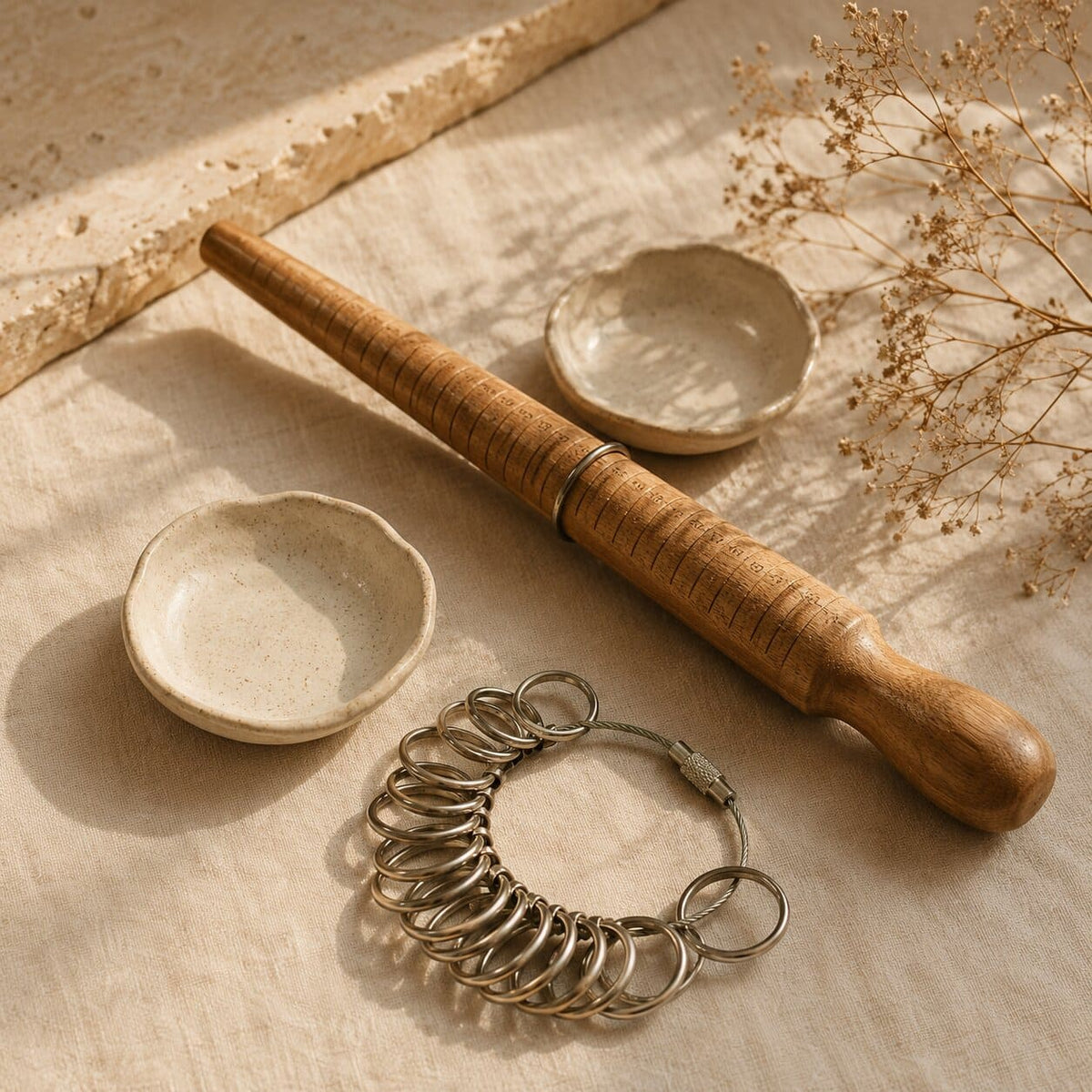
Ring Sizing Myths: The Sizing Advice That Sounds Right (But Usually Isn't)
Somewhere between the jewelry counter and your kitchen table, ring sizing advice gets passed around like folklore — confidently stated, rarely questioned, and wrong more often than anyone admits. A size that felt perfect in the store turns into a ring you're afraid to wear on a hot day. A "helpful" tip from a well-meaning friend turns into a ring that's been sitting in a drawer for six months because it's a half-size off and nobody told you that mattered.
Before you chalk up a bad fit to bad luck, it's worth separating the sizing advice that's actually true from the advice that just sounds true. Here's where a few of Gemiros' most-loved styles land on the sizing spectrum, and then the myths worth unlearning.


Myth: A ring's "size" is one fixed number, no matter the style
This is the myth that causes the most quiet disappointment. A size 6 in one setting is not the same physical experience as a size 6 in another. The number printed inside the band refers to the inner circumference — but how that band actually feels on your finger depends heavily on width, profile, and how much metal is touching your skin.
A slim, rounded band in your true size can feel looser than a wide, flat-profile band in that same size, simply because more surface area creates more friction and a snugger perceived fit. This is exactly why a wider band and a narrower band in your stack can feel like two different sizes even when they're not. If you've ever measured your size once and assumed it applies identically to every ring you'll ever buy, that's the myth working against you.
Worth knowing: Jewelers size in quarter and half increments precisely because "your size" shifts slightly depending on band width and profile — it was never meant to be a single, universal number.
Myth: Sizing charts convert cleanly between countries
US, UK, EU, and Australian sizing systems all measure the same underlying circumference, but they express it in different units and starting points — inches, millimeters, and letters that don't line up in neat, round numbers. A conversion chart gets you close, but "close" and "correct" aren't the same thing when a fraction of a millimeter is the difference between comfortable and constant readjustment.
If you're buying based on a size quoted from a different country's system — a hand-me-down ring, a partner's guess after a trip abroad, or an old receipt — treat the converted number as a strong estimate, not a final answer. This is doubly true if the original sizing came from a system with half-size gaps that your actual measurement falls between.
Myth: If it fit in the store, it'll fit at home
Rings are measured against a body that is, at any given moment, mid-fluctuation. Temperature, sodium intake, time of day, air travel, and even how recently you exercised all shift finger size by a small but noticeable margin. A ring sized on a cool, calm afternoon in an air-conditioned store can feel different by evening, after a salty meal, or the morning after a long flight.
This isn't a flaw in the sizing — it's just biology. The fix isn't to chase a "perfect" size that accounts for every possible condition (there isn't one), but to size for your normal, resting state and expect very minor day-to-day variation as completely normal.
✦ Pro tip: Size your ring in the afternoon rather than first thing in the morning — hands are typically at their most "average" size a few hours after waking, before heat, activity, or salt intake start to shift things.
Myth: Any ring can be resized to fit perfectly, any time
Resizing is possible for many rings, but it isn't universal, and it isn't free of tradeoffs. Setting style matters enormously here. A simple band with no stones can often be sized up or down with minimal visual impact. A ring with a hidden halo, pavé detailing that wraps around the shank, or side stones set close to the band's edge is a much more delicate resizing job — sometimes possible, sometimes not, and always with more risk to the setting.
Before assuming resizing is a safety net, ask specifically whether your ring's construction supports it. This is worth knowing before you buy, not after you've fallen in love with a style that turns out to be difficult to adjust later.

The Victoria Ring
A marquise-cut center stone wrapped in a pavé halo — the elongated shape and detailed band make this a style worth having properly sized from the start, since the halo setting limits how much a resize can shift the fit.
Shop The Victoria Ring →Myth: Only the base of your finger matters when sizing
A ring has to travel over your knuckle to get on and off, and it has to sit comfortably at the base of your finger once it's there — and those are two different measurements that don't always agree. If your knuckle is noticeably wider than the base of your finger, sizing purely for a snug fit at the base can mean a ring that's genuinely difficult to remove, especially later in the day when hands are slightly swollen.
The better approach is sizing for the knuckle first, then adjusting for comfort at the base. Ignoring the knuckle entirely is one of the most common ways a "correctly sized" ring still ends up feeling wrong.
Myth: Between sizes, you should always size down
The advice to "size down, you can always add a guard" sounds practical, but it optimizes for the wrong problem. A ring that's slightly too small is a daily discomfort and, over time, a circulation issue — it also can't be quietly fixed the way a slightly loose ring can. A ring that's slightly too big can be brought in with an inexpensive guard or spacer while you decide whether to have it properly resized.
If you're between two sizes, sizing up is almost always the safer, more comfortable default. The idea that "tight now, loose eventually" is a good trade only holds up if you enjoy taking a ring off every time your hands are cold.
Myth: Once you're sized, you're set for life
Ring size isn't static, and treating your first measurement as permanent is how rings end up unworn in a drawer. Pregnancy, weight changes, medication, age, and even long-term joint changes can all shift your size over months or years — not dramatically, usually, but enough to matter. A ring that fit perfectly at 25 may not fit the same way at 35, and that's not a defect in the ring or in you.
Treat sizing as something to periodically revisit rather than a one-time task, particularly around any major life change. It's a five-minute check, and it's a lot less disruptive than discovering the mismatch mid-event.
| The Myth | The Reality |
|---|---|
| Your size is one fixed number | Band width and profile change how a given size actually feels |
| International charts convert exactly | Treat converted sizes as a close estimate, not a final answer |
| Store fit = home fit, always | Temperature, salt, and time of day cause small, normal shifts |
| Any ring can be resized easily | Halo, pavé, and side-stone settings limit how much resizing is safe |
| Only the base of the finger matters | Knuckle width often determines the real, comfortable fit |
| Between sizes, size down | Sizing up is safer — a guard can always take up slack |
| Sizing is a one-time task | Revisit sizing after major life or body changes |
Quick Takeaways
- Your size shifts slightly depending on the band's width and profile — it was never one universal number.
- International size conversions are estimates, not guarantees — confirm with an actual measurement where possible.
- Small daily fluctuations in fit are normal and don't mean your ring was sized wrong.
- Check whether your ring's setting actually supports resizing before you rely on that as a fallback.
- When your knuckle and finger base don't match, size for the knuckle first.
- Between two sizes, sizing up is almost always the more comfortable choice.
- Revisit your size periodically — it isn't a one-time measurement for life.
Frequently Asked Questions
Why does the same size ring fit differently depending on the style?
Band width, thickness, and profile all change how much metal contacts your skin, which changes how snug a given size feels — a wider or flatter band in your usual size will typically feel tighter than a slim, rounded one.
Is it better to size up or down if I'm between two sizes?
Sizing up is generally the safer choice. A slightly loose ring can be adjusted with a guard or spacer, while a ring that's too tight is uncomfortable daily and much harder to correct without a full resize.
Can every ring be resized?
No. Simple bands without stones are usually easy to resize. Rings with hidden halos, pavé detailing along the shank, or side stones near the band's edge are more delicate to adjust and, in some cases, can't be resized without compromising the setting.
Do I need to get re-sized after my ring has fit fine for years?
Not automatically, but it's worth checking after any major life change — pregnancy, significant weight change, or new medication can all shift finger size gradually enough that you might not notice until the fit feels off.
The most useful thing you can do with any of this is treat sizing as a specific, ongoing conversation with your jeweler rather than a single number you memorize once. Ask about the setting, ask about resizing limits, size for your knuckle if it's wider than your finger base, and give yourself permission to size up when in doubt. The right ring should disappear onto your hand — not something you're constantly aware of, adjusting, or working around.


