

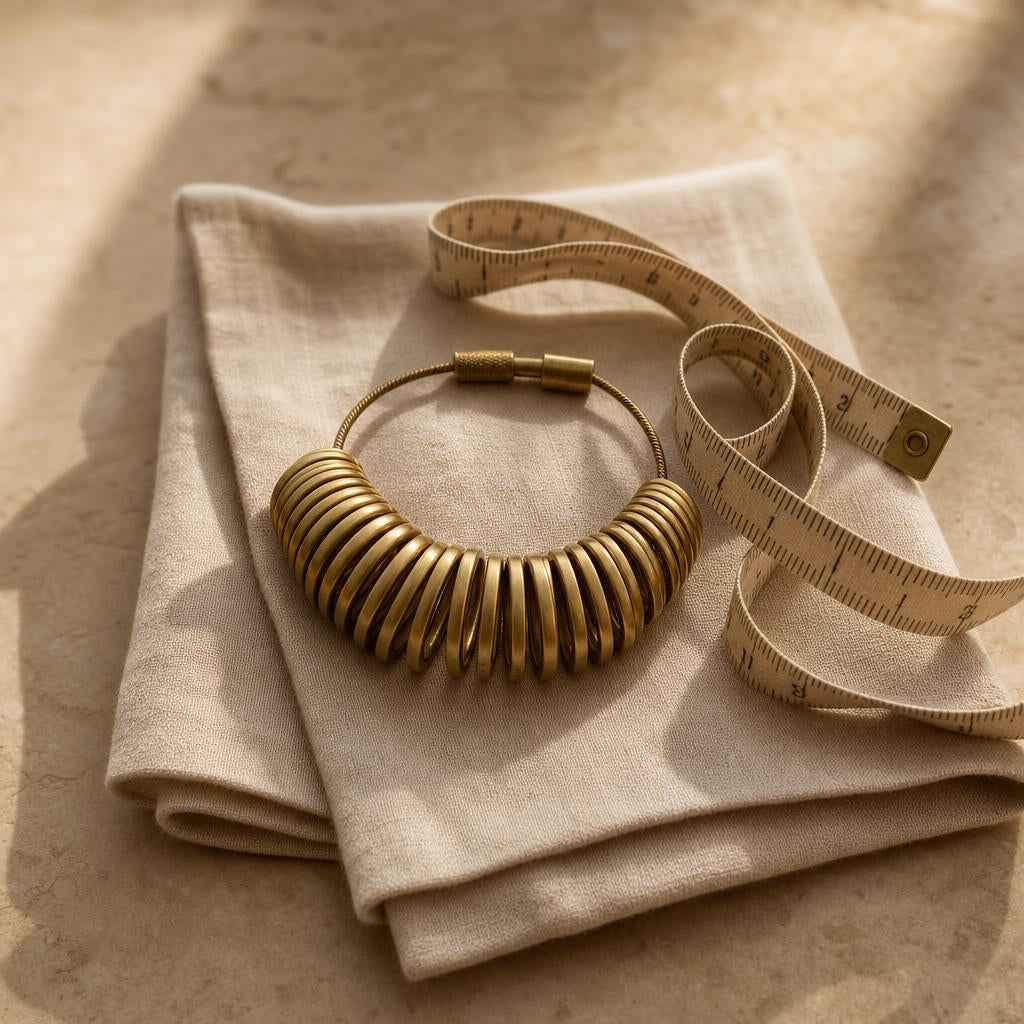
Ring Sizes Around the World: How US, UK, EU and Australian Sizing Compares
You've found the ring. You know the finger it's going on. But the size on the listing says "7," and somewhere in the back of your mind a small, nagging question surfaces — is that a US 7, a UK 7, or something else entirely, built on a completely different scale?
Ring sizing isn't universal, and the confusion is genuinely reasonable — the US, UK, continental Europe, and Australia each measure a ring's circumference on a different scale, starting from a different baseline. Here's how the major systems actually compare, and how to convert your size with real confidence before you buy.


Why Ring Sizing Isn't Universal
Every ring size system is really just a different way of describing the same thing: the inside circumference of the band, measured in millimetres. The US system converts that circumference into a whole-and-half-number scale. The UK and Australia convert it into a letter scale, running from A up through Z and beyond. Continental Europe mostly skips the abstraction altogether and states the circumference in millimetres directly. Because each system was standardized independently, in different countries, at different points in the last two centuries, none of them line up on tidy round numbers when you convert between them.
That's the whole reason sizing charts exist — and why the safest habit, whenever you're buying from a store based outside your own country, is to check the actual millimetre measurement rather than assuming a number or letter means what it does at home.
The Four Major Sizing Systems
US & Canada
North America uses a numeric scale that typically runs from about 3 to 13, with half and sometimes quarter sizes available. A US size 7, for example, corresponds to an inside circumference of roughly 54.4mm. This is the scale you'll see on almost every American and Canadian jewelry site, including ours.
UK, Ireland & Australia
The UK system (also used in Ireland, Australia, and New Zealand) uses letters — A through Z, with half sizes denoted as "M½" or similar. A UK size N, for instance, sits close to a US size 6½. Because the letter scale has smaller jumps between sizes than the US numeric scale in some ranges, it's worth double-checking the millimetre equivalent rather than assuming letters map neatly onto numbers.
Europe (France, Germany & most of the continent)
Continental Europe mostly measures rings by stating the inside circumference directly, in millimetres — so a "size 54" ring has an inside circumference of 54mm. This is arguably the most literal and least ambiguous system, since there's no conversion table required once you know your own circumference. The trade-off is that European sizing typically moves in whole-millimetre increments, so it doesn't offer the fine half-size adjustments the US scale does.
Japan & wider Asia
Japan (and much of the rest of Asia, with some regional variation) uses its own numeric scale, generally running from about size 1 to size 27. A Japanese size 13, for example, lands close to a US size 6½. If you're buying a ring while traveling, or importing one from an Asian retailer, this is the scale most likely to catch you off guard, since the numbers look similar to the US scale but mean something entirely different.
| Inside diameter (mm) | US / Canada | UK / Australia | Europe (circumference mm) | Japan |
|---|---|---|---|---|
| 15.7 | 5 | J½ | 49 | 9 |
| 16.5 | 6 | L½ | 52 | 12 |
| 17.3 | 7 | N½ | 54 | 14 |
| 18.1 | 8 | P½ | 57 | 17 |
| 18.9 | 9 | R½ | 60 | 19 |
Keep in mind these figures are approximate — different manufacturers round slightly differently, especially at the boundary between two sizes. When precision matters, the millimetre column is always the one to trust.
When You're Stacking Across Sizes
International sizing gets a second layer of complexity once you start building a stack, since a wedding band, an eternity ring, and a solitaire don't always need to be ordered in the exact same size — a slightly thicker band can sit differently on the finger than a slim one. If you're building a stack from pieces ordered from more than one region, it's worth re-measuring your finger for each individual piece rather than assuming your "usual" size transfers cleanly.

The Cherish Ring
A bezel-set eternity band designed to sit flush against almost any centre stone — a dependable choice when you're sizing a stack rather than a single ring.
Shop The Cherish Ring →Converting Your Size Accurately
The most reliable way to convert your size internationally is to skip the labels altogether and start from a physical measurement. Wrap a strip of paper or string snugly around the base of your finger, mark where it overlaps, then measure that length in millimetres — that's your circumference. From there, you can look up the equivalent in any system using the circumference column, rather than trying to convert a US number into a UK letter into a European number and hoping nothing got lost along the way.
What to Watch For When Buying From an International Retailer
A few practical habits make international sizing much less risky:
- Always check whether the retailer's chart is based on circumference or diameter — the two are related but not interchangeable, and mixing them up is the single most common sizing mistake.
- Measure at the end of the day, when fingers tend to be at their largest, rather than first thing in the morning.
- If you fall between two sizes on a foreign scale, size up rather than down — a slightly loose ring is a quick, inexpensive fix with a sizer; a ring that doesn't go on at all is not.
- Note that half sizes are common in the US system but far less standard in European sizing, so a "between sizes" US measurement may round differently once converted.
A ring with a larger, more dramatic centre stone also tends to make sizing feel more noticeable day to day — the extra visual weight can shift slightly if the fit isn't quite right, so it's worth being especially precise when the piece itself is a statement.

The Majesté Ring
A 4-carat elongated cushion centre with a hidden halo beneath — the kind of scale-forward piece where getting the size exactly right matters more than usual.
Shop The Majesté Ring →Common Mistakes When Converting Between Systems
Worth knowing: Ring size conversion charts are approximations, not exact science — different jewelers round differently at the boundary between two sizes, particularly when converting into a system with wider jumps (like UK letters) from one with finer gradation (like US half-sizes).
The most common mistake isn't picking the wrong number — it's trusting a number at all instead of the underlying measurement. A US 7 assumed to equal a UK 7, for instance, is a completely different ring size in practice; the actual UK equivalent is closer to N. Shoppers who skip the millimetre conversion and go by the numeral alone are the ones most likely to end up with a ring that needs resizing before it's ever worn.
✦ Pro tip: If you already own a ring that fits the intended finger well, measure its inside diameter with a ruler rather than relying on memory of "what size I usually wear" — sizes can vary slightly between brands even within the same country's system.
Quick Takeaways
- US, UK/Australia, European, and Japanese ring sizes all use different scales — none convert to round numbers.
- The millimetre circumference (or diameter) is the only truly universal measurement — use it as your source of truth.
- European sizing is stated as circumference directly; US and Japan use numeric scales; UK and Australia use letters.
- When between two sizes on an international chart, size up rather than down.
- Re-measure for each piece in a stack rather than assuming one size fits every ring you own.
Frequently Asked Questions
Is a US size 7 the same as a UK size 7?
No — they're entirely different scales. A US 7 is closer to a UK size N. The overlapping numeral is a coincidence of two independent systems, not an equivalence.
Which system is the most precise?
European sizing, since it states the inside circumference in millimetres directly rather than translating it into an abstracted number or letter. That said, it typically only moves in whole-millimetre steps, so the US half-size system offers finer adjustment within a single scale.
Do ring sizes vary between brands within the same country?
Slightly, yes. Manufacturing tolerances mean a size 7 from one jeweler can measure a hair different from a size 7 elsewhere. If precision matters, measure the actual ring rather than relying on the printed size alone.
Should I size up or down when converting between systems?
When in doubt, size up. A ring that's slightly loose can be adjusted inexpensively with a sizer or a professional resize; a ring that doesn't fit over the knuckle at all is a much bigger problem to solve.
Do wider bands need a different size than thinner ones?
Often, yes. A wider band takes up more surface area against the finger and can feel tighter than a thin band in the same labeled size. If you're moving from a slim ring to a wide statement style, it's worth sizing up half a size as a starting point.
Wherever your ring is coming from, the underlying logic stays the same: trust the millimetre measurement over the label, measure at the time of day your fingers run largest, and when a conversion chart leaves you between two sizes, choose the one that gives you room to adjust rather than the one that risks not fitting at all.


