

Ring Sizing During Perimenopause: Why Your Fingers Change and What to Do About It
Somewhere in your forties, a ring that has fit you comfortably for a decade starts behaving strangely. Some mornings it slides right off. By afternoon it's pressing into your knuckle. You haven't changed your size on paper — but your hand has, and nobody warned you this was coming.
Perimenopause gets blamed for a long list of symptoms, but ring fit rarely makes the list — even though it's one of the more disorienting ones, precisely because it feels random. It isn't. Here's what's actually happening, and a few versatile styles worth having in rotation while your hands settle into their new normal.


Why Perimenopause Changes How Your Rings Fit
Estrogen does more than regulate your cycle — it also influences how your body manages fluid and how your connective tissue behaves. As estrogen levels start fluctuating in your late thirties and forties, rather than declining smoothly, a lot of women experience unpredictable water retention. Fingers are one of the first places it shows up, because the skin and tissue there have so little room to expand before a ring starts telling on you.
This is different from the swelling you already know — the kind from a hot day, a salty dinner, or a long flight. That swelling comes and goes within a day. Perimenopausal swelling can linger for weeks, ease off, then return with the next hormonal shift, which makes it much harder to pin down and much easier to dismiss as "just one of those weeks."
Worth knowing: Joint tissue also loses some of its elasticity as estrogen drops, which is part of why knuckles can look and feel more prominent in your forties and fifties than they did in your twenties — even without any real weight change.
How to Tell If It's a Bad Day or an Actual Shift
The distinction matters, because the fix is completely different. A single swollen afternoon needs nothing more than patience. A genuine, lasting change in your finger size needs a new ring size — or at least a wardrobe of rings that can handle both.
- It's probably temporary if the tightness shows up after heat, salt, alcohol, or exercise, and eases within 24–48 hours.
- It's probably a real shift if a ring that used to slide on easily now consistently needs force to get past the knuckle, on good days and bad days alike, for more than a month or two.
- It's worth tracking if the tightness seems to cycle — easing, then returning — over a period of weeks rather than hours. That pattern points toward hormonal fluctuation rather than a single trigger.
If you're in the second or third category, it's worth actually remeasuring rather than assuming the old number still applies. A ring sizer at home, done at a few different points in the day and month, will tell you more than guessing.
What This Means for Resizing — and Why Not Every Ring Handles It the Same Way
Here's the detail most sizing advice skips: not every ring style can be resized the same amount, or resized at all, and that matters enormously if your size is genuinely shifting rather than settling into a single new number.
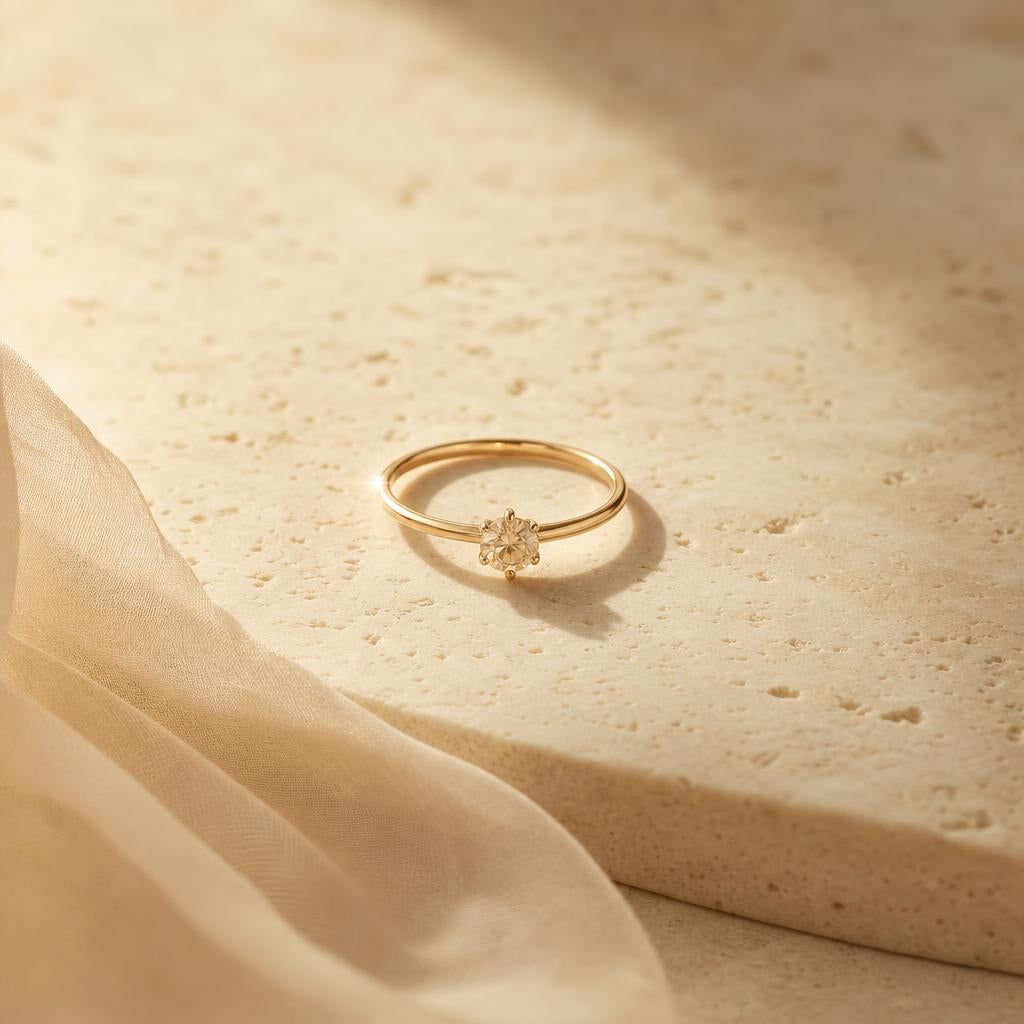
A plain band or a solitaire with a simple shank, like The Kensington Ring, can typically be sized up or down within a couple of sizes without disturbing the setting. There's no pattern of stones running around the entire band to interrupt, so a jeweler has room to work.

The Everlasting Ring
Full eternity bands like this one carry stones the entire way around the shank, which is exactly what makes them tricky to resize — there's no plain metal left to cut and rejoin. If your size is still settling, a full eternity style is worth saving for after your fit stabilizes, or wearing as a stacking piece rather than a solo ring you're relying on day to day.
Shop The Everlasting Ring →Half-eternity styles and bezel settings tend to sit in the middle — some resizing room, but less than a plain band. A bezel-set piece in particular, where the stone is wrapped in a rim of metal rather than held by prongs, tends to hold up well through a resize because the setting itself isn't fragile.
Building a Ring Wardrobe That Can Flex With You
If your size is genuinely in flux — not settled, not predictable — the more useful move is often to stop chasing a single perfect size and instead build a small rotation of rings that can absorb some variation without feeling like a project every time.

The Beatrice Ring
A slim pavé round like The Beatrice Ring is easy to size generously — comfortable with a little extra room on a swollen day, without looking loose the rest of the time. It's also simple enough to wear on its own or slide into a stack, which makes it a genuinely useful piece while your size is settling.
Shop The Beatrice Ring →Stacking pieces are especially forgiving during this stretch, because you can simply leave one off on a tighter day rather than force a whole hand's worth of rings over a swollen knuckle. A single low-profile stacking band, worn alone on the days your hand needs the room, does more for your comfort than any single "correct" size ever will.
✦ Pro tip: If you wear a ring you love but your fit keeps shifting, consider sizing it slightly generous rather than snug, and use a discreet ring guard or spacer on the tighter-knuckle days. It's a lot easier to add a little friction than to force a ring that's genuinely too small.
When to Actually Get Remeasured
A good rule of thumb: if a ring's fit has felt "off" — not just once, but as a pattern — for more than six to eight weeks, remeasure. Hormonal swelling can take a while to settle into a new baseline, and resizing too early, before your hand has actually stabilized, sometimes means resizing again a few months later.
Measure at a consistent time of day, ideally in the evening when hands tend to be at their largest, and take a couple of readings across different days rather than relying on one. If you're between two sizes, most jewelers and most online sizing guides recommend sizing up rather than down — a ring that's a touch loose is a minor annoyance; one that's genuinely too tight can be uncomfortable and, in some cases, hard to remove.
It's Not Just You
If this is the first time a ring's fit has genuinely surprised you, it's worth saying plainly: this is common, it's hormonal, and it isn't a sign anything is wrong. It's simply a stage your hands are moving through, the same way they did during any earlier hormonal shift in your life. The goal isn't to fight it into submission with one perfect ring size — it's to build a small, flexible collection that can move with you until things settle.
Quick Takeaways
- Fluctuating estrogen during perimenopause affects fluid retention and connective tissue, which can change how rings fit — sometimes for weeks at a time.
- Distinguish a one-off swollen day from a genuine shift by watching whether tightness persists across both good and bad days for a month or more.
- Full eternity bands are the hardest style to resize; plain bands, solitaires, and bezel settings generally have more room to work with.
- Stacking pieces and slightly generous sizing let you adapt day to day without needing a resize for every fluctuation.
- Wait six to eight weeks of a consistent pattern before resizing, so you're not chasing a fit that hasn't finished settling.
Frequently Asked Questions
Can perimenopause really change your ring size?
Yes. Fluctuating estrogen affects fluid retention and the elasticity of connective tissue in your fingers, which can make rings feel tighter or looser than usual — sometimes for weeks or months at a stretch, not just a single day.
Should I resize my ring right away if it starts feeling tight?
Not immediately. Give it six to eight weeks to see if the tightness is a consistent pattern rather than a temporary swing. Hormonal swelling can ease on its own, and resizing too early sometimes means resizing again later.
Which ring styles are easiest to resize?
Plain bands and solitaires with simple shanks are generally the easiest, since there's uninterrupted metal for a jeweler to cut and rejoin. Bezel settings hold up well too. Full eternity bands, where stones run the entire way around, are the most difficult and sometimes impossible to resize significantly.
Is it normal for my knuckles to look bigger than they used to?
Yes — as estrogen declines, connective tissue can lose some elasticity, which often makes knuckles more prominent relative to the base of the finger, even without any real weight change. It's a common and normal part of this life stage.
Your hands changing shape isn't a flaw to correct — it's just information. A slightly more flexible approach to sizing, and a couple of styles that can flex with you, will get you through this stretch far more comfortably than trying to force one ring to do a job it was never built to do this decade.


