

Between Sizes: Should You Size Up or Down — And Does It Actually Matter?
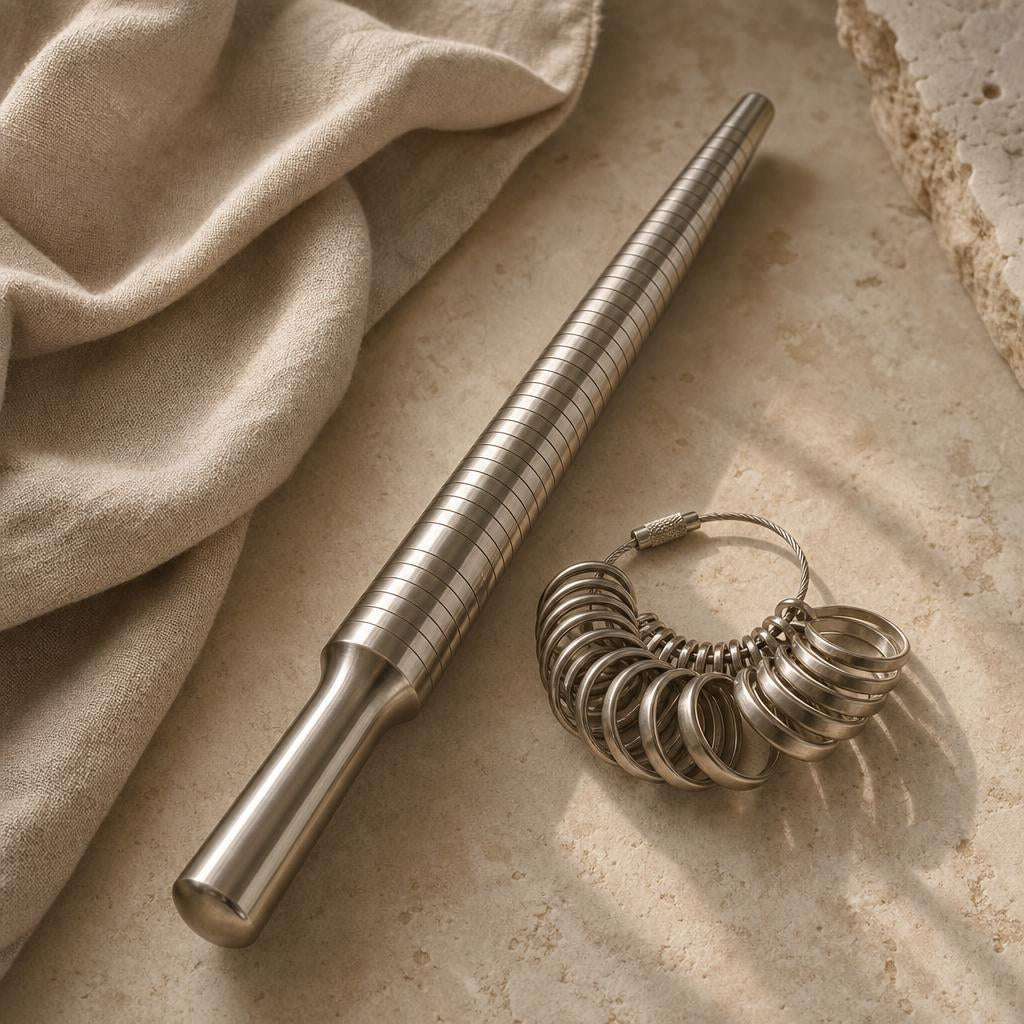
You've measured twice. You've tried the string trick, the printable chart, maybe even slid a friend's ring on as a stand-in gauge. And the answer is still frustratingly in-between — technically a 6.5, but the size 6 fits fine some mornings and the size 7 fits fine by evening. If you've ever stared at a size dropdown that skips straight from 6 to 7, wondering which one to trust, you're not imagining the problem. Half sizes are common. Whole-size-only dropdowns are also common. The two facts don't always line up neatly, and almost nobody warns you what to do about it.
The good news is that being between sizes isn't a crisis — it's an ordinary sizing situation with a few genuinely different right answers depending on the ring itself. Before we get into the logic, here's a spread of styles worth knowing, because which way you round often depends on how the setting is built.


Why "between sizes" happens in the first place
Most sizing confusion doesn't come from a bad measurement. It comes from the fact that your finger isn't actually one fixed size — it's a range. Temperature changes it, time of day changes it, sodium and hydration change it, and for a lot of women, so does the point in a monthly cycle. Measure your ring size at 7am in a cold kitchen and again at 8pm after a salty dinner, and you can genuinely land on different numbers. That's not user error. That's just how hands work.
So when a chart tells you 6.5, it's not lying — it's reporting an average of a finger that moves within a small range all on its own. The dropdown menu, meanwhile, doesn't know any of that. It just wants a single number. That mismatch between a body that fluctuates and a system that demands a fixed answer is where "which way do I round" actually comes from.
Worth knowing: A full ring size typically changes the internal circumference by roughly 0.4mm–0.5mm. That sounds tiny, but on a narrow band it's often the difference between "snug" and "loose," which is exactly why half-size decisions feel more consequential than they actually are on most rings.
Does it actually matter which way you round?
Here's the part most sizing guides skip: the answer changes depending on the setting you're buying. A ring is not just a size — it's a size plus a structure, and some structures are far more forgiving of being slightly off than others.
Prong and solitaire settings: round up, and don't overstress it
Classic prong and solitaire settings, like a single elevated stone with an open band, are the most forgiving shape on this list. There's no pattern of stones running around the shank to worry about, and because the metal itself is a simple continuous band, a jeweler can usually resize it up or down without disturbing the setting at all. If you're stuck between two sizes on a solitaire-style ring, the safe default is to size up. A ring that's a touch loose is a five-minute fix with a jeweler or a ring guard. A ring that's genuinely too tight is uncomfortable to wear and, in a worst case, has to come off in an emergency by being cut. Loose is the easier problem to solve.
Bezel settings: precision matters a little more

The Cherish Ring
A row of individually bezel-set stones, each held in its own rubbed-edge frame — a smooth, low-profile take on the eternity band.
Shop The Cherish Ring →Bezel settings wrap a rim of metal fully around each stone rather than holding it with prongs. That smooth edge is part of what makes bezel rings so durable and snag-free day to day, but it also means there's a little less flexibility for a jeweler to work with during resizing — the metal is doing more structural work than a thin prong band. It's not a dealbreaker, but if you're between sizes on a bezel ring, it's worth erring toward the size that matches how your finger actually measures most days, rather than defaulting to "just size up" out of habit.
Pavé eternity bands: the size you buy is usually the size you keep

The Beloved Ring
A full row of brilliant pavé stones circling the entire band — a stacking favorite, and the style where sizing decisions matter most.
Shop The Beloved Ring →This is the style where the size-up-or-down question actually has teeth. Pavé eternity bands are set with stones running the entire way around the shank, which means there's no plain stretch of metal left for a jeweler to cut into and adjust — the stones are the band. This is one of the styles behind our earlier note on whether a ring can actually be resized, and eternity bands are usually the clearest example of a style where the size you order is close to the size you'll be wearing indefinitely. If you're choosing between two sizes on a full pavé eternity band, take the extra few minutes to measure carefully, ideally at a neutral time of day, rather than treating it as a quick decision the way you might on a simpler band.
A simple rule of thumb
- Open, prong-based settings (solitaires, halos with a simple shank): size up if you're between two. It's the easiest style to adjust later.
- Bezel settings: size to whichever measurement is more typical for you, rather than defaulting up.
- Full pavé eternity bands or anything set stone-to-stone around the entire shank: measure twice, size carefully — this is the one category where "close enough" isn't quite good enough.
- Gift or surprise purchases: size up. A slightly loose ring is comfortable to wear temporarily and easy to adjust; a tight one isn't wearable at all.
✦ Pro tip: If you already know your half size but a listing only offers whole sizes, round toward whichever whole number is closer to your actual measurement first — only default to "always round up" once you know the setting can accommodate it.
What to do if you already own a ring that's slightly off
If you're reading this after the fact, rather than before you buy, you're not out of options. A ring that's a hair too big is one of the easiest fit problems to solve without sending anything out for permanent alteration. Ring guards and spacers sit invisibly on the inside of the band and take up just enough space to stop a ring from spinning or sliding off, without changing how it looks on your hand. They're inexpensive, they're reversible, and they buy you time to decide whether a permanent resize is even necessary.
If the fit feels genuinely uncertain — not just "a little loose" but actually shifting around your finger throughout the day — it's worth reading through the signs of what a proper fit actually feels like before deciding on a fix. Sometimes what feels like a sizing problem is actually a knuckle-versus-base mismatch, which calls for a different solution entirely.
When rounding matters more than a normal day
Two situations tend to make the size-up-or-down question feel higher stakes than it usually is: buying a ring as a surprise, and buying one right before travel or a big event where swelling is likely. In both cases, the safer instinct is the same — round toward the size that gives you a little breathing room, and treat "slightly loose" as the more comfortable failure mode. A loose ring is a five-minute fix. A ring that doesn't go past your knuckle is a much worse morning.
Quick Takeaways
- Being between two ring sizes is normal — your finger is a range, not a fixed number.
- Open, prong-based settings are the most forgiving to resize, so size up if unsure.
- Bezel settings have a little less resizing flexibility — size to your typical measurement.
- Full pavé eternity bands are the hardest to resize later, so measure carefully upfront.
- When in doubt for a gift or a big event, round toward the looser option — it's the easier problem to fix.
Frequently Asked Questions
Is it better to size up or down when you're between two ring sizes?
In most cases, sizing up is the safer default, because a slightly loose ring is easy to adjust with a ring guard or a professional resize, while a ring that's too tight isn't wearable at all. The exception is full pavé eternity bands, where resizing later isn't really an option, so it's worth measuring more precisely upfront rather than defaulting to "up."
Why does my measured ring size seem to change depending on the day?
Your finger size fluctuates naturally with temperature, hydration, salt intake, and time of day. A measurement taken first thing in the morning in a cool room can differ from one taken in the evening after a warm day. This is completely normal and is exactly why "between sizes" is such a common experience.
Do all rings resize the same way?
No. Open, prong-based settings with a plain band are the easiest to resize up or down. Bezel settings have a bit less flexibility because the metal is doing more structural work around each stone. Full pavé eternity bands, where stones run the entire way around the shank, are the most difficult or sometimes impossible to resize, since there's no plain metal left to work with.
What should I do if I'm buying a ring as a surprise and can't get an exact measurement?
Round up to the closer whole size and choose an open, prong-based setting where possible, since it's the most forgiving to adjust afterward. A ring guard can also close a small gap invisibly in the meantime, without requiring any permanent alteration.
At the end of the day, "between sizes" isn't a flaw in your measuring — it's just what a living, changing hand looks like on paper. The setting you choose has more influence over how forgiving that gap can be than the size itself does, so it's worth thinking about the two together rather than treating sizing as a number you pick in isolation. Get the setting right for how you plan to wear it, size toward comfort rather than precision when you're unsure, and the rest tends to sort itself out.


