

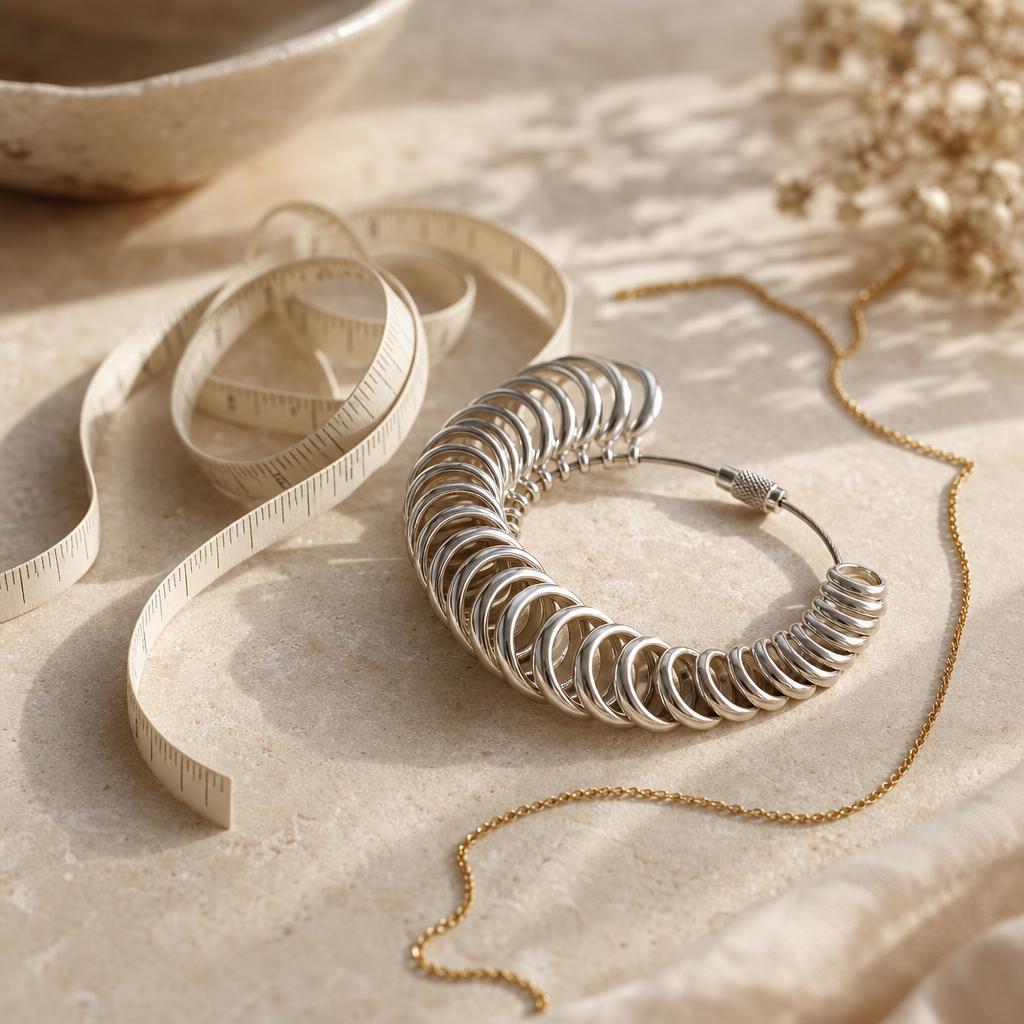
Ring Sizing Charts: Why US, UK and International Sizes Don't Always Convert Cleanly
You've found the ring. You've even found her size — or so you think — until you open three different ring sizing charts and get three different answers for the exact same finger. A UK "N" that's supposed to match a US 7 doesn't quite land. An EU chart gives you a number that looks nothing like either. If you've ever stared at a sizing chart feeling less informed than when you started, you're not imagining it — the charts genuinely don't always agree, and there's a reason why.
Before we get into the why, let's look at a few rings worth sizing correctly in the first place. Each of the styles below is available in a full US 5–9 range, so once you've nailed down your actual size, you're covered.


Why Ring Size Numbers Don't Mean the Same Thing Everywhere
It feels like sizing should be simple math — take a measurement, look it up, done. But ring sizing charts aren't actually built on one universal standard. They're built on at least three different measurement philosophies that happened to develop in different countries at different times, and none of them were designed with the others in mind. That's the root of almost every sizing headache you'll run into while shopping.
The US and Canadian system measures a ring's inner circumference and assigns it a number, with half and quarter sizes filling the gaps. The UK, Ireland, and Australian system instead measures inner diameter in millimetres and assigns a letter, working through the alphabet in small, unequal steps. The EU system skips symbolic labels altogether and just uses the inner circumference in millimetres as the size itself. Three different logics, three different units, three different rounding conventions — and every "conversion chart" you've seen is really just one person's attempt to force all three onto the same table.
Worth knowing: A conversion chart is an approximation, not a measurement. Two people who are genuinely different sizes can land on the exact same converted number if the rounding happens to work out that way — which is exactly why relying on a chart alone can send you the wrong ring.
The Three Measurement Systems, Explained
It helps to actually understand what each number is doing, rather than just memorizing a lookup table.
US & Canada: circumference in eighths
US sizing is based on the ring's inner circumference, historically measured in increments that don't divide evenly into millimetres. A US size 7 corresponds to roughly 54.4mm of inner circumference — but the increments between sizes aren't perfectly uniform across the whole range, which is part of why half sizes exist at some points in the scale and not others.
UK & Australia: diameter mapped to letters
The UK system measures inner diameter, then maps that measurement onto a letter scale from A to Z (with "half" letters like N½ appearing where needed). Because it's letter-based rather than numeric, there's no intuitive sense of how far apart two sizes actually are — N and O look adjacent on paper, but the physical gap between them isn't always the same as the gap between two other neighbouring letters.
EU: circumference, no symbol
The EU system is the most literal of the three: your size is simply your inner circumference in millimetres, full stop. A size 54 ring has a 54mm inner circumference. It sounds like it should be the easiest to convert — and for straightforward comparisons it often is — but it still requires converting into inches or the US scale's own step sizes, which reintroduces rounding.
| US Size | UK / AUS | EU (approx.) | Diameter (mm) |
|---|---|---|---|
| 5 | J ½ | 49 | 15.7 |
| 6 | L ½ | 52 | 16.5 |
| 7 | N ½ | 54 | 17.3 |
| 8 | P ½ | 57 | 18.1 |
| 9 | R ½ | 59 | 18.9 |
Keep in mind this table — like every sizing chart, ours included — is an approximation designed to get you close. If you've never actually measured your finger and are working from memory of "what size I usually wear," it's worth working through a proper at-home measuring method before you commit to a chart-based guess. And if you want the fuller regional breakdown beyond just these three systems, our guide to how US, UK, EU and Australian sizing compares goes deeper into each region's scale.

The Isabella Ring
A graceful pear-shaped centre stone with a shimmering halo, in warm rose gold — available across the full US 5–9 range, so an accurate measurement matters more than a rough estimate.
Shop The Isabella Ring →Why the Same "Size 7" Can Fit Differently Across Brands
Here's the part most sizing charts leave out entirely: even when the number is technically correct, the ring can still fit differently depending on how it's made. A few things move the number around in practice, not just in theory.
Band width. A wider band takes up more surface area against your finger, which makes it feel tighter than a slim band of the technically identical size. A 6mm eternity band and a 1.5mm solitaire band in the same labelled size will not feel the same going on.
Rounding during conversion. Because US, UK and EU systems don't divide evenly into one another, most conversion charts round to the nearest available size in the target system. That rounding is usually fine — but it means a chart-converted size is a best estimate, not an exact match, especially near the boundary between two sizes.
Manufacturing tolerance. Rings are physical objects made to a tolerance, not a mathematical constant. A small, normal variance between production batches — often a fraction of a millimetre — can be the difference between a ring that slides on easily and one that needs a firmer push over the knuckle.
Setting height and profile. A high-set halo or a cathedral-style shank changes how the ring sits and how the metal distributes pressure, which can make it feel a half-size different from a low-profile band even at the identical internal measurement.
✦ Pro tip: If you're between two sizes on a conversion chart, size up rather than down. A slightly loose ring is an easy fix with a ring guard; a ring that doesn't clear your knuckle isn't wearable at all.

The Camilla Ring
A round brilliant centre stone set into a graceful twisted halo band — a good example of a setting profile that reads slightly differently size-to-size depending on where the twist sits against your finger.
Shop The Camilla Ring →How to Actually Use a Conversion Chart Without Getting Burned
None of this means sizing charts are useless — it just means they work best as a starting point, not a final answer. Here's the order of operations that actually gets you a size you can trust.
Start by measuring your actual finger, not your memory of a size from another ring you own. A string-and-ruler measurement, a printable sizer, or a set of plastic ring sizers all get you a real millimetre number to work from — shopping without visiting a store in person makes this step non-negotiable rather than optional. Once you have a millimetre measurement, use that number — not a remembered "I'm usually a size 7" — to cross-reference against the specific retailer's own chart, since that's the chart that was built for the actual rings you're buying.
If your measurement lands right on the boundary between two sizes, factor in the band width and setting style of the specific ring, not just the generic chart. A slim pavé band and a wide statement band at your exact measurement can reasonably call for different decisions. And take note if you consistently find that identical sizes fit differently across brands you've bought from before — that's real information about your finger shape, not a reason to distrust the chart entirely.
Finally, resist the urge to trust a single number from a well-meaning chart you found online with no context for how it was built. The most reliable charts are the ones published directly by the retailer next to the product you're actually considering, because they reflect that specific ring's actual tolerances rather than a generic industry average.
Quick Takeaways
- US, UK and EU ring sizes are built on three different measurement philosophies — none converts perfectly cleanly into the others.
- A converted size is an estimate, not a guarantee — rounding happens at nearly every step.
- Band width, setting height, and manufacturing tolerance all shift how a "correct" size actually feels on your hand.
- Measure your real finger in millimetres first, then check that number against the specific ring's own chart.
- When you're between two sizes, size up — it's the easier problem to solve after the ring arrives.
Frequently Asked Questions
Which sizing system is the most accurate?
None of them is more "accurate" than the others — they're just different ways of describing the same measurement. The EU system is arguably the most transparent, since the number is the millimetre measurement itself, but accuracy for you comes down to measuring your actual finger rather than which system you use to describe it.
Why did a conversion chart give me a size that didn't fit, even though I measured correctly?
Most likely a rounding step in the conversion, or a difference in band width or setting style between the ring you were comparing to and the one you ordered. A correct millimetre measurement can still land you on the wrong side of a rounding boundary.
Should I trust the sizing chart on the specific retailer's website over a general conversion chart?
Yes. A retailer's own chart is built around the actual rings they sell and their actual manufacturing tolerances, which makes it more reliable than a generic chart trying to average across every possible brand.
Do half sizes exist in every system?
Not consistently. US sizing offers half and quarter sizes at most points on the scale, while the UK letter system uses half-letters more sparingly, and EU sizing is granular enough in millimetres that "half sizes" are somewhat built in already.
Ring sizing charts are a genuinely useful tool — they just work best when you treat them as a translation between systems rather than a substitute for measuring your actual finger. Get the real number first, cross-reference it against the specific ring you're buying, and the chart stops being a source of confusion and starts being exactly what it was meant to be: a shortcut, not a guess.


