

The 'Runs Small' and 'Runs Large' Problem: Why Identical Ring Sizes Fit Differently Across Brands
You order a size 7. It fits perfectly in one ring, but on the next one the same size 7 spins loosely around your finger — same hand, same day, same number stamped inside the band. If you've ever second-guessed your own measurements because of this, the confusion isn't in your head. Ring sizing is far less standardized than most buyers assume, and the number etched inside a band is only ever part of the story.
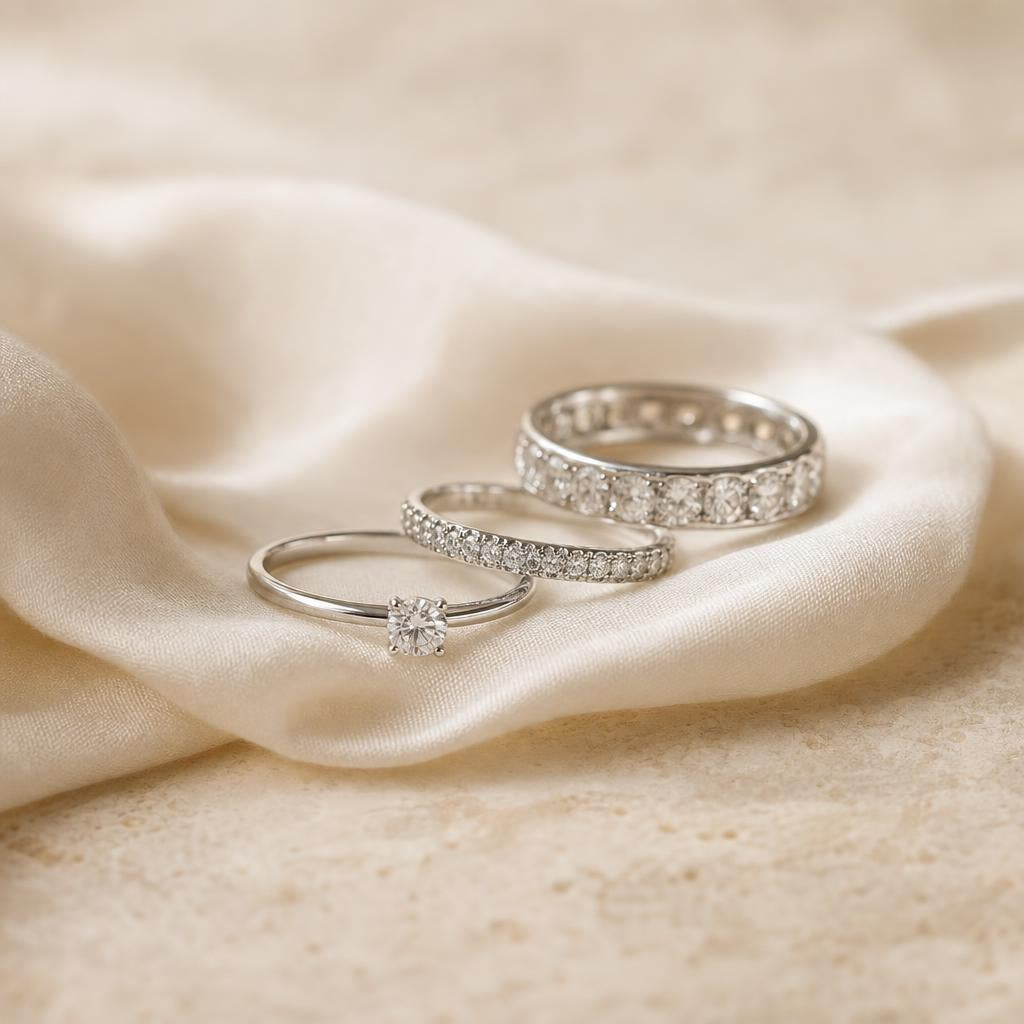
Before we get into why this happens, it helps to see the variation in practice. These four Gemiros styles span a real range of band widths and settings — a useful starting point for understanding how one labeled size can feel completely different from ring to ring.


Why "Size 7" Isn't Actually One Fixed Measurement
Ring size charts give the impression of precision — a size 7 corresponds to an inside diameter of roughly 17.3mm, full stop. In reality, that number describes the internal circumference of a ring at a single cross-section, measured under specific, idealized conditions: a flat, uniformly thin band with no interior contouring. Almost no ring you'd actually want to wear is built that way.
The moment a band gains width, curvature, a raised setting, or an engraved or comfort-fit interior, the relationship between "size 7 on the chart" and "how a size 7 feels on your finger" starts to bend. Two rings can carry the identical stamped size and still require a full half size of difference to slide on and sit the same way. This isn't a flaw in any particular brand's sizing — it's simply what happens once a ring becomes a real, three-dimensional object instead of a flat number on a chart.
The Physics of a Wider Band
Band width is the single biggest reason identical sizes feel different across styles. A narrow 1.5–1.8mm band contacts only a thin ring of skin around your finger, so it can pass over the knuckle with very little resistance. A wide band — anything from about 3mm up through a full statement or eternity width — has to travel over that same knuckle while dragging a much larger surface area of metal along with it.
More surface area means more friction, and more friction means a wider band in your "correct" size will often feel snugger going on and staying on than a thin band in the same size ever would. This is why jewelers commonly recommend sizing up a half size for wide bands, even when a customer already knows their number from a slimmer ring. Full eternity bands, which wrap continuously with no gap for flex, feel this effect most acutely.

The Everlasting Ring
A continuous round-cut pavé band set the whole way around on a fuller 3mm profile — the kind of width where sizing genuinely benefits from trying it on rather than guessing from a chart.
Shop The Everlasting Ring →Domed, Flat, and Comfort-Fit: The Interior Shape Matters as Much as the Number
Two bands of the exact same width can still fit differently depending on the shape of their interior wall. A flat-inside band meets the finger with a hard, straight edge along its entire contact line — every millimeter of that edge has to clear the knuckle at once. A rounded, comfort-fit interior tapers gently from the outer edge inward, so it slips over the same knuckle with noticeably less resistance, even at an identical labeled size.
This is one of the most overlooked reasons a "true to size" ring from one brand runs looser than a "true to size" ring from another. If you've read up on comfort fit vs standard fit bands and how the inside of the ring matters as much as the outside, you already know this is less about the number and more about the geometry doing the work behind it.
Worth knowing: A comfort-fit interior can make a ring wear up to roughly half a size looser than the same nominal size in a flat-interior band — which is exactly why two "size 7s" from two different sources can feel like two different rings entirely.
Prong Height, Halo Bulk, and Why Settings Change the Feel of a Size
Sizing isn't only about the band — it's also about what sits on top of it. A tall 4-prong solitaire setting concentrates its bulk high above the finger, so the band itself can stay thin and the ring still clears the knuckle easily. A halo setting, by contrast, adds width and height right at the base of the stone, and a double halo adds even more. That extra mass changes how the ring balances and how much clearance it needs at the joint where your finger bends.
This matters most for anyone sizing a ring for wide or wide-set knuckles, where the base of the finger and the knuckle itself are noticeably different circumferences. A slim solitaire might glide right over a larger knuckle in your usual size, while a halo ring in the same size catches, because the wider silhouette needs more room to pass the same joint.

The Duchess Ring
A cushion-cut center stone wrapped in a double halo on a 2.2mm pavé band — a good example of how added setting height changes the way a size actually wears, independent of the band width alone.
Shop The Duchess Ring →Full Eternity vs Half Eternity: How Much Metal Actually Touches Your Finger
Half-eternity bands set stones across the front and sides of the ring, leaving a plain, often thinner strip of metal at the back where the ring meets your palm. Full-eternity bands set stones the entire way around, with no plain section anywhere. That plain back section on a half-eternity ring isn't just decorative — it's a small amount of extra flex and give that a full-eternity band simply doesn't have.
The setting style also changes the texture the ring presents to your skin. A pavé full-eternity band has slightly raised stones and prongs running continuously around the finger, while a channel-set eternity band keeps its stones flush and enclosed between two rails of metal, so the surface reads as smoother even though the width is comparable. Both effects are easy to miss on a size chart and very easy to notice the moment you put the ring on.

The Devotion Ring
Baguette-cut stones set into a smooth channel rather than raised pavé prongs — a full eternity band with a noticeably different surface feel than a pavé style in the same width.
Shop The Devotion Ring →Does the Metal Itself Change the Fit?
Within a single ring, switching between sterling silver, gold vermeil, or rose gold plating doesn't meaningfully change the fit — the same mold and the same interior diameter are used regardless of finish. Where metal does play a role is in how a ring compares across brands and manufacturers. A heavier, more substantial casting can sit slightly differently on the hand than a lighter one at the same nominal size, simply because of how the extra weight settles against the skin over the course of a day.
It's a small factor compared to band width or setting bulk, but it's part of why two rings can share a size number and a metal type and still feel like they were sized by two different systems entirely — because, in a sense, they were.
How to Buy Across Brands With Confidence
None of this means ring sizing is unknowable — it just means the number alone isn't the whole answer. If you regularly find yourself between sizes, that decision alone becomes more important once band width enters the picture, since rounding up or down can be the difference between a comfortable fit and a snug one in a wider style. A few habits make cross-brand sizing far more reliable:
- Know your measurement in millimeters, not just your usual size number, so you can compare it against a specific listing's stated inside diameter.
- Check whether a listing describes the band as comfort-fit or standard — this single detail can shift how a size actually wears more than a full size difference in width.
- For anything wider than about 3mm, or any full-eternity style, lean toward sizing up half a size from what you'd choose in a thin band.
- Measure your finger at the end of the day, when it's at its largest, rather than first thing in the morning.
✦ Pro tip: If you already own a ring that fits well, note its band width and setting style, not just its size — that pairing is a far more useful reference point than the size alone when you're shopping a new style or a new brand.
If you're still unsure where to start, it's worth reading through some of the broader sizing advice that sounds right but usually isn't, since a surprising amount of common wisdom around ring sizing doesn't hold up once band width and setting height are factored in.
| Band width | Typical feel at your usual size | General guidance |
|---|---|---|
| Under 2mm (thin solitaire, pavé) | Runs true to size | Order your standard size |
| 2–3mm (half-eternity, most halos) | Slightly snugger, especially with a halo | Order your standard size; consider comfort-fit |
| 3mm and up / full eternity | Noticeably tighter than a thin band in the same size | Consider sizing up half a size |
Quick Takeaways
- A ring size describes a single measurement point — band width, interior shape, and setting height all change how that same number actually wears.
- Wider bands and full-eternity styles create more friction at the knuckle, which is why they commonly run tighter than thin bands in the same size.
- A comfort-fit interior can make a ring feel up to half a size looser than a flat-interior band at the identical stamped size.
- Halo and double-halo settings add bulk that changes clearance at the knuckle, independent of the band width itself.
- When comparing across brands, use millimeter measurements and band-width context, not just your usual size number.
Frequently Asked Questions
Why does the same size feel different in a wide band versus a thin band?
A wider band contacts more surface area of your finger as it passes over the knuckle, creating more friction. That extra resistance is why wide bands and full-eternity styles commonly feel tighter than a thin band in the identical labeled size.
Should I size up for a halo ring compared to a solitaire?
Not always, but it's worth considering if you have wider or wide-set knuckles. A halo adds bulk right at the base of the stone, which changes how much clearance the ring needs at the joint — a factor that a plain solitaire in the same size doesn't have to deal with.
Why do full-eternity bands run tighter than half-eternity bands?
A full-eternity band has stones set the entire way around, with no plain section of metal at the back for flex. A half-eternity band leaves that back section plain, which gives it a small amount of give that a full-eternity style in the same size doesn't have.
Does a comfort-fit band really make that much difference?
Yes — a rounded, comfort-fit interior can make a ring wear up to roughly half a size looser than a flat-interior band at the exact same stamped size, since it tapers over the knuckle instead of meeting it edge-on.
Is it safe to assume my size from one brand will work at another?
It's a reasonable starting point, but not a guarantee. Compare the millimeter measurement where possible, and factor in band width and setting style before assuming your number transfers exactly from one ring to the next.
The number inside your ring was never meant to be the whole story — it's a starting point, not a guarantee. Once you understand how band width, interior shape, and setting height each pull that number in a different direction, sizing across brands stops feeling like guesswork and starts feeling like something you can actually plan around.


