

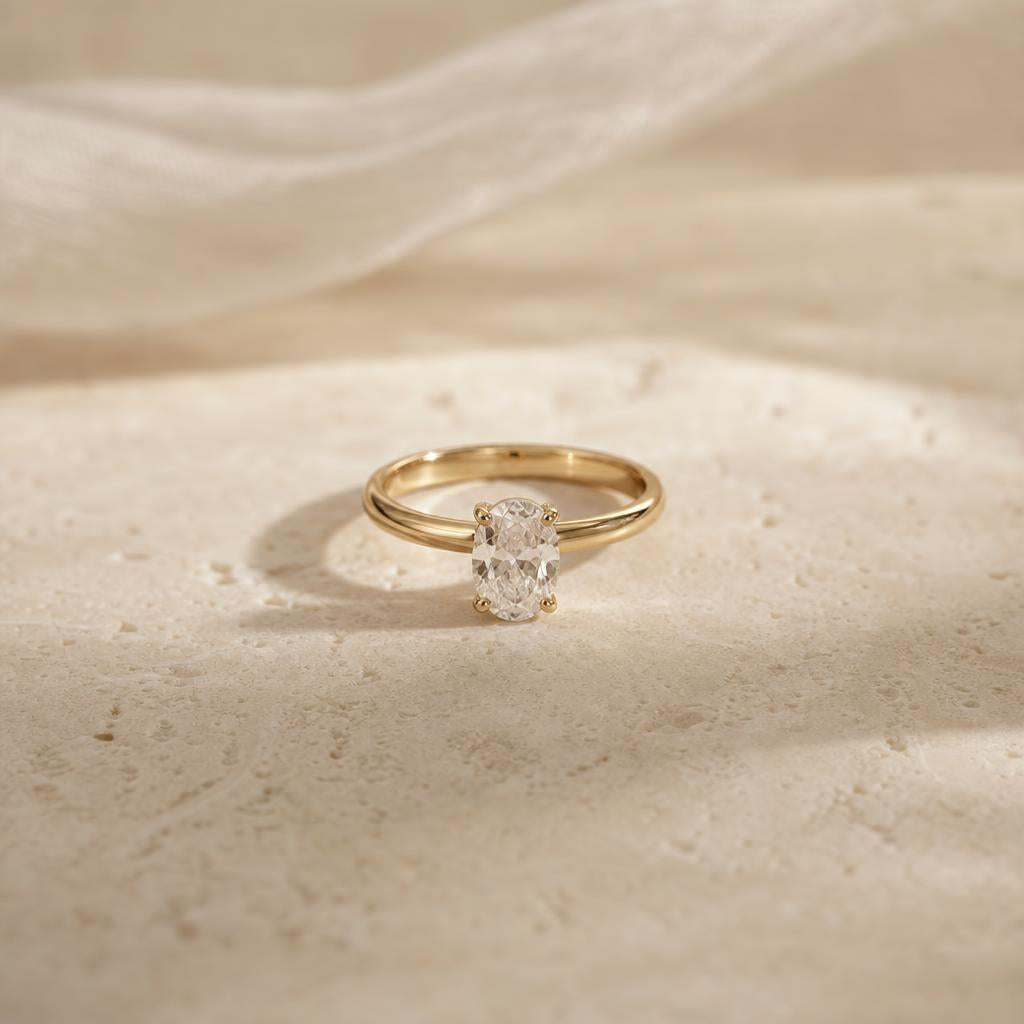
Quiet Drama: The Quiet Luxury Engagement Ring Edit That Sparkles On Its Own Terms
Not every ring is trying to get your attention. Some are built to hold still under office light, then catch fire the second you tilt your hand toward a candle. That restraint is not a compromise — it is a decision, and it is quietly becoming the most sophisticated one a woman can make about her own hand.
Call it the quiet luxury engagement ring moment: fewer rings shouting from across the room, more rings that reward a second look. Before we get into why that shift is happening, here are four Gemiros styles built exactly for it.


The case against a ring that never stops performing
For a long time, "impressive" and "loud" were treated as the same word. Bigger halo, higher setting, more surface area for light to hit — the assumption was that a ring's job was to announce itself the second it entered a room. But the women actually wearing these rings every day, at a desk, on a video call, reaching for a coffee cup, have quietly started asking for something else: a ring that reads as expensive without needing to prove it constantly.
This is where a hidden halo earns its name. A small ring of pavé stones sits underneath the center stone rather than around it in plain view — invisible from a straight-on glance, fully lit the moment the hand turns. The center stone still does the obvious work. The hidden halo is the part that makes people look twice without knowing why.
Worth knowing: A hidden halo can add real, measurable brilliance to a center stone without changing its apparent size from above — which is exactly why it reads as sophisticated rather than showy. The effect only reveals itself in profile.
What "quiet drama" actually means in a ring
Quiet drama is not the same as minimalism. A plain band with a single small stone is minimalist. A ring with a hidden halo, a fully pavé shank, and a deliberately restrained profile is something else — it is engineered for contrast. Flat light, and it looks composed. Directional light, and the whole hand lights up. That contrast is the entire point, and it is a harder thing to design than a ring that just sparkles constantly from every angle.
The Gemiros Ophelia Ring is the clearest example of this in the current collection. From across a table, it reads as a single, substantial oval stone — elegant, resolved, done. Only when the light catches the hidden halo underneath does the full construction reveal itself: layers of pavé doing quiet work beneath a stone that already looked complete on its own.
Why bezel settings belong in this conversation too
A bezel setting takes the opposite approach to the same goal. Instead of hiding sparkle beneath the stone, it wraps the stone in a smooth band of metal that catches its own edge of light — a thinner, cooler kind of shine than pavé, and one that reads as deliberate rather than accidental. The Cherish Ring below uses exactly this idea, and it is worth understanding on its own terms before you decide whether hidden halo, pavé, or bezel is the version of "quiet" that actually fits your hand.

The Cherish Ring
A bezel-set stacking band that trades pavé sparkle for a smooth, architectural line — the kind of quiet detail that reads as intentional up close and disappears into the hand from a distance.
Shop The Cherish Ring →The Gemiros case for buying into it
None of this restraint requires a trade-off on what the ring actually is. The Ophelia, the Majesté, the Duchess, and the Paris are set in 925 sterling silver with Gemiros' Signature Simulated Diamonds — indistinguishable from a diamond to the eye, and they pass diamond testers. The Ophelia in particular is routinely compared to pieces that run $15,000 or higher, which is exactly the kind of arithmetic a quiet luxury engagement ring is supposed to reward: the look holds, the price doesn't have to.
That distinction matters more than most buying guides admit. A ring built on a weak center stone just looks small no matter how it's set. One built on a stone with real fire — cut and set to actually perform in changing light — looks composed on purpose. The hidden halo and the pavé shank aren't there to compensate for anything. They're there because the woman wearing it already knows the difference, and she's not interested in paying a jewelry-store markup to prove she does.

The Maxima Ring
A 3.5-carat cushion cut set in a hidden halo, pavé mount — full-size presence with a profile quiet enough for daily wear.
Shop The Maxima Ring →How to tell if a "quiet" ring is actually just a plain one
Not every ring marketed as a subtle engagement ring earns the word. There's a real difference between a ring that's simple because it's unfinished and a ring that's simple because every unnecessary detail has already been removed. A few things worth checking before you buy into the quiet-luxury framing:
- Does it change under different light? Hold it under a warm lamp, then near a window. A genuinely well-built quiet piece should look noticeably different in each — flat light softens it, directional light reveals the halo or bezel underneath. If it looks identical everywhere, there's nothing actually happening beneath the surface.
- Is the center stone doing real work? A hidden halo or pavé shank is meant to support a strong center stone, not distract from a weak one. Check the cut and clarity of the center stone first.
- Does the setting have a reason to exist? A bezel that's there because it protects the stone during travel or daily wear is functional restraint. A bezel that's just thin metal with no real purpose is a missed opportunity.
✦ Pro tip: If you're deciding between two simple unique engagement rings that look nearly identical in product photos, ask to see (or find) a video in natural light. Studio photography flattens exactly the kind of contrast a hidden halo or bezel is designed to create.
The everyday argument for a quieter ring
There's also a practical case here that has nothing to do with aesthetics. A lower, hidden-halo profile snags less on sweaters, gloves, and gym equipment than a tall, exposed halo. A bezel setting protects the stone's girdle from the kind of daily knocks that loosen prongs over time. Quiet drama isn't only a look — for a lot of women, it's also the ring that survives an actual week of wear without needing to be babied.
The Duchess Ring and the Paris Ring both make this case in different stone shapes — cushion and pear — proving the effect isn't limited to one silhouette. Whatever shape flatters your hand, there's very likely a hidden-halo or pavé version of it that keeps the drama for when you decide to show it off.
Quick Takeaways
- A hidden halo sits beneath the center stone, invisible head-on, fully lit in profile — the definition of sparkle on your own terms.
- Bezel settings create the same restrained effect through a smooth metal edge instead of pavé stones.
- A genuinely well-built quiet piece looks different under changing light. If it doesn't, there's nothing structural happening beneath the surface.
- Lower, hidden-set profiles snag less and wear better day to day than tall, exposed settings.
- Gemiros' hidden halo and bezel styles are set in 925 sterling silver with Signature Simulated Diamonds — the sparkle is real, even when it's not shouting.
Frequently Asked Questions
What makes a ring "quiet luxury" instead of just plain?
A quiet luxury engagement ring is deliberately restrained on the surface — a clean profile, no oversized halo — while still using construction like a hidden halo or pavé shank to add real brilliance underneath. The difference from a plain ring is in what's happening structurally, not just how big the center stone is.
Are solitaire and bezel-set rings actually timeless, or just trending right now?
Both have stayed in steady rotation for decades because they solve a real problem — showcasing a stone without unnecessary ornamentation — rather than chasing a specific era's aesthetic. A bezel-set stone from a decade ago and one made today look essentially the same, which is a fair working definition of timeless.
Will a hidden halo actually make my ring look bigger?
It adds visible sparkle and perceived dimension from certain angles, but unlike a visible halo, it isn't designed to increase the apparent size of the center stone from a straight-on view. Choose a hidden halo for the light effect, not as a size trick — that's what a visible halo setting is for.
Is a subtle ring harder to keep clean than a flashier one?
Not meaningfully. Pavé and hidden halo settings collect the same amount of everyday residue as any other setting — a warm-water soak and a soft brush handle it. Bezel settings are actually easier to keep looking sharp, since there are no exposed prongs to catch lint or buildup.
A ring doesn't have to be loud to be confident. If anything, the opposite is starting to feel more true: the rings that hold their composure in flat light and only reveal themselves when you tilt your hand are the ones that actually make people look twice. That's not a smaller kind of sparkle. It's just a smarter one.


