

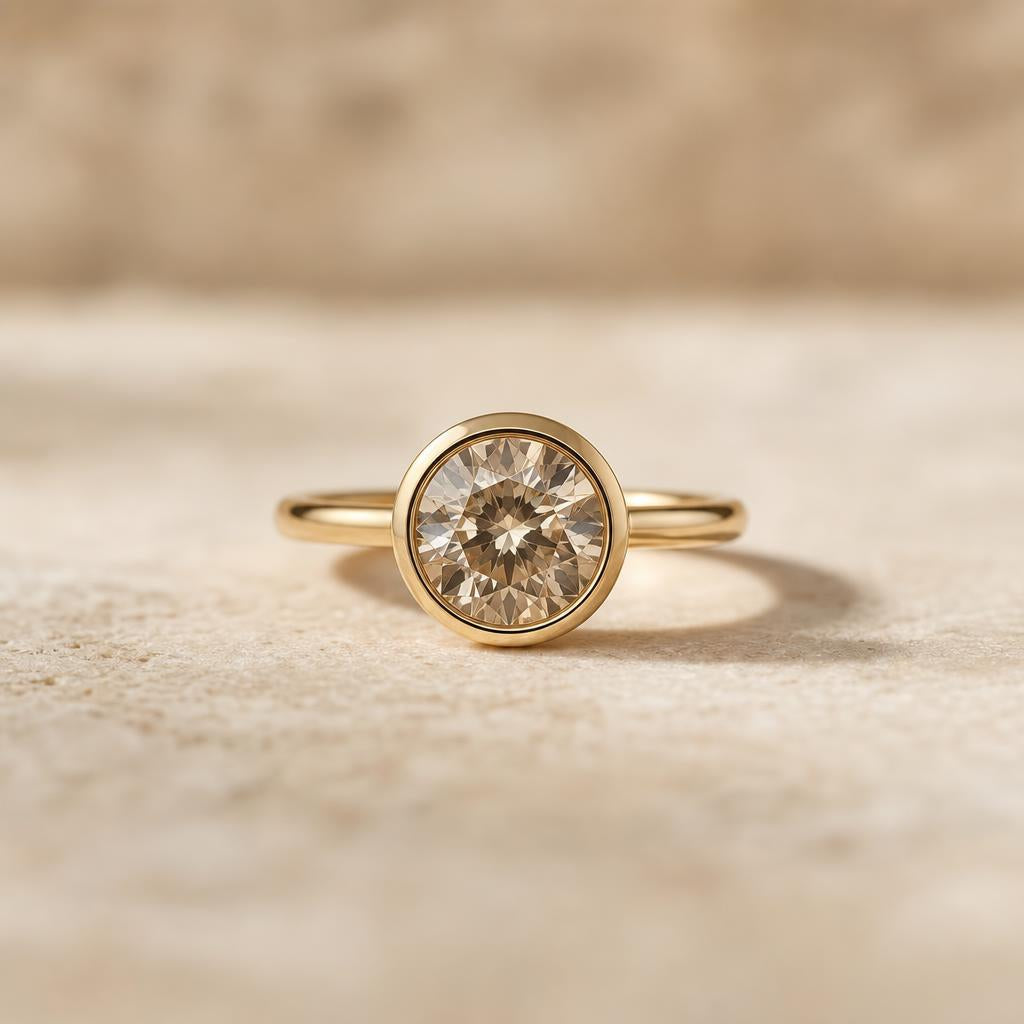
Bezel-Set Rings: The Low Profile Engagement Ring Setting Built to Last
There's a setting quietly taking over the engagement ring conversation, and it isn't the one with the biggest halo or the most prongs. It's the bezel — a smooth ring of metal that wraps fully around the stone instead of holding it up on thin metal claws. No sharp edges. No snag points. Nothing standing between the stone and your day.
The appeal isn't really about trend at all. It's about a woman who wears her ring every single day — through workouts, keyboards, luggage handles, and everything else — deciding she'd rather have a setting built for her actual life than one built for a photograph. Here's a look at what a bezel setting actually does, and a few Gemiros pieces worth knowing if the idea appeals to you.


What a Bezel Setting Actually Is
Strip away the marketing language and a bezel setting is simple: a thin rim of metal that circles the stone and holds it in place from the outside, rather than four or six prongs gripping it from a few points. A full bezel wraps the stone completely. A half bezel leaves the sides open, so the metal frames the top and bottom of the stone while letting more light reach it from the edges.
Structurally, this changes how the ring sits on the hand. Because there's no prong basket lifting the stone up, the whole piece naturally sits closer to the finger — which is exactly what people mean when they search for a low profile engagement ring setting. The stone reads as part of the ring's silhouette instead of something perched on top of it, and there's nothing raised enough to catch on a sweater, a seatbelt, or the edge of a pocket.
Worth knowing: A bezel isn't a hedge against a stone that "might" chip or loosen — it's a structural upgrade. The metal itself absorbs impact that would otherwise hit the stone directly, which is why jewelers consistently point to bezels as one of the most protective settings available.
Full Bezel vs. Half Bezel
The two variations solve slightly different problems. A full bezel gives you maximum coverage — ideal if you work with your hands, hit the gym daily, or simply want to stop thinking about your ring altogether. A half bezel engagement ring is the compromise version: metal at the top and bottom for security, open sides for sparkle. It's a popular middle ground for anyone who wants the low, protected feel of a bezel without losing the light play of a fully open setting.
Neither version is more "correct" than the other. It comes down to how much exposed stone you want to see versus how much coverage you want protecting it — a decision worth making based on your actual week, not just how the ring photographs.
Why Bezel Settings Read as Quietly Expensive
There's a reason bezel settings show up so often in the "old money," understated-luxury conversation: they don't rely on a big, obvious prong basket to make a statement. The stone sits flush, the line of the ring is clean, and the whole piece reads as intentional rather than showy. It's the same instinct behind choosing a solitaire over a cluster — confidence that doesn't need to explain itself.
That restraint is also why a bezel-set stone can look smaller than the same stone in a prong setting — the metal rim visually "crops" a sliver of the stone's edge. It's a fair tradeoff to know about going in: you're gaining structure and a cleaner silhouette, and giving up a small amount of visible surface area. Nothing about that is a downside unless you're choosing a bezel purely to maximize apparent size, in which case a halo setting will serve you better.

Cherish Ring
A row of bezel-set stones, each held in its own smooth metal frame — reimagining the eternity band as something low, clean, and built for daily wear.
Shop Cherish Ring →Bezel Settings and Moissanite: A Natural Pair
One question worth answering directly: does a metal rim dull a stone's sparkle? For a bezel engagement ring moissanite shoppers ask about most, the answer is no — if anything, the pairing works in your favor. Moissanite already throws more fire and rainbow flash than a mined diamond of the same size, so the slightly more contained light performance of a bezel setting doesn't read as "less sparkle." It reads as sparkle with intention, catching the light in flashes rather than a constant scatter. Gemiros rings are indistinguishable from a diamond and pass diamond testers — a bezel setting doesn't change that, it just frames it differently.
Styling a Bezel Piece Into Your Everyday Stack
Because a bezel sits low and close to the finger, it plays exceptionally well with other rings. A bezel-set stacking piece like the Cherish sits flush against a solitaire or a plain band without the gap you'd get from a taller prong setting, which makes it one of the easier pieces to build a stack around rather than fight with. If you already wear a solitaire daily, adding a bezel-set band is a low-effort way to layer in more sparkle without the stack looking top-heavy.
For anyone shopping specifically for a wedding band to sit next to a bezel-set centerpiece, the same logic applies in reverse — you'll generally have an easier time finding a bezel set wedding band that sits flush, since there's no raised basket to build around.

Solis Ring
A 1.5 carat round center stone in a low, clean solitaire setting — the kind of quiet, everyday brilliance that pairs naturally with a bezel-set stacking piece.
Shop Solis Ring →Not Every Bezel Has to Be Round
Most of what shows up when people search bezel styles skews round and oval, but the setting works across shapes. An oval bezel engagement ring is a particularly popular combination right now — the elongated shape already reads as modern, and the bezel sharpens that further by giving the stone a clean, unbroken outline. It's worth exploring beyond the obvious shapes, too: an emerald or asscher cut framed in a bezel leans architectural, while a pear or marquise brings movement to an otherwise minimal setting.
What ties all of it together is the same underlying appeal: a bezel doesn't ask the shape of the stone to do less work. It just removes the distraction of prongs so the shape can speak for itself. Anyone drawn to a less expected setting tends to land here — not because the bezel is rare, but because it lets an unusual cut actually read as unusual instead of getting visually broken up by hardware.
✦ Pro tip: If you're deciding between shapes, hold a candidate ring under a single overhead light rather than a ring light or window. A bezel setting's flash pattern shows up most clearly in directional light — it's a better preview of how it'll actually look day to day.
Who a Bezel Setting Is Actually For
Not every buyer needs to overthink this. If your current ring already survives your life without a second thought, there's no reason to switch settings just because bezel is having a moment. But if you've ever caught a prong on a glove, worried about a stone loosening after a year of wear, or simply wanted a ring that reads as deliberate rather than delicate — this is the setting built for exactly that woman. It isn't a compromise on sparkle. It's a decision that you'd rather wear your ring than manage it.
Quick Takeaways
- A bezel setting encircles the stone in metal instead of holding it with prongs — full bezels wrap completely, half bezels leave the sides open.
- Because there's no raised basket, bezel rings sit low and close to the finger, which is what makes them such a strong everyday, low-set choice.
- The metal rim absorbs impact, making bezels one of the most protective settings for daily wear, gym days, and travel.
- Moissanite's exceptional fire holds up beautifully in a bezel — the setting frames the sparkle rather than reducing it.
- Bezel-set pieces stack flush against solitaires and plain bands, making them easy to layer into an existing collection.
Frequently Asked Questions
What exactly is a bezel setting?
A bezel setting holds a gemstone with a continuous rim of metal that wraps fully or partially around its outer edge, instead of using prongs. It creates a smooth, low profile and adds an extra layer of protection since there's more metal in contact with the stone.
Is a bezel setting more secure than a prong setting?
Yes. Because the metal surrounds the stone rather than gripping it at a few points, a bezel setting is widely considered one of the most secure options available — it's a common recommendation for anyone with an active daily routine.
Does a bezel setting make a stone look smaller?
The metal rim covers a small sliver of the stone's edge, so it can read slightly more contained than the same stone in a prong setting. It doesn't reduce brilliance — it just shifts the stone's presence from "exposed" to "framed."
What's the difference between a full bezel and a half bezel?
A full bezel wraps the entire stone in metal for maximum coverage. A half bezel covers the top and bottom only, leaving the sides open so more light reaches the stone — a middle ground between full protection and full exposure.
Can a bezel-set ring be stacked with other rings?
Bezel settings are actually easier to stack than most, since the low profile means there's no raised basket for a neighboring band to clear. A bezel-set band will typically sit flush against a solitaire or plain wedding band.
Is moissanite a good fit for a bezel setting?
Yes — moissanite's higher fire and brilliance compared to a mined diamond of the same size holds up well within a bezel's more contained frame, so you still get plenty of flash without needing an open prong setting to show it off.
A bezel setting isn't a trend you need to chase — it's a structural choice for anyone who'd rather wear a ring without thinking about it twice. Whether that means a single bezel-set stacking piece added to a collection you already love, or a full solitaire built low and clean from the start, it's one of the few upgrades that looks as good as it lives.


