

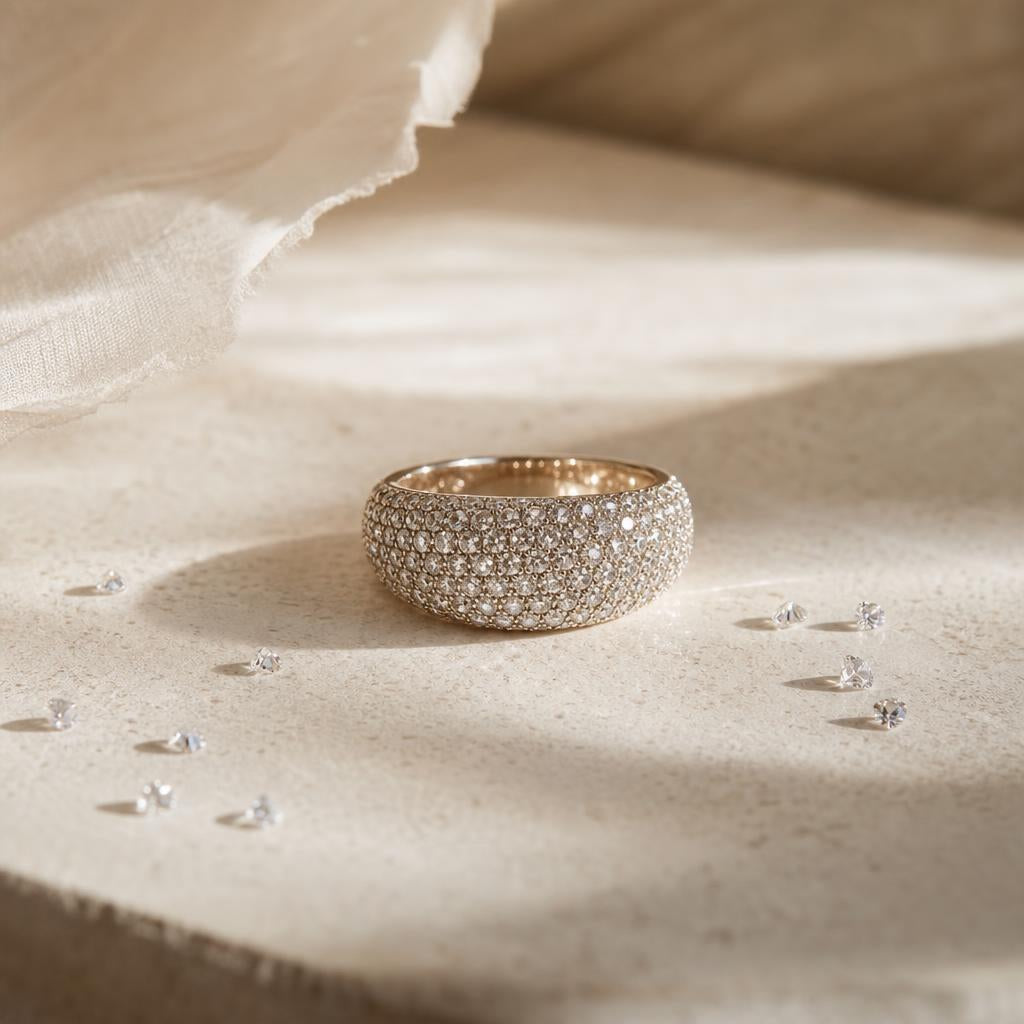
The Pavé Effect: What a Pavé Ring Actually Does to a Setting
Put the same center stone in two settings — one plain, one paved in tiny stones — and you get two completely different rings. Same carat weight. Same shape. Completely different personality.
That's the pavé effect, and once you notice it, you can't unsee it. Before we get into how it actually works, here's a look at how Gemiros interprets it across four different shapes.


What "Pavé" Actually Means
Pavé comes from the French word for "paved" — as in a cobblestone street, where every inch of surface is covered rather than left bare. Apply that idea to a ring, and a pavé ring is one where small stones are set closely together across the band or around the center stone, held in place by tiny shared prongs or beads of metal instead of one stone standing alone in open space.
The result isn't just "more sparkle." It's a structural shift in how the whole ring reads. A solitaire draws the eye to a single point. A pavé setting spreads that same attention across dozens of smaller points, so the light seems to come from everywhere at once instead of one spot.
The Pavé Effect: What Actually Changes
Three things shift the moment you move from a plain band to a pavé one, and none of them have to do with the center stone getting any bigger.
The stone looks larger than it is. A halo or band of pavé stones around a center stone creates a visual "frame" that expands the eye's read of the whole piece. This is the same principle behind why a hidden halo can look like it's carrying more carat weight than the number on the listing suggests.
Movement replaces stillness. A single stone catches light in flashes as your hand moves. A field of pavé stones catches it constantly, from more angles, because there are simply more facets doing the work at once. It's the difference between one spotlight and a room full of candles.
The setting disappears. Because the metal holding pavé stones in place is minimal — tiny beads or shared prongs rather than a solid band — your eye reads stones, not metal. That's the "paved surface" effect the French name describes: continuous brilliance with almost nothing visibly holding it there.
✦ Pro tip: If you want maximum sparkle without a large center stone, a pavé setting does more visual work per stone than almost any other style — it's the detail that makes a modest carat weight photograph like something bigger.
None of this requires the stones themselves to be anything other than what they are. A well-cut moissanite or simulated diamond set in a precise pavé arrangement is indistinguishable from mined diamond pavé at arm's length — the setting technique, not the stone's origin, is what's doing the visual heavy lifting. That's worth knowing before you assume "more sparkle" has to mean "more spent."
Standard Pavé vs. Micro-Pavé
Not all pavé is the same scale. Standard pavé uses slightly larger accent stones with visible individual sparkle points. Micro pave diamonds — or in Gemiros' case, micro-set moissanite and simulated stones — are smaller still, set so tightly that the band reads as one continuous ribbon of light rather than a row of distinct stones. Micro-pavé takes more precision to set well, since every stone has to sit flush and even, but the payoff is a setting with almost no visible break between one point of sparkle and the next.
This is also where craftsmanship shows up most clearly. Uneven micro-pavé looks obviously handmade in the wrong way — gaps, crooked rows, stones sitting at slightly different heights. Well-executed micro-pavé looks machined in the right way: level, symmetrical, and dense enough that counting individual stones becomes genuinely difficult. It's a small detail, but it's the one that separates a pavé setting that photographs beautifully from one that just photographs busy.
Pavé Halo vs. Pavé Band: Two Different Effects
Pavé describes a technique, not one single look — and where it's placed on the ring changes what it does.
A pavé halo, like the one framing the Maxima's cushion-cut center, wraps the accent stones directly around the center stone. This is the setting most responsible for the size illusion — it's doing the work of visually adding carat weight without adding an ounce of actual stone.
A pavé-set band along the shank, on the other hand, carries the sparkle down toward the fingers instead of — or in addition to — around the center. It's a quieter effect: less about making the center stone look bigger, more about making sure there's no plain, un-sparkling stretch of metal anywhere your eye lands.

Camilla Ring
A round-cut center on a gently twisted pavé band — proof that the shank can carry as much personality as the center stone itself.
Shop Camilla Ring →Some rings use both — a pavé halo and a pavé band together, which is where a piece stops being "accented" and starts being genuinely paved, top to bottom.

Soleil Ring
A round-cut solitaire set in a six-prong mount with a pavé band underneath — the sparkle continues even where the center stone leaves off.
Shop Soleil Ring →Which Shape Wears Pavé Best?
Pavé is flexible enough to work with almost any center stone shape, but it plays a slightly different role depending on what it's framing.
Oval and cushion cuts benefit the most from a pavé treatment, because both shapes already have soft, rounded outlines — the accent stones echo that curve rather than fighting it. This is the Maxima's whole premise: a 3.5-carat cushion center with a hidden halo and pavé working together to make the stone look even more substantial. An oval center, like the Ophelia's, gets the same lift — a pavé oval ring reads noticeably larger than the same oval alone in a plain mount.
Emerald and other step cuts read as more architectural, so pavé softens the geometry instead of amplifying it — you can see this in the Kensington, where a hidden halo and pavé band ease the emerald cut's sharp lines into something less severe.
Pear-shaped stones have a natural asymmetry that pavé settles down. The Isabella pairs a teardrop center with a halo and pavé band specifically because the extra sparkle balances out the point of the pear rather than exaggerating it.
Square and princess-cut centers can carry a pavé treatment too, though a pavé square ring reads differently again — cleaner lines, sharper contrast between metal and stone, less soft than an oval or cushion silhouette. If your hand runs toward angular, geometric jewelry generally, this is usually the more flattering direction than a rounded halo.
None of this is a rule you have to follow exactly. The point of knowing how pavé behaves with different shapes isn't to box yourself into one "correct" combination — it's to understand why a ring you're drawn to photographs the way it does, so you can shop with that knowledge instead of guessing.
Common Questions About Pavé Settings
What does "pavé" actually mean on a ring?
It's French for "paved," describing a setting where small stones are placed closely together and held with tiny shared prongs or beads of metal — so the surface reads as continuous sparkle rather than one stone standing alone.
What's the difference between pavé and micro-pavé?
Scale. Standard pavé stones are slightly larger and each one is individually visible. Micro-pavé uses smaller stones set even closer together, so the band reads as one unbroken ribbon of light instead of a row of distinct points.
Are pavé settings more work to keep clean?
A little — more surface area means more spots for lotion or soap residue to collect. A soft brush and warm water every couple of weeks keeps a pavé setting looking as bright as the day it arrived.
Is a solitaire or a pavé ring the better choice?
Neither is objectively better — they're different statements. A solitaire is confident in its simplicity; a pavé setting is confident in its detail. If you want maximum brilliance for the size of the center stone, pavé does more visual work. If you want the center stone to be the entire story, solitaire wins.
Do pavé stones loosen or fall out over time?
Any set stone can loosen with enough hard wear, which is why Gemiros pavé pieces are set in solid 925 sterling silver rather than a soft or hollow alloy. Treat it the way you'd treat any fine jewelry — off during heavy lifting or workouts — and there's no reason it won't hold up for years.
Quick Takeaways
- Pavé means "paved" in French — small stones set closely together, held by minimal metal
- A pavé halo makes the center stone look larger; a pavé band keeps sparkle going down the shank
- Micro-pavé uses smaller, tighter-set stones for an almost seamless ribbon of light
- Oval and cushion shapes soften beautifully with pavé; emerald and pear shapes get balanced by it
- 925 sterling silver settings hold pavé stones securely with normal, sensible care
The next time a ring looks like it's throwing more light than its carat count should allow, look closer at the band. Odds are good it's not one stone doing all that work — it's dozens of small ones, paved in, doing it together.


