

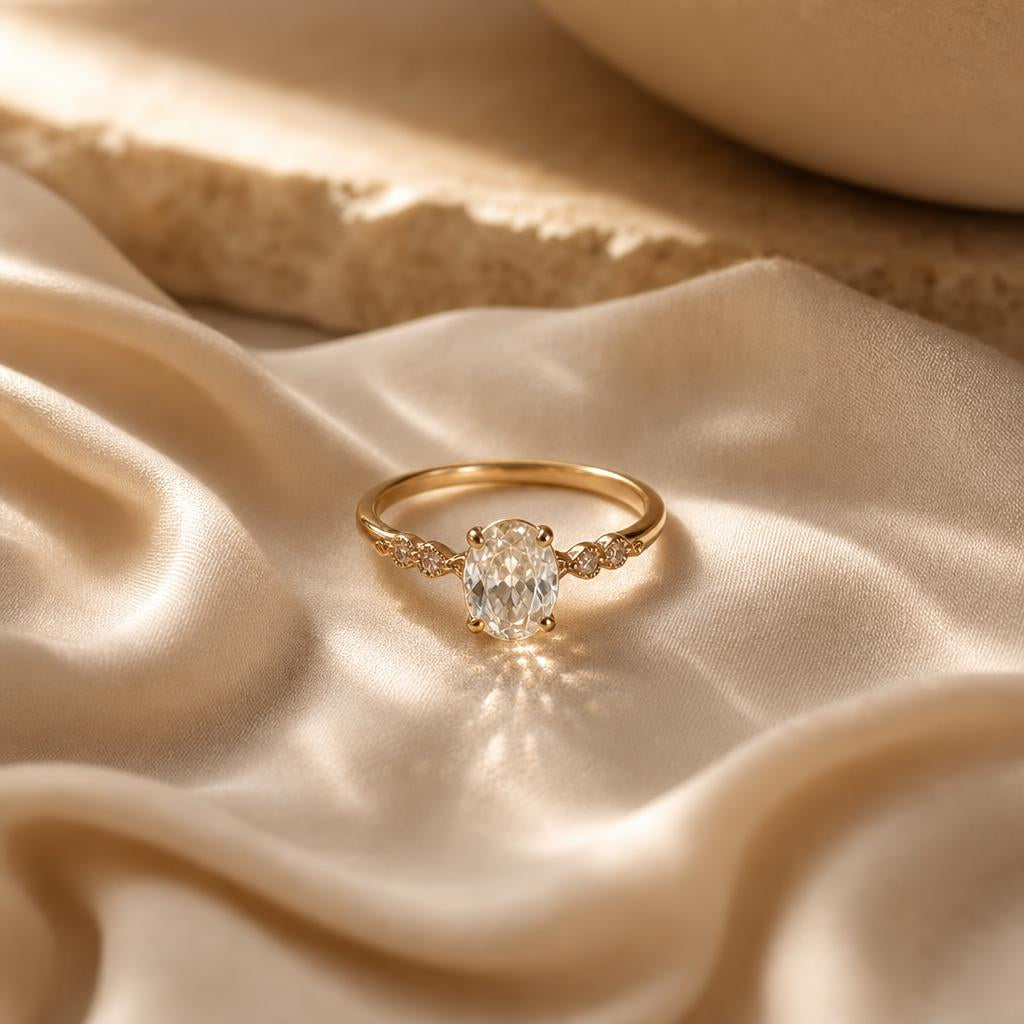
Hidden Halo Engagement Rings: The Secret Setting That Makes Your Stone Look Bigger
From across the room, it reads as a clean, quiet solitaire. Lean in, and there's a second layer of light you weren't expecting — a row of stones tucked directly beneath the center gem, catching light the moment you tilt your hand. That's the whole idea behind a hidden halo engagement ring, and it's quietly become one of the smarter setting choices a woman can make for herself.
It's a small structural decision with an outsized effect: more brilliance, a center stone that reads larger than its actual size, and a silhouette that still looks understated from above. Here's what that setting actually looks like on a few different shapes.


What Is a Hidden Halo, Exactly?
A hidden halo is a ring of small accent stones set directly beneath the center stone, along what jewelers call the gallery rail — the thin band of metal that connects the prongs and supports the stone from underneath. On a plain setting, that rail is bare metal. On a hidden halo setting, it's lined with pavé stones instead, so the sparkle lives underneath the center stone rather than around it.
The effect only reveals itself from certain angles. Look straight down at your hand and the ring reads as a clean, classic solitaire — nothing competing with the main stone for attention. Tilt your hand, catch the light from the side, and that hidden ring of stones flashes into view. It's the kind of detail that rewards a second look, which is exactly the point.
Hidden Halo vs. Halo: What Actually Changes
A traditional halo surrounds the center stone in a visible ring of pavé, framing it from every angle and adding noticeable width to the overall look. A hidden halo does the opposite: it sits below the stone instead of around it, so from above the ring looks nearly identical to a solitaire. The two settings solve different problems. A visible halo is for someone who wants maximum sparkle and doesn't mind the stone reading larger and more elaborate. A hidden halo is for someone who wants the quieter silhouette of a solitaire with a private layer of brilliance underneath it.

The Belle Ring
If you want the halo effect on full display rather than tucked underneath, the Belle wraps a round brilliant center stone in a full pavé halo and half-pavé band — sparkle from every angle, no secrets.
Shop The Belle →Hidden Halo vs. No Halo: Is the Extra Sparkle Worth It?
The honest comparison isn't hidden halo versus visible halo — it's hidden halo versus no halo at all. A plain gallery rail holds the stone just as securely, costs nothing extra in visual weight, and gives you the cleanest possible solitaire. Choosing a hidden halo instead means trading that bare rail for a hidden layer of stones you'll notice every time you move your hand under a light. Neither is the "correct" choice. It's a question of whether you want the sparkle to stop at the center stone, or extend one layer further, out of sight until you go looking for it.

The Lumière Ring
For comparison: the Lumière keeps its 4-carat round brilliant center stone on a plain gallery rail — no hidden halo, no visible halo, just the stone and a slim band.
Shop The Lumière →Does a Hidden Halo Actually Make the Stone Look Bigger?
This is the detail most people miss. Because the hidden stones sit at the base of the center stone rather than around its edges, they subtly extend the visual footprint of the setting without changing the ring's top-down profile. The center stone doesn't get any larger, but the eye reads more surface area of sparkle in that lower third of the ring, and the brain fills in the rest. It's an optical illusion, not a magic trick — but it's a genuinely effective one, especially on oval and pear shapes where the elongated silhouette already does a lot of the visual heavy lifting.
Worth knowing: A hidden halo pairs especially well with an elongated center stone — oval, pear, or radiant — because the extra sparkle at the base extends the same direction the eye is already traveling.
What About the Gallery Rail Itself?
Every prong setting needs a gallery rail, hidden halo or not — it's the structural piece that keeps the prongs from bending or splaying under normal wear, and it's what actually determines whether a hidden halo is even possible on a given ring. A plain gallery rail is just bare metal doing its job quietly. Add pavé stones along that same rail, and you've turned an invisible structural necessity into a design feature. This is worth knowing if you're comparing listings: a ring described as having "no gallery rail" usually means an open, floating-stone look, which is a different setting decision entirely from choosing hidden halo over plain.
Is a Hidden Halo Setting Secure Enough for Everyday Wear?
Indistinguishable from a diamond, passes diamond testers, and just as wearable day to day — the moissanite and CZ stones beneath a Gemiros hidden halo are set the same way the center stone is: secure, low-profile, and built for actual use rather than a single photograph. The one practical note worth knowing is that the underside of a hidden halo can trap lotion or soap residue slightly more than a plain rail, simply because there's more surface detail down there. It's a wipe-with-a-soft-cloth issue, not a durability one.
✦ Pro tip: Rinse and pat dry after applying lotion or sunscreen, and give the underside of the hidden halo a quick once-over with a soft-bristle brush every couple of weeks to keep the pavé looking bright.
Which Stone Shapes Work Best With a Hidden Halo?
Round, oval, cushion, and pear center stones all take a hidden halo well, since the gallery rail simply follows the curve of the setting underneath. Elongated shapes like oval and pear tend to show it off most dramatically, because the hidden stones extend along a shape that's already reading long and dramatic from the top. A round center stone gives a more contained, classic version of the same effect — sparkle underneath a shape that's already familiar and easy to wear daily. The Ophelia remains the clearest example of a hidden halo oval engagement ring done well: a 4.5-carat oval center stone with the hidden detail doing exactly what it's there to do.
Quick Takeaways
- A hidden halo sits beneath the center stone on the gallery rail — invisible from above, visible from the side.
- It's a different decision from a visible halo, which wraps around the stone instead of underneath it.
- The extra sparkle creates a genuine optical illusion of a larger stone, especially on oval and pear shapes.
- Cleaning is slightly more involved than a plain setting, but security and durability aren't affected.
- There's no universally "better" choice — it comes down to how much hidden sparkle you want under your hand.
Frequently Asked Questions
What is a hidden halo on a ring?
It's a ring of small accent stones set along the gallery rail, directly beneath the center stone, rather than around its edges. From a top-down view the ring looks like a clean solitaire; from the side, the hidden stones catch the light.
What's the difference between a halo and a hidden halo engagement ring?
A halo surrounds the center stone and is visible from every angle, adding noticeable width to the ring. A hidden halo sits underneath the stone instead, keeping the top-down silhouette close to a solitaire while adding sparkle only visible from the side.
Are hidden halos out of date?
No — it's a detail-driven choice rather than a trend tied to a particular year, which is exactly why it works as well on a classic round stone as it does on a more contemporary elongated cut.
Are hidden halo rings worth it?
If you like the idea of a solitaire with a private layer of extra brilliance, yes. It's a matter of preference rather than value — you're not paying more for a "better" ring, just choosing a different structural detail underneath the stone you already love.
Is a hidden halo secure enough for everyday wear?
Yes. The gallery rail is a structural piece either way — adding pavé stones to it doesn't compromise how securely the center stone sits. The only everyday difference is that the underside benefits from an occasional soft-brush cleaning to keep the detail bright.
Do I need a gallery rail if I'm not choosing a hidden halo?
Yes — a gallery rail is a structural feature, not a decorative one, and most prong settings include one regardless of whether it's set with stones. Choosing a hidden halo simply means dressing up a piece your ring needed anyway.
However you land on it, a hidden halo isn't an upgrade you make for anyone else's benefit. It's the kind of detail only you tend to notice — catching the light on your own hand, on an ordinary afternoon, for no particular reason at all. That's reason enough.


