

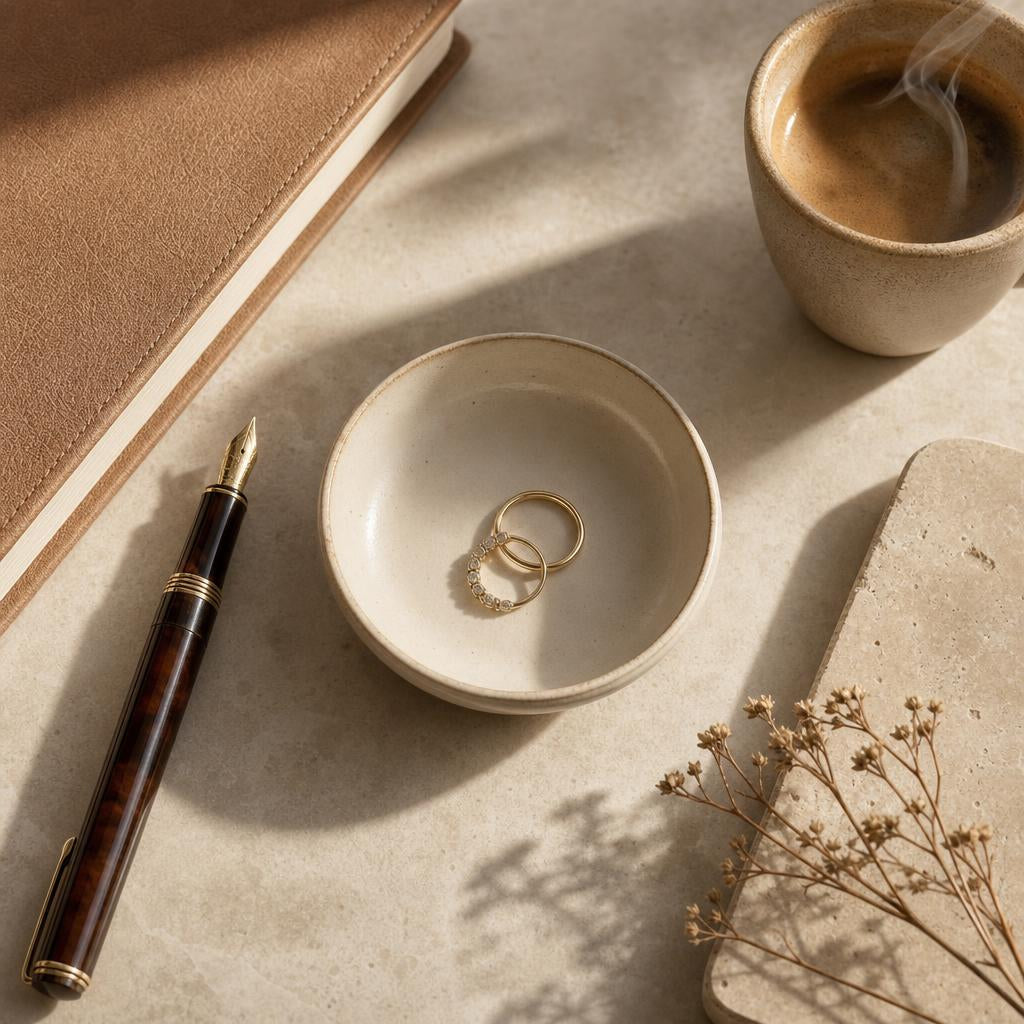
Office-Appropriate Rings: What Reads as Polished, Not Dressed-Up, at Work
There's a specific kind of ring that looks right reaching for a stapler, typing through a 9am call, and shaking a client's hand — and a different kind that looks right at dinner afterward. Most women own plenty of the second kind. Far fewer have thought about the first.
"Office-appropriate" isn't about a ring being smaller or quieter — it's about the setting doing its job without asking for help all day. Some of the sharpest-looking rings in a jewelry box are also the ones that catch on gloves, snag a sweater sleeve, or need constant re-centering after eight hours at a keyboard. Here's what actually holds up at a desk, and why.


What "Office-Appropriate" Actually Means for a Ring
It's tempting to assume office-friendly means small, but that's not quite it. A four-carat stone in a bezel setting can read as perfectly composed at a desk, while a delicate half-carat ring with high, spindly prongs can feel fussy and fragile the moment you're typing, unlocking a filing cabinet, or pulling on a coat. The difference is structural, not size-based.
Three things tend to separate a ring that survives a workday from one that fights you through it: how low the setting sits against your hand, how exposed the edges are, and how much the ring moves when your hand is in constant motion. Get those three right and almost any style — from a clean solitaire to a fully pavéd band — can read as polished rather than "dressed up for a night out."
The Settings That Read as Polished
Some settings were essentially built for exactly this kind of day. A low-profile setting keeps the stone sitting close to the hand instead of raised on tall prongs, which means less catching on gloves, keyboards, and the lining of a bag — and less visual "look at me" energy in a meeting where the ring shouldn't be the main event.
Bezel settings: the quiet workhorse
A bezel setting wraps a thin rim of metal fully around the stone's edge instead of holding it up on prongs. Practically, that means there's nothing for a sweater, a glove, or a laptop bag strap to catch on — the stone sits flush and protected. Visually, it reads as modern and a little architectural rather than ornate, which is exactly the register most offices reward. The Cherish Ring is a good example: its bezel-set stones sit low against the hand, and the eternity-style band means there's no single raised point to worry about.

The Majesté Ring
A hidden halo sits beneath the center stone rather than around it, adding scale and light without adding a second obvious focal point — the kind of quiet detail that reads as considered up close and clean from across a conference table.
Shop The Majesté Ring →Pavé detailing: sparkle without a statement
Pavé settings — tiny stones set closely along the band — add sparkle without adding a single dominant focal point. That distinction matters more at work than almost anywhere else. A ring that throws light in a soft, diffuse way across a whole band tends to read as "put-together," while a ring built around one enormous, attention-grabbing stone can occasionally tip into "dressed for evening" territory in a conservative workplace. The Beatrice Ring's vintage-inspired pavé band is a good middle ground: detailed enough to look intentional, restrained enough to disappear into a normal workday.
Worth knowing: Sterling silver and rhodium-plated finishes reflect light in a cooler, more diffuse way than yellow gold, which is part of why so many "quiet luxury" office rings lean silver or white metal — the sparkle reads as polish rather than flash.
Clean solitaires and architectural cuts
A single, well-cut stone in a simple setting is close to foolproof for work. The Verge Ring's split-shank solitaire and the Kensington Ring's emerald-cut silhouette both lean into clean lines rather than ornamentation — an emerald cut in particular reads as structured and almost geometric, which tends to photograph and present well in professional settings like headshots, video calls, and handshakes across a table.
What Actually Gets in the Way at a Desk
The complaints that come up most from women who wear their rings to work every day aren't really about how a ring looks — they're about how it behaves. A few patterns are worth knowing before you decide what to wear on a Monday.
- Tall prong settings can catch on tights, silk blouses, and the edge of a laptop bag. They're not wrong for work, but they ask a little more care.
- Exposed side stones or delicate galleries — the open metalwork beneath the center stone — are more prone to catching on gloves and fine-knit sweaters than a solid, closed setting.
- Rings sized slightly loose tend to spin during typing, which is more distracting over an eight-hour day than most people expect before it happens to them.
✦ Pro tip: If you type for a living, try the ring on and mime typing before you commit to a size. A ring that feels fine standing at a counter can behave completely differently after two hours at a keyboard.

The Solis Ring
A 1.5-carat round center stone on a pavé band, sized to sit comfortably through a full workday without the visual weight of a larger statement stone — an easy, versatile choice for daily wear.
Shop The Solis Ring →A Quick Setting-by-Setting Cheat Sheet
Since so much of this comes down to the setting rather than the stone itself, it helps to see the trade-offs side by side. None of these settings are wrong for the office — but each asks something slightly different of the person wearing it all day.
| Setting | Snag risk | Sparkle style | Desk-day comfort |
|---|---|---|---|
| Bezel | Very low | Soft, contained glow | Excellent — sits flush |
| Pavé band | Low | Diffuse, all-over sparkle | Very good |
| Hidden halo | Low–moderate | Added scale, subtle lift | Good |
| Clean solitaire (4-prong) | Moderate | Single strong point of light | Good, if properly sized |
| Tall prong / high gallery | Higher | Maximum brilliance | Fair — needs more care |
None of this is a reason to avoid a setting you love. It's simply useful to know, going in, which settings will need a little more attention — pulling on a coat carefully, or turning the stone to center before a meeting — and which ones you can genuinely forget you're wearing.
Building a Ring Routine That Works Both Ways
You don't need a separate "work ring" and "everything else" ring if the pieces you already own are chosen with a little intention. A small capsule of rings — one low-profile solitaire, one bezel or pavé band, maybe one slightly bolder piece for evenings — tends to cover a Monday board meeting and a Friday dinner without any real thought required in between. The goal isn't owning fewer rings; it's owning a few that don't fight the day you're actually having.
Fit matters here too, more than most people plan for. Knuckle size relative to the base of your finger affects which settings will sit flat and stay put through a day of typing, writing, and handshakes — a ring that needs to pass over a wider knuckle to get on will often sit slightly loose at the base, which is exactly the kind of thing that becomes noticeable during a long meeting rather than in the mirror at home.
None of this means playing it safe forever. A hidden halo, a warm rose gold tone, or a slightly larger stone in a bezel setting can still feel like "you" at your desk — the goal is simply matching the setting to the day, not shrinking your taste to fit an idea of what an office ring is supposed to look like.
Quick Takeaways
- Low-profile and bezel settings resist snagging on gloves, sweaters, and laptop bags far better than tall prong settings.
- Pavé and hidden halo details add sparkle and scale without a single attention-grabbing focal point.
- Emerald and other clean, structured cuts read as polished and photograph well for video calls and headshots.
- Fit — not just style — determines whether a ring behaves at a keyboard; a slightly loose ring will spin and distract.
- A small capsule of two or three considered rings can cover both a workday and an evening without a wardrobe change.
Frequently Asked Questions
Is a bigger stone automatically less office-appropriate?
Not necessarily. A larger stone in a bezel or hidden halo setting often reads as more composed than a smaller stone on tall, exposed prongs, because the setting — not the size — is what determines how the ring catches on things and how it sits against the hand.
Should I take my ring off before typing all day?
Most low-profile and bezel-set rings don't need to come off for typing. If a ring is spinning, digging in, or catching on the keyboard, that's usually a sizing or setting issue worth addressing rather than something to work around daily.
What's the most versatile setting for someone who doesn't want multiple rings?
A clean solitaire or a bezel-set stone tends to move most easily between a workday and an evening out, since neither relies on ornamentation that reads as "dressed up" on its own.
Does metal tone matter for how "office-appropriate" a ring looks?
It can. Sterling silver and white metal tones tend to read as cooler and more understated under office lighting, while warmer tones like rose or yellow gold can feel a touch more directional — neither is wrong, but it's worth trying both under the lighting you actually work in.
The rings that actually get worn every day are rarely the ones that demand the most attention — they're the ones that stop asking for it after the first five minutes. Choose for how a ring behaves at 3pm on a Tuesday, and the way it looks tends to take care of itself.


