

How Your Knuckle Size Affects Which Ring Styles Sit Flat and Feel Comfortable
Here's something most ring-buying guides skip entirely: two rings marked with the exact same size number can feel completely different on your hand — and the reason usually has nothing to do with your finger's actual width. It has to do with your knuckle.
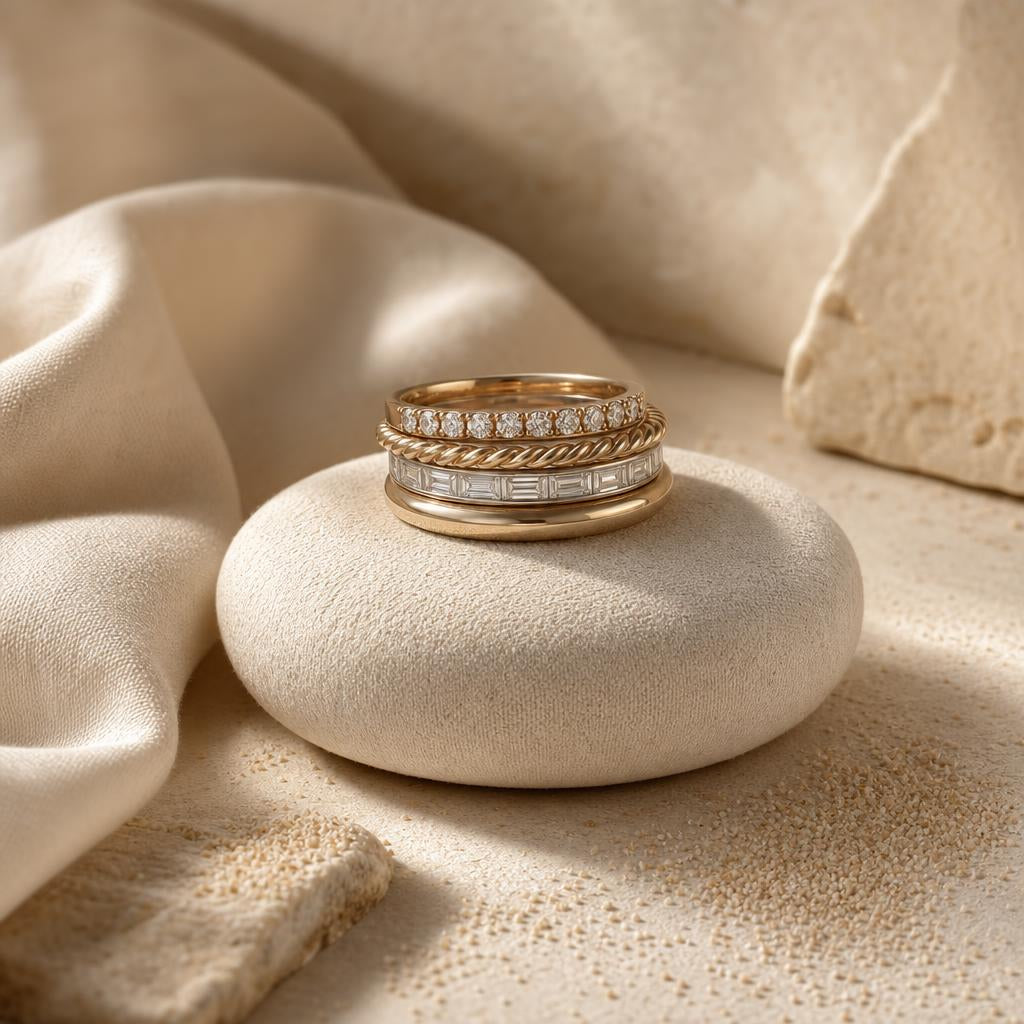
Before we get into the why, here's a look at four ring styles built with the lower, flatter profiles that tend to work well across a wider range of knuckle shapes — worth keeping in mind as you read on.


Why Knuckle Size and Finger Size Are Two Different Measurements
Most people assume "ring size" is one single number that describes their finger. In practice, a finger actually has two relevant measurements: the circumference at the base, where the ring will rest most of the day, and the circumference at the knuckle, which the ring has to clear every single time you put it on or take it off.
For a lot of people, those two numbers are close enough that it never becomes an issue. But for plenty of others — and this is more common than most jewelry guides let on — the knuckle is noticeably wider than the base of the finger. If you size a ring to glide easily over that knuckle, it ends up loose and spinning at the base all day. If you size it snug at the base, it can turn getting the ring on or off into a genuine production, especially first thing in the morning or after a workout when fingers are slightly swollen.
This mismatch is exactly why some rings that "should" fit based on the size chart still feel wrong the moment they arrive. It's rarely the ring's fault. It's a fit problem, and fit problems have style solutions.
Worth knowing: A jeweler can often add tiny interior beads or a subtle spring insert to help a ring glide over a larger knuckle while still sitting snugly at the base. It's a small, inexpensive fix worth asking about if you already own a ring that fits this description.
The Prong Problem: Why Tall Settings Snag on Bigger Knuckles
Prong height matters more than most buyers realize. A tall, dramatic setting — the kind that lifts a stone up and away from the hand for maximum sparkle — also lifts the entire structure of metal and prong tips higher off the finger. On a hand with pronounced knuckles, that extra height means the setting has more opportunity to catch on gloves, the inside of pockets, thick sweaters, and yes, other knuckles when your hands are clasped or resting against each other.
It isn't that tall settings are wrong. Plenty of women wear them every day without a single issue. But if you already know your rings tend to shift, catch, or feel like they're "sitting on top" of your hand rather than settled into it, a lower setting is worth considering before you assume the size itself is the problem.
Bezel and Low-Profile Settings: The Quiet Comfort Upgrade
A bezel setting wraps a thin rim of metal fully around the stone's edge instead of relying on individual prongs to hold it in place. The practical result is a smoother, rounder silhouette with no raised tips to catch on anything — including a wider knuckle joint as the ring passes over it.

The Cherish Ring
A rounded, bezel-set band designed to sit close and even against the hand, with none of the raised prong tips that tend to catch on a fuller knuckle. It also stacks cleanly against other bands without shifting out of line.
Shop The Cherish Ring →This is also why bezel settings show up so often in recommendations for anyone who works with their hands, types all day, or simply prefers a ring they don't have to think about. The comfort benefit and the knuckle benefit are, in this case, the same benefit.
Wide Bands, Split Shanks, and Why Width Changes Everything
Band width changes how a ring distributes pressure across your finger, and it changes how the ring feels crossing a knuckle, too. A very thin band concentrates all of its pressure into a narrow line, which can feel like it's "cutting in" on a fuller finger. A wider band spreads that same pressure across more surface area, which many people find sits more comfortably, particularly on fingers where the knuckle-to-base difference is more pronounced.
Split-shank designs — where the band divides into two slimmer strips as it approaches the setting — offer a middle path. They keep the visual lightness of a thinner ring while adding structural width exactly where the ring needs to flex slightly to pass over a knuckle.

The Verge Ring
A split-shank silhouette that widens gradually toward the setting, giving the band more surface contact without adding visual bulk — a practical middle ground for hands where sizing has always felt slightly off.
Shop The Verge Ring →What About Classic Prong Solitaires?
None of this means a traditional four-prong solitaire is off the table. If the difference between your knuckle and base measurement is small, a classic prong setting will likely fit just as comfortably as anything else on this list, and there's a reason it remains the most requested engagement ring style year after year — the visible prongs let more light reach the stone from every angle, which is exactly what gives a solitaire its sparkle.

The Stella Ring
A four-prong round solitaire with a slightly raised setting — a strong option if your knuckle and base measurements are close, or if you're happy to have a ring resized down the road as needed.
Shop The Stella Ring →The honest answer is that knuckle size doesn't rule any style out entirely — it just changes which styles require the least compromise. If you love a tall setting, you can still wear one; you may just want to size it slightly differently than you would a low-profile band, and expect to size up or down by a half size more than you would with a flatter design.
Pavé Shanks and Elongated Stones: Two More Variables Worth Knowing
A pavé-set shank — where small accent stones are set directly into the band rather than sitting on top of it — tends to sit closer to the hand than a plain shank of the same width, because there's no raised metal edge along the sides. That closer fit can make a pavé ring feel more settled on a fuller knuckle than its band width alone would suggest.
Stone orientation matters too. An elongated cut set east-west, or a solitaire with a narrower profile at the base, can sometimes clear a knuckle more comfortably than a wide round stone of the same carat weight, simply because there's less bulk directly at the point where the ring needs to flex.
✦ Pro tip: If you're ordering online and unsure which way your fit will lean, measure both your knuckle and the base of your finger separately. If the difference is more than about half a size, mention it to sizing support before you order, or lean toward a lower-profile, wider-band style from the start.
A Quick Reference: Matching Ring Style to Knuckle Type
| Your Situation | Styles Worth Considering |
|---|---|
| Knuckle noticeably wider than base | Bezel settings, pavé shanks, wider or split-shank bands |
| Knuckle and base are close in size | Classic prong solitaires, cathedral settings, taller styles |
| Rings tend to catch on gloves or sweaters | Bezel or low-profile settings |
| Fingers swell later in the day | Comfort-fit interior, slightly wider band |
| Want a stack that lies flat | Flush-fit or bezel-set pieces designed to sit close together |
None of these are hard rules — they're starting points. The right way to think about it is that your knuckle shape narrows down which styles will feel effortless from day one, and which ones might need an extra half-size or a small adjustment to feel just as good.
Quick Takeaways
- Your knuckle and the base of your finger are two different measurements — and the gap between them is what actually determines comfort.
- Bezel settings and pavé shanks sit lower and closer to the hand, which tends to help on fuller knuckles.
- Wider bands and split shanks distribute pressure more evenly than thin bands.
- Classic prong solitaires still work beautifully when the knuckle-to-base difference is small.
- When in doubt, measure both points separately before you order.
Frequently Asked Questions
How do I know if my knuckle is significantly bigger than my finger base?
Try a ring sizer or a snug-fitting ring you already own at both points. If it takes real effort to get over the knuckle but then feels loose at the base, or vice versa, you likely have a meaningful gap between the two measurements.
Will a bezel setting really feel different from a prong setting?
Yes, noticeably. Without raised prong tips, a bezel-set ring has a smoother, rounder edge that tends to glide over a knuckle more easily and catch on fewer things day to day.
Should I just size my ring for my knuckle to be safe?
Not necessarily. Sizing purely for the knuckle often means the ring spins or slides at the base, which creates its own comfort and durability issues. It's usually better to choose a style suited to your specific gap rather than sizing around the problem alone.
Can an existing ring be adjusted to fit a bigger knuckle better?
Often, yes. A jeweler can add small interior sizing beads, a hidden spring bar, or a subtle horseshoe-shaped insert that lets the ring flex slightly at the knuckle while holding its size at the base.
Fit is one of those details that quietly makes or breaks how often you actually reach for a ring. Once you know how your knuckle and finger base compare, choosing a style that sits flat and feels comfortable becomes a lot less like guesswork — and a lot more like picking the ring you'll actually want to wear every day.


