

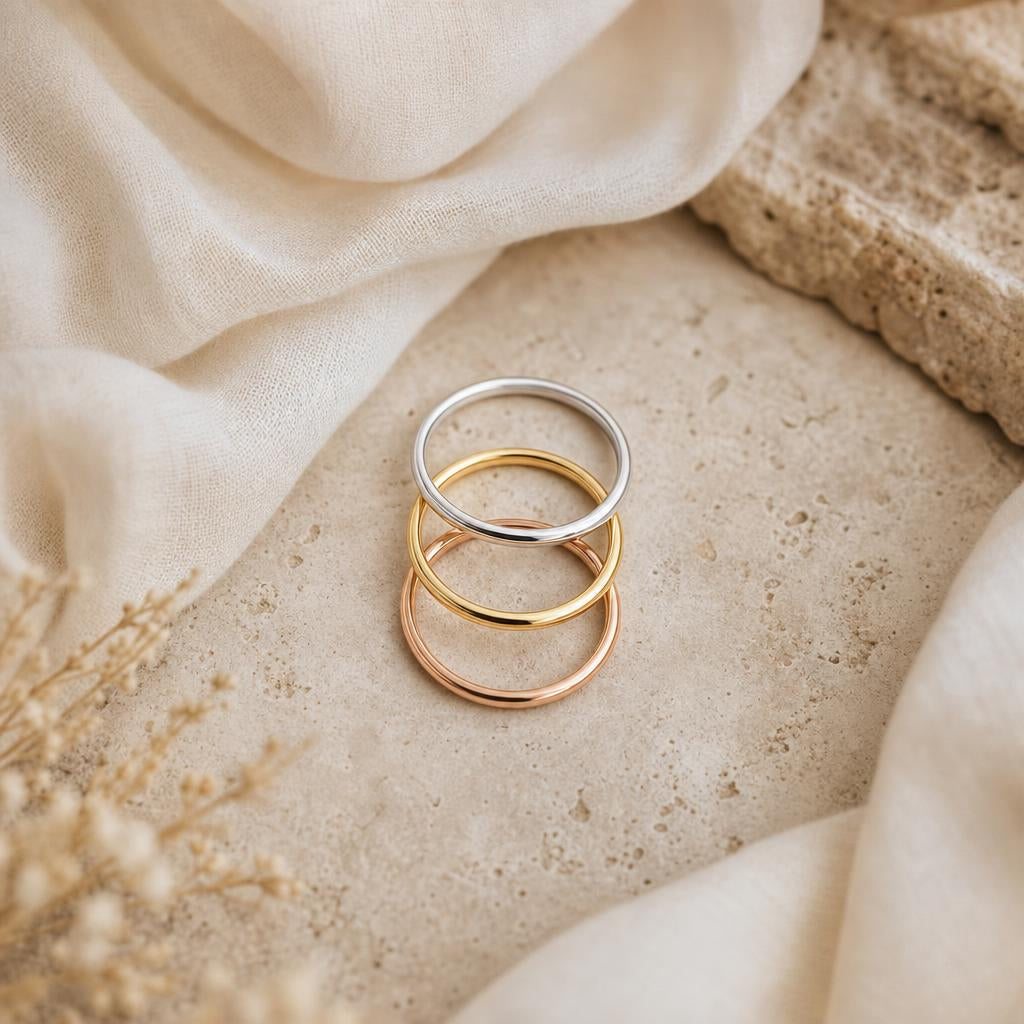
Mixing Metals in Your Ring Stack: Does Your Wedding Band Have to Match?
There's an old rule about wedding jewelry that nobody actually voted on: your wedding band has to match your engagement ring, down to the exact shade of gold. Somewhere along the way that rule stopped making sense — and the women building the best-looking stacks right now are the ones who stopped following it first.
Mixing metals in an engagement ring and wedding band stack isn't a workaround or a compromise you settle for. Done with a little intention, it's the difference between a stack that looks put together over years and one that looks like it arrived in a single box and never changed.


The Rule You Were Taught, and Why It's Worth Breaking
Somewhere in the last century, "your wedding set should match" became treated as a law of physics instead of what it actually is: a merchandising convention. Jewelry stores sold rings in pairs because pairs were easier to sell — one trip, one decision, one card swiped. It was never a rule about what actually looks good on a hand.
You've likely already noticed the metal on your engagement ring and the metal you're drawn to for a wedding band aren't always the same. Maybe your engagement ring is platinum and every band you keep circling back to is warm yellow gold. That's not a problem to solve. It's information about your taste, and it's worth trusting.
What Mixing Metals in a Ring Stack Actually Means
Mixing metals jewelry, in the context of a ring stack, isn't about throwing every finish you own onto one hand and hoping for the best. It's a specific, controllable styling choice with two main versions.
Warm Against Cool
This is the version most people picture first: a platinum or white gold engagement ring next to a yellow or rose gold band, or the reverse. The contrast is the whole point — each metal reads more distinctly because of what's sitting beside it. A platinum solitaire looks cooler and brighter next to warm gold; a rose gold band looks warmer and softer next to platinum.
Same Undertone, Different Finish
The quieter version: yellow gold paired with rose gold, or two platinum pieces with different textures — one polished, one with pavé detail. Both metals sit in the same warm or cool family, so the effect is subtle rather than a statement. This is the easier entry point if you're used to a matched set and want to test the waters before committing to a high-contrast pairing.
Worth knowing: Neither version is more "correct" than the other. High contrast reads as confident and current; same-family mixing reads as quiet and considered. The only wrong version is one you didn't actually choose on purpose.
Three Ways to Make a Mixed Stack Look Deliberate
The difference between a stack that reads as styled and one that reads as accidental usually comes down to three habits, not talent.
Let one metal lead. Pick the tone you want to dominate — often whatever your engagement ring already is — and let it make up most of what's on your hand. A second metal works best as the accent, not an equal partner. Two rings in a 50/50 split tend to fight each other; one dominant tone with a supporting second reads as intentional.
Repeat every metal you introduce. A single rose gold band next to an all-platinum stack can look like a mistake. Two smaller touches of rose gold — a slim band plus a rose gold detail elsewhere in the setting — tell the eye it was a choice, not an oversight.
Use one ring as the bridge. A band that already combines two metals — say, a platinum shank with warm pavé detailing — does the connecting work for you. It sits between your other pieces and makes the transition from one tone to the next feel built-in rather than abrupt.

The Petal Ring
A marquise-inspired stacking band that works as a soft rose gold accent next to a platinum or white gold engagement ring — enough presence to register, not enough to compete.
Shop The Petal Ring →Does Stacking Different Metals Actually Damage Anything?
This is the question underneath most of the hesitation, and it deserves a straight answer: no. Sterling silver, rhodium plating, and gold plating don't react with each other, discolor each other, or degrade each other through contact. Two rings worn on the same finger can rub against one another over years of daily wear, and that friction can create light surface marks — the same cosmetic wear any ring develops from being worn at all, mixed metals or not. It polishes out. It isn't structural, and it isn't a reason to keep two rings you love sitting in separate boxes.
The honest limit isn't durability — it's fit. A wide band and a narrow band sit differently against each other than two bands of matching width, so if you're stacking a wedding band directly against your engagement ring, check the profile and width before you check the metal. That's a sizing and silhouette question, not a mixing-metals one.

The Forever Ring
A half-eternity pavé band in warm 18k gold plating, built to sit as a dominant lead metal or a bridge piece between a platinum ring and a rose gold accent.
Shop The Forever Ring →Metal Combinations That Actually Work Together
If you're staring at your ring and a stack of options with no idea where to start, a few combinations show up again and again for a reason — they're genuinely easy to wear, not just trend-driven.
Platinum with warm gold. The classic high-contrast pairing. A platinum or white gold engagement ring next to a yellow gold band makes both metals look more distinct — the platinum reads brighter and cooler, the gold reads warmer and richer. This is the combination most people picture when they think "mixed metals," and it's popular because the contrast does the work for you.
Rose gold with yellow gold. Two warm tones from the same family, close enough in undertone that the pairing feels soft and cohesive rather than bold. If a full platinum-and-gold contrast feels like too much of a statement, this is the gentler version of the same idea.
One metal, mixed finish. Sometimes the simplest way in is to stay within a single metal color and vary the setting instead — a smooth polished band next to a pavé-textured one. You get the visual depth of "mixed" without introducing a second tone at all, which is a low-risk way to build confidence before you commit to true contrast.
None of these is more correct than the others, and this article's own research pulled up the same conclusion from stylists and jewelers across the board: the successful mixes all share deliberate contrast rather than an accidental clash. What separates a stack that looks styled from one that looks like a drawer of loose rings usually comes down to whether the pairing looks chosen.
How to Build Your First Mixed-Metal Stack
Start with what you already have on your hand — your engagement ring is your anchor whether you planned it that way or not. Choose one band in a contrasting or complementary tone and wear the two together for a week before adding anything else. You'll know quickly whether you want more contrast or less.
Resist the urge to solve the whole stack in one purchase. The stacks that look most considered are almost always built one ring at a time, over months or years, which is exactly why they don't look like a matched set from a display case. And if a future ring doesn't match what you already own — that's not a problem to fix. It's the stack working the way it's supposed to.
Quick Takeaways
- Your wedding band matching your engagement ring's metal exactly is a convention, not a rule — mixing metals is a legitimate, deliberate styling choice.
- Let one metal dominate the stack and use a second as an accent, rather than splitting evenly between the two.
- Repeat any metal you introduce at least twice so it reads as intentional rather than a stray piece.
- Sterling silver, rhodium, and gold plating don't react or discolor against each other — the only real consideration is band width and profile, not metal type.
- Build a mixed stack one ring at a time rather than trying to finalize the whole look in a single purchase.
Frequently Asked Questions
Does my wedding band have to match my engagement ring's metal?
No. Matching sets are a retail convention, not a requirement. Plenty of the best-looking stacks pair a platinum engagement ring with a gold or rose gold band on purpose — the mix is the design, not an oversight.
Is mixing metals in a ring stack tacky?
Not when it's done with intention. Mixing metals only reads as tacky when it looks accidental — a single stray tone with nothing else to connect it. Repeat each metal at least once and let one tone lead, and a mixed stack reads as considered, not careless.
Will mixing metals damage my rings over time?
No. Sterling silver, rhodium plating, and gold plating don't corrode or discolor from contact with each other. Rings worn together on the same finger can develop light surface wear from friction, exactly like any ring worn daily — it's cosmetic, and it polishes out.
What's the easiest way to start mixing metals in a stack?
Add one band in a contrasting or complementary tone to the ring you already wear daily, and live with just those two for a week or two. Most women find they instinctively know whether they want more contrast or less before they add a third piece.
The matching-set rule was never really about how a ring looks on your hand — it was about how easy a ring was to sell in a box. Once you stop treating your stack as something that has to be finished and matched on day one, mixing metals stops being a risk and starts being the most honest way to build a collection that actually looks like you.


