

Men's Ring Sizing vs Women's: Why the Numbers Don't Always Mean the Same Thing
Ask a woman her ring size and she'll usually say a number between 5 and 8. Ask a man, and it's almost always somewhere between 9 and 13. It's tempting to assume there must be two different sizing systems at play — a "men's scale" and a "women's scale" — but there isn't. The numbers come from the exact same measuring system. What actually changes is everything around the number: the width of the band, the shape of the hand it's built for, and the assumptions a jeweler makes about who's buying.
That gap causes real confusion the moment sizing crosses gender lines — a partner buying his own wedding band from a site built around engagement rings, a woman ordering a signet-style ring designed with a man's knuckle in mind, or a couple simply comparing notes and wondering why "size 9" sounds enormous to one of them and completely normal to the other. Here's what's actually going on, and what to check before you order.


There's only one sizing scale — not two
The US ring sizing system runs on a single continuous scale based on the internal circumference of the ring, typically from about size 3 up through size 16 and beyond. A size 8 ring is the same internal measurement whether it's marketed toward a man or a woman. There's no separate "men's size 8" that's secretly larger. If you and a partner both wear a size 9, your rings are — dimensionally — identical on the inside, regardless of style.
What creates the impression of two different systems is statistical, not structural. Ring sizes around the world already vary enough to cause confusion even within one gender — add in the average difference between men's and women's finger circumference, and the mismatch becomes obvious. Most adult women land somewhere between US 5 and 7.5. Most adult men land between US 9 and 12. Retailers built around one audience simply stock the range their customers actually need, which is why a site full of engagement rings rarely carries anything below a 4.5, and a men's band retailer rarely carries anything under an 8.
Worth knowing: The overlap zone — roughly US 7 to 9 — is where sizing confusion happens most often. Plenty of women wear an 8, and plenty of men wear a 9, so "average" size assumptions break down exactly in the range where a lot of real hands actually sit.
Band width changes how a size actually fits
This is the part that trips people up most: two rings in the identical size can fit differently depending on how wide the band is. A thin 1.5mm band and a chunky 8mm band, both stamped "size 7," will not sit the same way on the same finger. The wider the band, the more surface area it displaces against the knuckle, which means a wide band in your usual size will typically feel tighter going over the knuckle than a slim one — even though the internal circumference is technically identical.
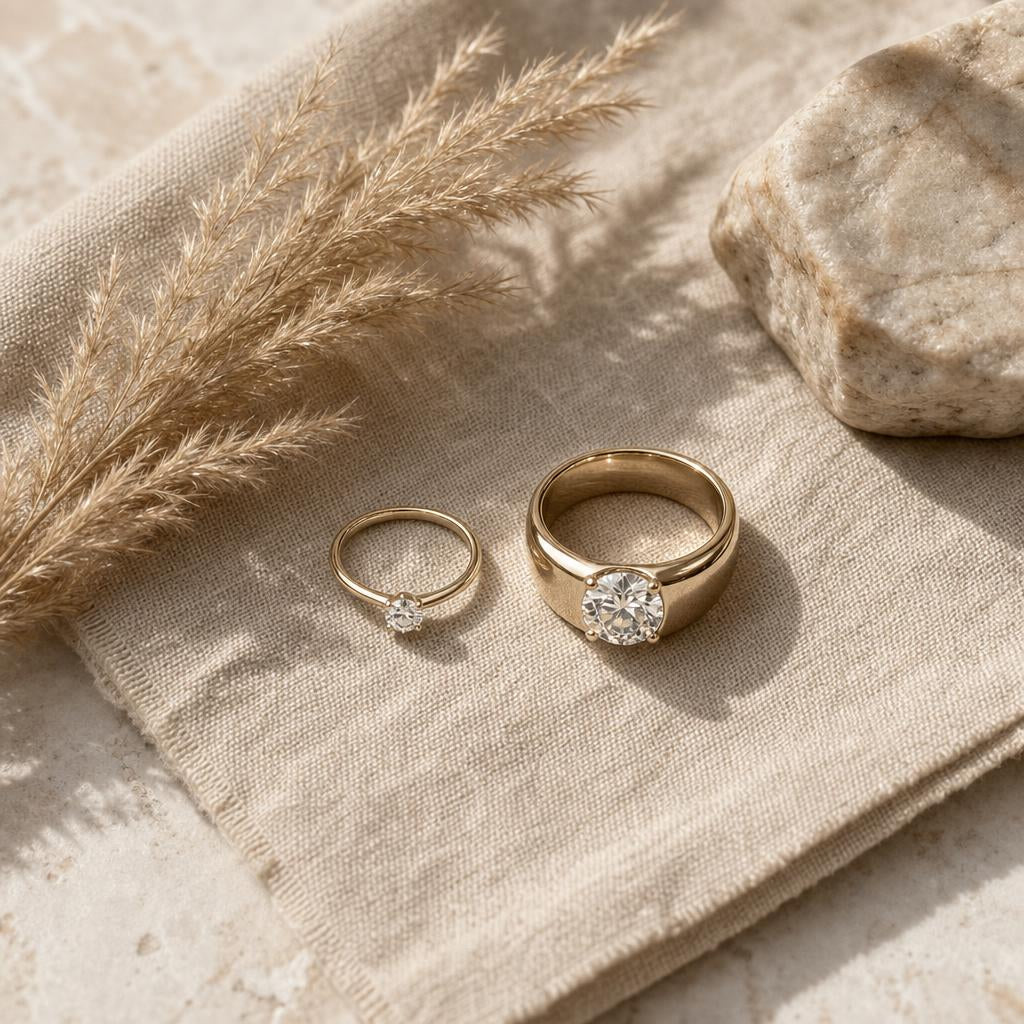
This matters specifically across the men's-versus-women's line because of a style convention, not a biological one: women's fashion and engagement rings trend toward slimmer bands (1.5mm–3mm), while men's bands — wedding bands, signet styles, statement pieces — trend toward 6mm and up. If you're used to a slim silhouette and try on a wide band for the first time, sizing up half a size is common. The reverse is also true: someone used to wearing wide bands may find a delicate ring feels loose at their "usual" size.

The Échelon Ring
A clean, structured Asscher-cut solitaire with a smooth band — a shape that reads well on any hand, regardless of who's shopping for it.
Shop The Échelon Ring →Knuckle-to-base ratio isn't a gendered trait
One myth worth retiring: the idea that men "just have bigger knuckles" as a rule, so their rings need more room to clear the joint. In reality, the gap between knuckle width and finger-base width varies enormously person to person and has far more to do with individual hand structure than gender. Some men have a minimal gap and can wear a snug, close-fitting band comfortably. Some women have a pronounced knuckle and need real room to get a ring on and off, especially with a wider style. The mismatch between knuckle size and finger base is its own sizing conversation, and it applies just as often to a man buying his first signet ring as to a woman sizing an eternity band.
The practical takeaway: don't size based on assumptions about "how men's hands work" or "how women's hands work." Size based on the actual hand in question, at the actual time of day, accounting for the actual band width you're planning to buy.
Comfort fit matters more once you cross into wider bands
Comfort fit — where the interior of the band is gently rounded rather than flat — has historically been marketed almost exclusively toward men's wedding bands, because wider bands are where the difference is most noticeable. A flat-interior 8mm band grips more of the finger than a domed-interior 8mm band in the same nominal size, which is why comfort fit versions are often sized slightly differently than their standard-fit counterparts from the same collection.
This isn't actually a men's-only consideration. Any wide band — a statement cocktail ring, a wide stacking piece, an eternity band worn daily — benefits from the same comfort fit logic regardless of who's wearing it. If you're buying a wider style for the first time, whichever gender the ring is marketed toward, ask specifically whether it's offered in comfort fit and size accordingly.
✦ Pro tip: If you're moving from a slim, standard-fit ring into a wider comfort-fit style, don't assume your usual number carries over exactly. Get remeasured in person if you can, or size up half a step as a starting point and confirm with a printable sizer at home.
Buying across the gender line — sizing a gift with confidence
The most common real-world version of this problem isn't abstract — it's a partner trying to buy a ring for someone whose hand they haven't formally measured. A woman ordering a signet ring for her partner needs to think in the 9–13 range and expect a considerably wider band than she's used to shopping for herself. A man ordering an engagement or stacking ring for a partner needs to think in the 5–8 range and expect a noticeably slimmer band than anything in his own jewelry box. Neither direction is intuitive if the only reference point you have is your own hand.
Men buying an engagement ring for the first time run into this constantly — the instinct is to guess based on what feels "about right" using their own finger as a mental reference, which almost always overshoots. The safest approach in either direction is the same: borrow a ring she or he already wears on the correct finger, trace or measure the inside diameter, and match it to a printable chart rather than guessing from feel.

The Regent Ring
A princess-cut center with a halo and milgrain detailing — a fuller, more intricate silhouette worth sizing carefully given its wider profile at the crown.
Shop The Regent Ring →Resizing: what actually changes based on style, not gender
Resizing difficulty comes down to construction, not who the ring was designed for. A plain band resizes easily in either direction. A ring with stones set close to the shank, a full eternity band, or a heavily engraved pattern that runs around the entire circumference resizes with real limitations — sometimes only in one direction, sometimes not at all without disturbing the design. This is equally true of a men's eternity-style wedding band and a women's full pavé eternity ring; the constraint is structural, not stylistic-by-gender.
If a ring is being bought as a gift and there's any doubt about the exact size, choosing a style with an easily resizable plain or half-set band is the safer call — for a man's band just as much as for a woman's ring.
Quick Takeaways
- There is one universal ring sizing scale — the "men's vs women's" difference is about average size ranges and band width conventions, not a different measuring system.
- Band width changes how a given size fits — wider bands need more room over the knuckle than slim bands in the same nominal size.
- Knuckle-to-base mismatch is an individual trait, not a gendered one — measure the actual hand, not an assumption about it.
- Comfort fit matters most once you're buying a wider band, regardless of who it's marketed toward.
- When buying across the gender line, measure an existing ring rather than guessing from your own hand.
- Resizing limits come from the ring's construction — full eternity and heavily set styles are harder to resize either way.
FAQ
Is there an actual difference between men's and women's ring sizes?
No — both use the same US sizing scale based on internal circumference. The perceived difference comes from average finger size ranges and the band widths typically sold to each audience, not a separate measurement system.
Why does a size 9 feel huge for a woman but normal for a man?
Because it's genuinely above the average range most women fall into (roughly 5–7.5) and squarely within the average range most men fall into (roughly 9–12). The number itself means the same thing for both — it's just an uncommon size for one group and a common one for the other.
Do men's rings really need wider bands, or is that just convention?
It's convention rather than a physical requirement. Plenty of men wear slim bands and plenty of women wear wide statement pieces comfortably. The width difference is a style trend across the market, not a rule tied to anatomy.
Should I size up if I'm buying a wider band than I'm used to?
Often, yes. A wide band in your usual number can feel tighter over the knuckle than a slim one, so many people size up a half step when moving from a delicate ring into a wider style — this applies regardless of which audience the ring was designed for.
What's the best way to size a ring as a surprise gift for someone whose hand I can't measure directly?
Borrow a ring they already wear on the intended finger, trace or measure its inside diameter, and match it against a printable sizing chart. This works in either direction — sizing for a partner's hand much larger or much smaller than your own.
Do comfort fit bands run differently than standard fit in the same size?
Sometimes, slightly. Because the domed interior of a comfort fit band displaces less surface area against the finger, it can feel a touch looser than a flat-interior band marked with the same number. It's worth trying both if you're between sizes.
The real lesson buried in all of this is that "size" was never the gendered part. A ring is a fixed internal circumference wrapped in a design choice — and the design choice is what makes two identical numbers feel like two different things. Measure the hand you're actually buying for, account for the width of the band you've chosen, and the number will do exactly what it's supposed to do, no matter whose finger it's going on.


