

Knuckle Size vs Finger Base: The Sizing Mismatch Nobody Explains Before You Buy
You slide the ring on, it catches at the knuckle, and for a second you brace for it not to make it over at all — then it does, and promptly spins loose at the base like it belongs to someone else's hand entirely. If that sounds familiar, you don't have a sizing problem so much as a knuckle-base mismatch, and it's one of the most common — and least explained — reasons a ring never quite feels right.
Most sizing charts assume your knuckle and the base of your finger are roughly the same width. For a lot of hands, they're not — sometimes by half a size, sometimes by a full size or more. Before we get into why that happens and what actually helps, here are a few styles worth knowing about if you're shopping with this exact problem in mind.


Why Your Knuckle and Your Finger Base Aren't the Same Size
Your finger isn't a cylinder — it's closer to an hourglass with a joint in the middle. The knuckle is bone and cartilage close to the surface, so it doesn't compress the way soft tissue does. The base of your finger, just above your hand, is mostly soft tissue over a narrower bone structure, which means it can be noticeably slimmer than the knuckle sitting just above it. On most hands the difference is small enough that a standard ring size splits the difference comfortably. On others — often hands with more prominent joints, hands that have done a lot of manual work over the years, or simply hands built that way from the start — the gap is wide enough that no single size actually works for both parts.
This is different from a ring simply being "the wrong size." A true mismatch means there is no size that solves both problems at once: go small enough to stop the base from spinning, and the ring won't clear the knuckle at all. Go large enough to pass the knuckle comfortably, and the ring rotates and slides at the base the moment your hand relaxes.
Worth knowing: A knuckle-base mismatch isn't a flaw or something wrong with your hand — it's simply how a meaningful percentage of hands are built. It becomes a problem only when the ring style doesn't account for it.
How to Tell If You Have a Mismatch
The clearest sign is a ring that behaves in two different ways depending on where it sits. If a ring goes on with real resistance at the knuckle but then swims freely once it's past — spinning so the stone ends up facing your palm, sliding down toward your fingertip when your hand hangs at your side — that's a mismatch, not a fluke of one particular ring.
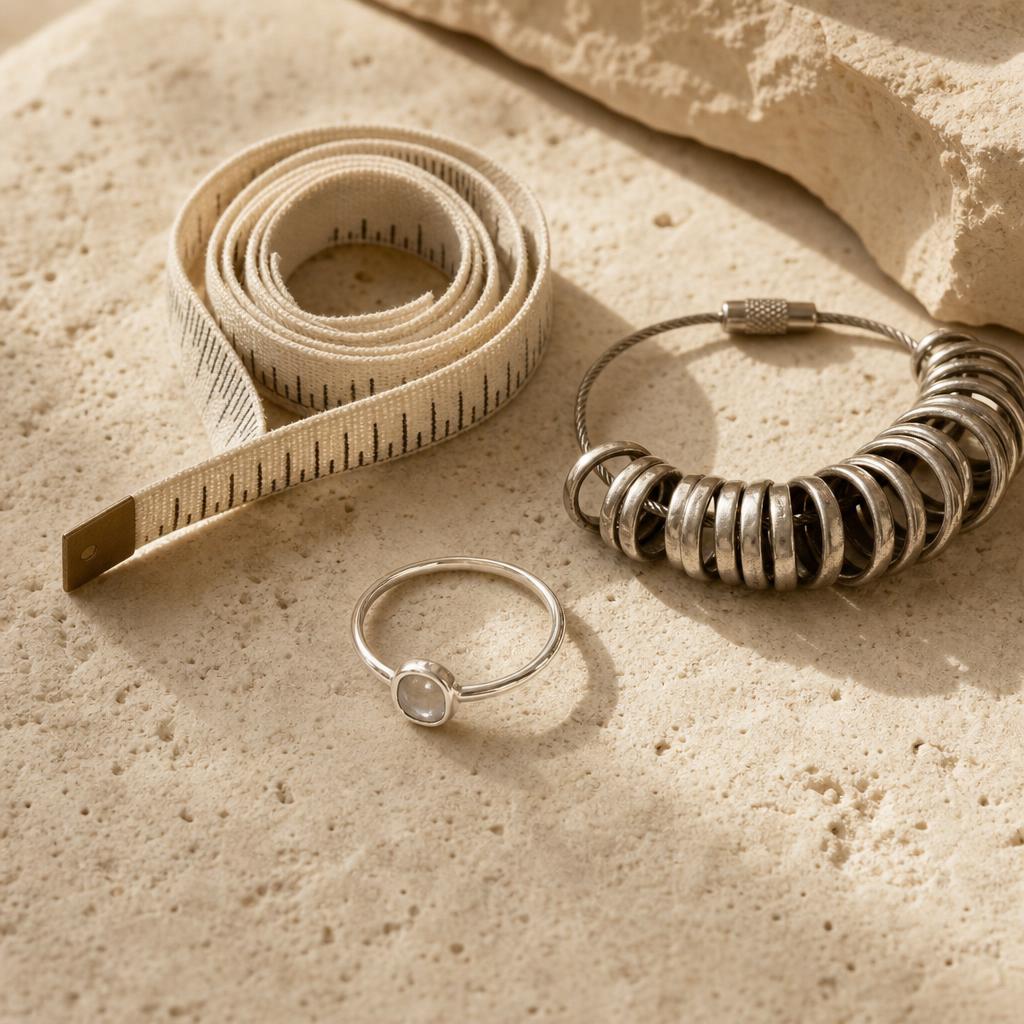
A simple way to check: measure your knuckle by wrapping a strip of paper or a fabric measuring tape snugly around the widest part of the joint, and measure the base of your finger the same way, about half an inch below the knuckle. If the two measurements land more than roughly one US size apart, you're working with a genuine mismatch rather than an in-between sizing question. It's also worth measuring at the end of the day rather than first thing in the morning — knuckles tend to be at their most swollen size by evening, which gives you a more realistic worst-case number to plan around.
✦ Pro tip: If you're between the two measurements and unsure which way to lean, size for the knuckle rather than the base. A ring that's slightly loose at the base can usually be managed with a guard or spacer — a ring that won't clear your knuckle can't be worn at all.
Which Ring Styles Actually Work With a Mismatch
Setting height and band profile matter more here than most buyers expect. A ring with a tall, domed setting or sharp prongs adds bulk exactly where your knuckle already has the least room to spare, which makes the "getting it over the joint" problem worse before it even gets to the base-fit problem. Lower-profile settings — bezel-set stones, flush or near-flush eternity bands, and hidden halo designs that keep the visual height close to the finger — tend to clear the knuckle more easily for a given size, because there's simply less structure standing proud of the band.
Band width plays a role too, though not in the direction most people assume. A slightly wider band can actually help with a mismatch, because it distributes contact across more of the finger rather than concentrating it at one narrow point — which is part of why a full eternity band often feels more secure at the base than a thin solitaire shank, even at the same nominal size.

The Devotion Ring
A continuous circle of baguette-cut stones set flush against the finger, with no raised prongs to catch on the way over a knuckle. The smooth, low profile makes it one of the easier eternity styles to size around a mismatch.
Shop The Devotion Ring →Solitaires aren't off the table if a mismatch is mild — a rounded, low 4-prong setting like a classic solitaire can still work, particularly if you size closer to the knuckle measurement and accept a touch of base movement, which a ring guard can quietly correct later. What tends to fight you hardest is a tall cathedral or heavily domed halo in that scenario, since the added height at the top of the ring makes the knuckle clearance problem more pronounced for the exact size you'd otherwise want to wear.

The Forever Ring
A slim, shimmering eternity band that sits closer to the finger than a bulkier setting — a good option for a milder mismatch, or as a stacking piece layered against a ring that's already sized for your knuckle.
Shop The Forever Ring →Getting Sized When You Have a Mismatch
If you're shopping online without the option to try a ring on first, plan around the knuckle measurement and treat the base fit as something you'll fine-tune afterward, not something to compromise the initial size for. A ring that's a hair loose at the base is a five-minute fix. A ring that won't pass your knuckle is a returns-and-reorder situation.
Ring guards and spacers — the small silicone or metal inserts that sit on the underside of the band — are the most common fix for a ring that clears the knuckle but rotates or slides at the base. They're inexpensive, reversible, and specifically designed for exactly this scenario, which makes them a better first move than sizing an entire ring down and fighting the knuckle every time you put it on or take it off. For a more permanent solution, a jeweler can add small beads of metal to the inside of the band at the base — enough to snug the fit without touching the size needed to clear the knuckle.
| Situation | What tends to help |
|---|---|
| Mild mismatch (roughly a quarter to half size) | Size to the knuckle; expect slight base movement, correct with a guard if needed |
| Moderate mismatch (around one full size) | Choose a lower-profile or bezel-set style; add a guard or spacer at the base |
| Pronounced mismatch (more than one size) | Prioritize flush-set, low-profile styles; consider a jeweler-fitted internal sizing bead |
| Mismatch that changes seasonally | Keep a removable guard on hand rather than resizing the ring itself |
What to Avoid
The instinct to size down "just enough" to stop the spinning at the base is the most common mistake, and it usually backfires — either the ring stops clearing the knuckle at all, or it clears it with enough force that it's uncomfortable to remove, which over time can also stress the band itself. It's worth resisting the temptation to solve a structural mismatch with sheer force; the fix belongs at the styling and hardware level, not the size number.
It's also worth being cautious with very tall or heavily embellished settings if your mismatch is on the larger side. They photograph beautifully, but the added height works directly against knuckle clearance, and buyers with a pronounced mismatch often end up happier — and more likely to wear the ring daily — in a setting that sits closer to the hand.
Quick Takeaways
- A knuckle-base mismatch means no single size perfectly fits both parts of your finger — it's a styling and hardware question, not just a sizing one.
- Measure both the knuckle and the base separately, ideally later in the day when swelling is at its highest.
- When in doubt, size to the knuckle — a loose base is easy to fix, a ring that won't pass the joint isn't wearable at all.
- Lower-profile, bezel-set, or flush eternity styles tend to clear a knuckle more comfortably than tall, domed settings.
- Ring guards and spacers are the simplest, most reversible fix for a ring that fits the knuckle but moves at the base.
Frequently Asked Questions
Is a knuckle-base mismatch common, or is something unusual about my hand?
It's genuinely common — plenty of hands have a noticeable difference between knuckle and base width, and it has nothing to do with your hand being "wrong." It's simply a shape that some ring styles handle better than others.
Should I size a ring for my knuckle or the base of my finger?
Generally, size for the knuckle. A ring that's a touch loose at the base can be corrected with an inexpensive guard or spacer, while a ring that won't clear the knuckle can't be worn regardless of how well it fits lower down.
Do ring guards actually work, or are they a temporary patch?
For most mild-to-moderate mismatches, they work well and can be worn indefinitely — they're not just a stopgap. Many people use them permanently rather than ever resizing the ring itself.
Does ring style really change how a mismatch feels, or is that overstated?
It makes a real difference. Lower-profile and flush-set styles clear the knuckle more easily at a given size than tall, domed settings, so the same degree of mismatch can feel like a non-issue in one style and a daily annoyance in another.
Can a jeweler permanently fix a knuckle-base mismatch?
Often, yes. A jeweler can add small sizing beads to the inside of the band near the base, tightening that part of the fit without changing the size needed to clear the knuckle — a more permanent alternative to a removable guard.
The truth is, most rings aren't sized wrong — they're just sized for an average that doesn't describe every hand, including plenty of very ordinary ones. Once you know whether you're working with a knuckle-base mismatch, the fix stops being a mystery and becomes a fairly simple set of choices: measure both points, lean toward the knuckle, and choose a style built to sit close to the hand. The right ring, on the right hand, should disappear into the background of your day — not remind you it's there every time you move.


