

6 Things Men Get Wrong When Buying an Engagement Ring (and How to Avoid All of Them)
Most partners get the proposal exactly right — the setting, the words, the moment. What they get wrong, far more often than anyone admits, is the ring itself. Not for lack of care, but because no one ever explained what actually matters when you're standing in front of a glass case (or, more likely, scrolling alone at midnight) trying to make a decision that feels enormous.
These are the six mistakes that come up again and again — and the specific, practical things that make each one completely avoidable.


Mistake 1: Buying for "women in general" instead of her specifically
The most common misstep isn't a bad choice — it's a vague one. Many partners buy the ring that looks objectively beautiful in the display case, or the one a friend's fiancée wore, or the style that's currently everywhere on Instagram. The problem is that none of those are her.
Before you look at a single ring, spend time observing what she actually wears. Does she gravitate toward delicate, minimal pieces? Does she layer bold jewelry? Is every ring she owns gold, or always silver? Does she prefer clean geometric lines or something more romantic and detailed? These are not minor details — they're the entire brief.
If you can't answer these questions with any confidence, that's useful information. It means you should look harder before you shop. Take note of the rings she admires when you're out together, which posts she saves, which jewelry she reaches for when dressing up. The pattern will become clear if you pay attention to it.
Worth knowing: The most common regret partners report isn't "I spent too much" or "I got the wrong size." It's "I bought what I thought was beautiful, not what I actually know she loves." Style is personal. Her personal.
Mistake 2: Guessing the ring size
Of all the mistakes on this list, this is the one most likely to turn a perfect moment into an awkward one. A ring that doesn't fit can't be worn — and having to immediately return a ring for resizing, or visibly struggling to get it onto her finger, changes the emotional tone of that moment in ways that are hard to quickly recover from.
Getting her ring size without asking directly is genuinely possible. If she already wears rings, find one she wears on her ring finger and trace the inside of it on paper, or press it gently into a piece of soap to capture the diameter. Ask a close friend or sibling — they may already know, or be willing to find out in a natural-feeling way. If you truly can't get the measurement, buy slightly larger rather than smaller: a ring that slides on easily can be resized down, but a ring that won't pass the knuckle can't be worn at all. For more methods, see our guide on how to find her ring size without asking.
✦ Pro tip: Gemiros rings come in US sizes 5 through 9. US 7 is the most common size for women who don't know their exact measurement. If you're completely stuck, it's the safest starting point — but try to get the actual measurement first.
Mistake 3: Ignoring the setting type
Most partners focus entirely on the stone: the shape, the size, how much it sparkles. The setting — the metal framework that holds the stone — often gets almost no attention. This is a significant oversight, because the setting determines the ring's character, its wearability, and in many cases whether she can wear it comfortably every day.
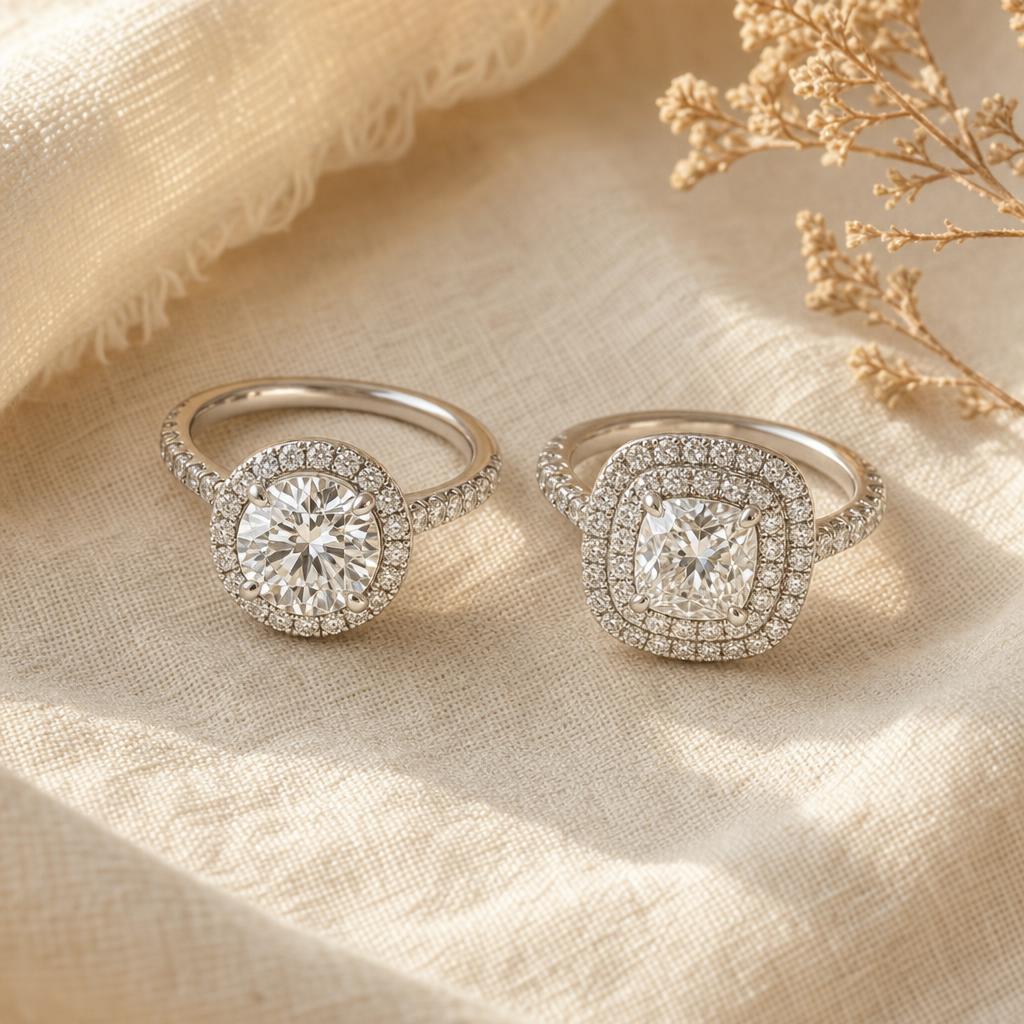
A prong setting (the classic option, with thin metal claws holding the stone) shows off the stone brilliantly but can snag on hair and fine fabric. A bezel setting (where a rim of metal encircles the stone) is sleeker, more modern, and far more practical for active lifestyles. A halo setting (a ring of smaller stones encircling the centre stone) maximises visual impact — the stone looks dramatically larger — but adds detail that suits some aesthetics and not others.
Think about her lifestyle. Does she work with her hands, garden, or exercise with jewelry on? A pavé-band halo ring is gorgeous but more delicate. A solitaire or a vintage-band setting is simpler and more robust. Neither choice is objectively better — but one will suit her life more than the other.

The Beatrice Ring
A brilliant round-cut simulated diamond in a classic setting, elevated by an intricate vintage-style pavé band that adds extraordinary detail without overshadowing the centre stone. For the partner who appreciates craftsmanship that rewards a closer look — and who prefers something with real character over something merely conventional.
Shop The Beatrice Ring →Mistake 4: Choosing a stone shape based on size alone
Bigger is not always better — and this is a truth the industry has never been especially motivated to share. The shape of a stone determines not just how large it appears, but how it sits on the hand, how much light it captures, and whether it suits the proportions of her specific fingers.
Elongated shapes — oval, pear, marquise, emerald cut — visually lengthen the finger and make stones appear larger than their carat weight would otherwise suggest. A 2ct oval looks noticeably larger face-up than a 2ct round brilliant. For partners who want maximum visual impact, shape choice is actually the most powerful lever available — more so than carat weight.
A round brilliant cut is the most versatile: it flatters almost every finger shape and complements every metal tone. Cushion cuts are soft and romantic. Radiant cuts are bold and architectural. Emerald and asscher cuts are sleek, step-cut, and decidedly modern in their aesthetic. None is objectively superior — but they signal very different aesthetics. Match the shape to her, not to whichever one caught your eye first.

The Empress Ring
A 3.5-carat elongated oval centre stone flanked by tapered baguette side stones — a shape that elongates the finger beautifully and delivers serious visual presence. The baguette accents add architectural contrast without competing with the centre stone for attention. For the partner who knows she wants something bold, elongated, and quietly powerful.
Shop The Empress Ring →Mistake 5: Overlooking the practical details
There are a few practical considerations that rarely appear in the romantic mental image of ring shopping, but that matter significantly once the ring is being worn every day.
Nickel sensitivity. A meaningful percentage of women experience nickel sensitivity — irritation, itching, or rashes from contact with certain metals. White gold often contains nickel. Sterling silver with rhodium plating typically does not. If she has ever mentioned that a watch clasp leaves a mark or a piece of jewelry makes her skin itch, she may be nickel-sensitive, and you should prioritise nickel-free materials. Gemiros rings are made from 925 sterling silver and are nickel-free, which makes them a practical and considerate choice for sensitive skin.
Metal tone. Yellow gold, white gold (or silver with rhodium plating), and rose gold don't complement every skin tone equally. Warm skin tones tend to glow with yellow and rose gold. Cooler or neutral skin tones often look most polished with white metal. Take notice of what she already wears — if every piece she owns is yellow gold, don't buy silver. Metal tone is one of the easiest things to get right if you're paying attention.
Profile height. A tall, dramatic ring that sits high above the finger looks spectacular in a flat lay photograph and considerably less convenient on the hand of someone who types all day, works with equipment, or is constantly catching it on things. A lower-profile setting or bezel-set stone is a thoughtful practical choice for active lifestyles — it's a sign of understanding, not of compromise.
Worth knowing: Gemiros rings are set in 925 sterling silver with either rhodium plating (white/silver finish) or 18k gold plating (yellow or rose gold), and are nickel-free. They're designed to look like fine jewellery and wear like it — a useful practical feature for someone who plans to wear her ring every day.
Mistake 6: Treating the proposal ring as a temporary placeholder
There's a persistent idea that the "real" engagement ring comes later — that whatever you propose with is merely a stand-in, and the proper ring will be chosen together once the shock has worn off. Sometimes this approach makes genuine sense. But it can also quietly undermine the proposal itself.
The ring you present at the proposal becomes part of the story. It's what she photographs minutes afterward, what she texts to her closest friends, what she wears for the days and weeks between the proposal and any eventual conversation about next steps. A ring that's clearly a placeholder can unintentionally communicate that you didn't quite try — even when the intention was simply to give her the freedom to choose what she loves.
There's a better path between "surprise ring I guessed on" and "we'll choose it together eventually." Choose a ring that is genuinely beautiful, that reflects what you actually know about her taste, and that she can wear with real pride — while remaining open to replacing it later if she wants something different. A well-chosen ring at the proposal is not a lesser version of the real thing. It is the real thing, chosen with care and intention.

The Camilla Ring
A brilliant round-cut simulated diamond in a halo setting, held by a gracefully twisted band that gives the ring real character without straying into anything difficult to wear. If she admires rings that have a distinctive detail — something worth looking at twice — the Camilla delivers it with composure and warmth.
Shop The Camilla Ring →A practical checklist before you buy
Before you click purchase or hand over a card, work through these five questions honestly:
- Do I know her ring style? Can I describe it in three words? If not, look more carefully before you shop.
- Do I have her ring size? Or failing that, have I bought slightly large with resizing in mind?
- Does this ring suit her lifestyle? Will she be able to wear it every day, or does the setting need to be more practical?
- Is the metal tone consistent with what she already wears? This one is easy to check and is frequently overlooked.
- Am I comfortable presenting this ring as it is — not as a stopgap? If the honest answer is no, reconsider the choice, not the rationale.
The Six Mistakes — Summarised
- Buying for a general aesthetic rather than for her specific, observable style
- Guessing the ring size instead of finding it out in advance
- Focusing only on the stone and ignoring the setting type entirely
- Choosing a stone shape for size alone, rather than for what works on her hand
- Overlooking practical details: nickel sensitivity, metal tone, profile height
- Treating the proposal ring as a placeholder rather than choosing something genuinely worth presenting
Frequently asked questions
What if I genuinely have no idea what style she likes?
Start with what she already wears — the pieces she reaches for most, not the ones she owns but rarely puts on. Look at the metal tones, whether there are stones and what shapes, whether her jewelry is dainty or bold. If she consistently wears delicate, minimal pieces, don't buy a statement ring. If every piece she owns is yellow gold, stay in that family. A close friend who shops with her regularly is also a valuable and discreet resource — most friends take this kind of confidence seriously.
How do I find out her ring size without ruining the surprise?
If she wears rings, find one she wears on her ring finger and trace the inside of it on a piece of paper, or press it gently into soap to capture the diameter. Alternatively, ask a close friend or sibling — they may already know, or can find it out naturally. If you can't get the measurement, buy slightly larger: a ring that fits easily can be resized down, while a ring that won't pass the knuckle creates the wrong kind of memorable moment.
Is a simulated diamond ring a real engagement ring?
Yes — the ring is real. The question is what the centre stone is made of, and that's a decision about materials and values, not about legitimacy. A simulated diamond ring uses a manufactured stone that looks identical to a mined diamond to the eye. Many couples choose them actively, for ethical reasons, for practical ones, or simply because the visual result is indistinguishable. The ring you give someone at a proposal is an engagement ring if it comes with that intention — the material doesn't change that.
Should I propose with a ring or choose it together afterward?
This depends on what you know about her. Some women have strong opinions about their ring and would genuinely prefer to choose it — in which case a beautiful, considered ring for the proposal, followed by a shopping trip together, is the right call. Others love the romance of being completely surprised and wearing whatever was chosen specifically for them. If she talks about rings she loves, saves images of specific styles, or has said she'd want to choose — those are clear signals. If she has never mentioned any preference, a thoughtful surprise is usually received exactly the way it was intended.
✦ ✦ ✦
Getting this right doesn't require knowing everything about diamonds or ring design. It requires knowing her — her style, her finger, her lifestyle, her taste in the things she actually wears. Start there, and the rest becomes a series of practical decisions rather than a high-stakes guess in the dark. The ring you choose with that foundation will mean more than any ring you chose without it.


