

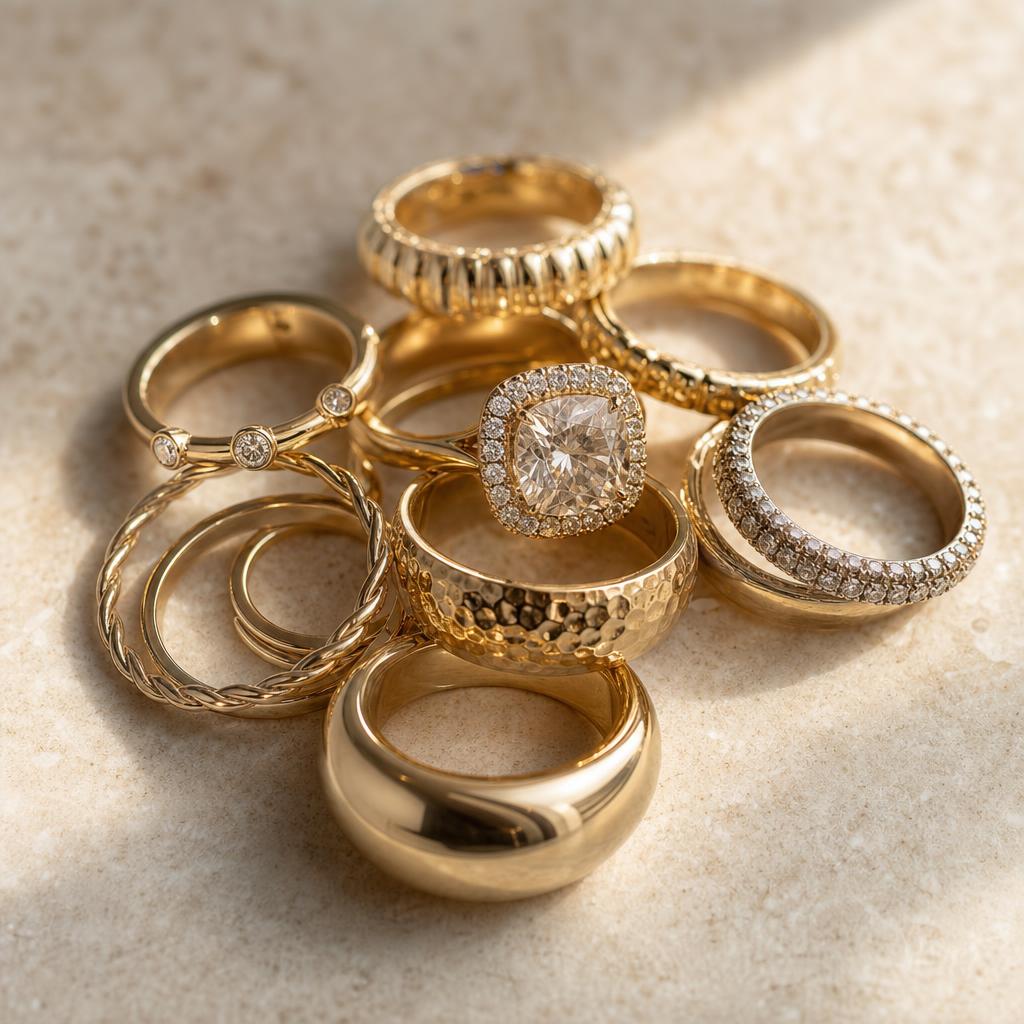
Maximalist Rings: How to Build a Bold, Layered Look Without the Costume Effect
There is a version of you that wears one thin band and calls it done. This is not about her. This is about the version who opens her jewelry box, looks at four rings, and thinks: why choose.
Maximalist rings are having a real moment — not a random pile-on of everything in the drawer, but a deliberate, curated kind of more. The difference between the two comes down to a handful of rules that are easy to learn and even easier to feel once you see them in practice. Here's where to start, plus the pieces we'd reach for first.


Why Maximalist Rings Are Having a Moment Right Now
For a long time, "tasteful" meant quiet. One ring, one metal, one stone size, worn like an apology. That rule was never really about taste — it was about not wanting to be looked at too closely. The maximalist approach flips that logic. It assumes you want to be looked at, and they're built to reward the second glance as much as the first: a hidden halo under a cushion cut, a row of pavé catching light along a band, a second ring doing exactly what the first one does, just slightly differently.
The shift tracks with something bigger than a trend cycle. Women who buy jewelry for themselves — not for an occasion, not for permission — tend to stop editing down once they realize nobody is actually grading them on restraint. A single Ophelia-style hidden halo already reads as more; a ring like the Duchess pushes that further with a halo inside a halo, so the sparkle has two places to come from instead of one. That's the whole maximalist argument in miniature: not louder for the sake of loud, but layered on purpose.
The Difference Between Maximalist and Costume
Here's the fear, said plainly, because it's the only thing standing between most women and a jewelry box they actually love: what if it just looks like a lot? The honest answer is that "a lot" reads as costume when it's random, and reads as maximalist when it's built. The rings themselves aren't the variable — a 3.5-carat cushion cut in 925 sterling silver and moissanite is indistinguishable from a mined diamond at that size, and it passes diamond testers the same as anything sitting in a case at three times the price. What actually separates a stack that looks expensive from one that looks like it fell out of a costume box is composition, not carat count.
Three things do almost all of the work. First, proportion — mixing genuinely different widths and heights instead of five nearly-identical bands that just crowd the knuckle. Second, a dominant metal tone, even in a mixed stack, so your hand has one clear story instead of three competing ones. Third, restraint somewhere in the stack — one plain band, one bare finger, one moment of quiet next to all the sparkle. Maximalist doesn't mean every ring is shouting. It means one or two rings are shouting and everything else is holding space for them.
How to Build a Stack That Reads as Intentional
Start with an anchor, not a lineup
Every maximalist ring stack needs one non-negotiable centerpiece — the ring the rest of the hand is arranged around. This is where a hidden halo does its best work: the Maxima or the Majesté both read as a single dramatic stone from across a room, then reveal the extra sparkle underneath once someone's actually holding your hand. Pick that ring first. Everything else gets built in relation to it, not next to it as an afterthought.
Layer with intention, not accumulation
Once the anchor is set, add texture before you add volume. A smooth polished band next to a pavé-lined one already reads as more without adding a third finger's worth of metal. Two eternity bands worn together is effectively a double stack ring, and it's one of the fastest ways to build visible layering without the stack getting heavy-handed — the sparkle compounds, but the silhouette stays clean. Add one more thin band and you're at the point most stylists treat as the ceiling before a single finger starts looking crowded instead of bold; past that, spread the extra rings to a neighboring finger instead.

Everlasting Ring
A continuous line of pavé simulated diamonds circling the entire band — the piece that does the most stacking work with the least effort, since it reads as bold from every angle instead of just the top.
Shop Everlasting Ring →Mix metals like you mean it
Rose gold and silver on the same hand used to be treated like a styling accident. It isn't — it's one of the fastest ways to make a stack look collected over time instead of bought in one order. The trick is ratio, not randomness: let one metal dominate at roughly 60% of what's visible, and let the second metal show up as an accent rather than an equal partner. A rose gold band worn next to two silver pieces reads as a deliberate warm note. Three metals fighting for the same real estate reads as indecision.

Infinity Ring — Rose Gold
Delicate pavé lines set in rose gold plating, built specifically to sit against silver pieces without clashing — the easiest single ring to add if your stack needs one warm note.
Shop Infinity Ring — Rose Gold →Give the eye somewhere to land
A stack with no focal point just looks busy, no matter how good each individual ring is. This is where a three-stone piece like the Empress earns its place — the elongated oval center with tapered baguette side stones already has visual hierarchy built into a single ring, so it can anchor an otherwise minimal hand or sit at the center of a fuller one without getting lost. If every ring in the stack is trying to be the star, none of them get to be.
Worth knowing: Building unique ring stacks is less about owning more rings and more about owning the right handful — three or four pieces that were chosen to work together will always read better than eight that were bought separately with no plan.
Leave one finger alone
Counterintuitively, the fastest way to make a full hand look intentional is to leave something bare. One empty finger — or one finger wearing nothing but a plain band — gives the eye a resting point between the busier fingers. If your ring finger already carries a triple stack ring, that's plenty of reason for the finger next to it to stay empty. Distribute weight across both hands too. A heavy stack on the right paired with a single quiet ring on the left reads as styled. The same heavy stack on both hands at once reads as trying too hard.
✦ Pro tip: Photograph your stack before you commit to wearing it out. Phone cameras flatten depth, which makes it easy to spot where a stack has gotten crowded in a way your eye skips over in the mirror.
What to Actually Buy First
If you're starting from nothing, resist the urge to buy the whole stack at once. Start with one anchor piece with real presence — a hidden halo cushion cut like the Maxima or Majesté does the heaviest lifting on its own, so you'll have a complete look even before the layering pieces arrive. Add one eternity-style band next for the double stack ring effect, then a second thinner band once you're ready to push toward three. Building slowly also means every new piece gets chosen in relation to what you already own, which is exactly the kind of intentional layering that separates a maximalist look from a drawer of rings that don't actually talk to each other.
Quick Takeaways
- A stack reads as expensive when it's built with proportion, a dominant metal tone, and one moment of restraint — and as a lot only when it's random.
- Pick one anchor ring first, then layer texture and metal around it — don't buy the whole stack at once.
- Layer two eternity bands for instant depth; a third thin band is usually the ceiling before a single finger starts looking crowded.
- Keep one metal dominant at roughly 60% of the stack, and leave at least one finger quiet to give the eye somewhere to rest.
Frequently Asked Questions
Are maximalist rings still in style?
Yes — the shift toward self-purchased, statement-first jewelry has only grown, and this look sits right at the center of it. What's changed is the execution: today's version is built with intention (proportion, a dominant metal, a clear anchor piece) rather than piled on without a plan.
How many rings should I stack for a maximalist look?
Three to five rings across both hands is the general range most stylists land on. On a single finger, two rings reads as layered, and three is usually the ceiling before it starts to look crowded — past that, spread the extra pieces to a neighboring finger.
Which finger should I start a stack on?
There's no strict rule, but the ring or middle finger tends to carry a stack best since it has the most length to work with. Build your anchor piece there first, then let thinner bands spread outward to the index or pinky if you want the look to extend across the whole hand.
Can I mix gold and silver in the same stack?
Yes, and it's one of the easiest ways to make a stack look collected rather than matched off a shelf. Keep one metal dominant at around 60% of what's visible so the second tone reads as an accent, not a competing statement.
How do I keep a full hand from looking cluttered?
Give the eye a resting point — one bare or quiet finger, and one clear anchor ring the rest of the stack is arranged around. A stack with a hierarchy always reads as styled; a stack where every ring is competing for attention reads as cluttered, regardless of how nice each individual piece is.
The women who wear this well aren't the ones who own the most rings — they're the ones who know exactly why each one is there. Start with a piece that can stand alone, add with intention, and let the rest of the stack earn its place on your hand the same way the first ring did.


