

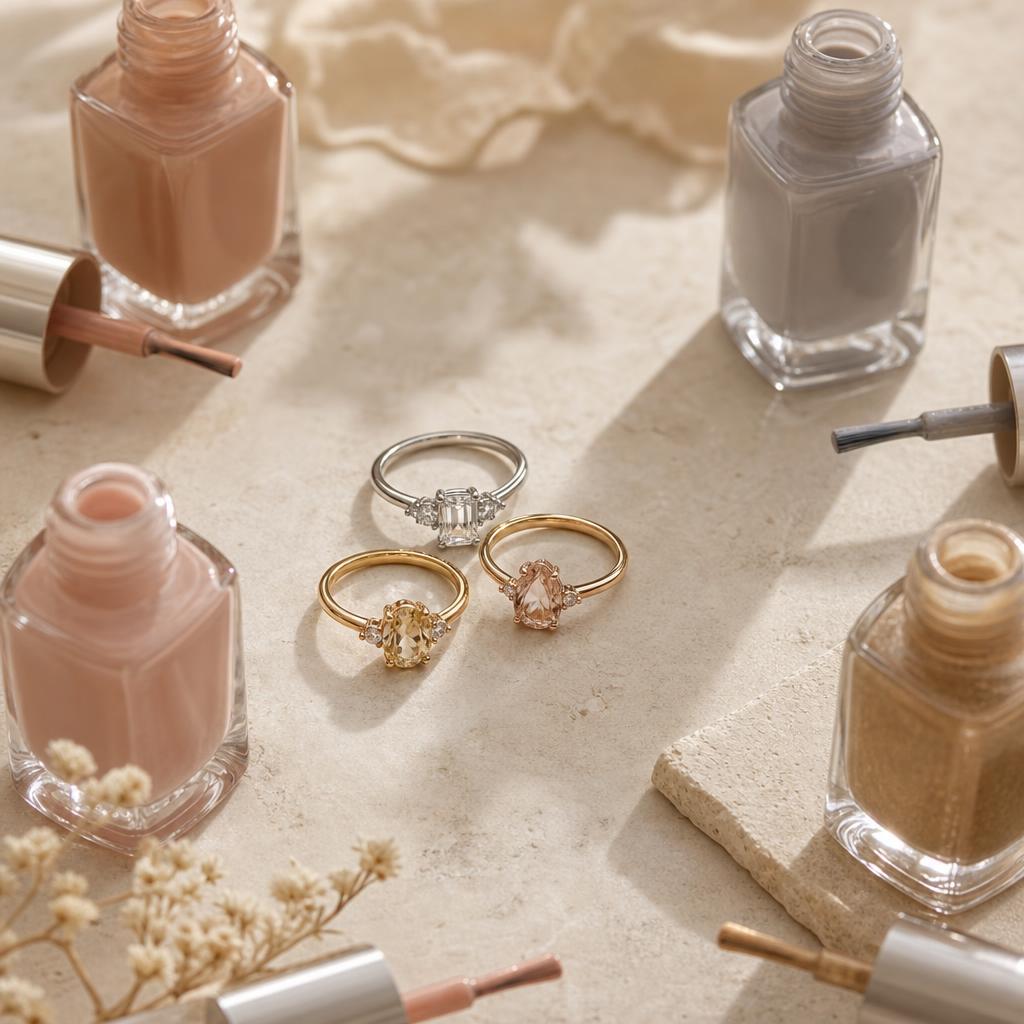
Matching Your Ring to Your Nail Polish, Not Just Your Outfit
You've spent an embarrassing amount of time matching your nail color to your outfit. To the season. To your mood, even. But the one pairing most women skip — the one that actually changes how your hand reads at a glance — is the relationship between your polish and your ring.
Metal tone and nail color aren't decorative afterthoughts. They're the two things anyone looking at your hand actually notices, and when they're working against each other, even a beautiful ring can look like it landed there by accident. Get the pairing right, and the whole hand reads as considered — like you knew exactly what you were doing before you left the house.


Why Metal Tone Matters More Than Polish Color
Start here, because it reorders the whole decision: your ring's metal tone is fixed. Your polish changes every one to two weeks. So the smarter question isn't "what ring goes with this polish" — it's "what family of polish colors makes the ring I already wear look intentional." Once you know your ring's undertone, choosing polish stops being guesswork and starts being a formula you can repeat.
Sterling silver and rhodium-plated pieces run cool — they sit closer to white and blue on the color wheel. Warm 18k gold plating leans yellow and amber. Rose gold splits the difference with a pink-copper undertone that flatters an unusually wide range of skin tones and polish shades. None of these are better than the others. They simply pull toward different temperatures, the same way your skin has an undertone that some clothing colors flatter more than others.
Worth knowing: You don't need a different ring for every manicure. You need to know which two or three polish families your existing metal tone actually flatters — and lean into those on repeat.
Cool Metals: Silver and Rhodium
If your everyday ring is sterling silver or rhodium-plated — like the Beatrice Ring in its silver finish — you're working with a cool base that pairs best with polish that also leans cool. Think icy lavenders, blue-based reds, true blacks, chrome and glass-fleck finishes, and any white with a hint of blue rather than cream. These shades echo the ring's own coolness instead of fighting it, so the metal reads brighter and the stone catches more light.
Where it tends to go wrong: warm, orange-leaning reds and yellow-based nudes next to a silver ring. It isn't a disaster, but the two tones sit at odds instead of in conversation, and the ring can start to look slightly muted by comparison — never because the ring itself is dull, but because the polish is pulling attention toward a different temperature entirely.

The Duchess Ring
A cushion-cut centerpiece with a hidden halo and pavé band, cast in sterling silver. Built for cool-toned polish — icy neutrals, true reds, and anything with a blue undertone.
Shop The Duchess Ring →Warm Metals: 18k Gold
Warm gold — like the Beatrice Ring in 18k gold — asks for polish in the same family: terracotta, warm browns, camel and caramel nudes, deep amber reds, and golds or bronzes with real shimmer. These shades sit right next to the metal on the color wheel, so instead of two separate elements competing for attention, your hand reads as one cohesive, warm-toned look.
Champagne and honey-toned polishes do something specific here worth knowing: they make gold jewelry look more expensive, not less noticeable. The eye doesn't have to work to reconcile two different temperatures, so it settles instantly on the ring itself — which is exactly where you want the attention to land.
Rose Gold: The Most Forgiving Tone
Rose gold — as seen on the Beatrice Ring in rose gold or the Eternity Ring in rose gold — is the one metal tone that genuinely works across both cool and warm polish families, because its pink-copper undertone sits directly between the two. Blush, mauve, dusty rose, soft berry, and even a classic warm red all pair naturally. It's the safest metal to build a rotating polish wardrobe around if you don't want to think about undertones every time you sit down for a manicure.

The Eternity Ring — Rose Gold
A continuous pavé band in rose gold, designed for stacking. Its pink-copper undertone flatters nearly every polish family, cool or warm.
Shop The Eternity Ring →What About Champagne and Mixed-Tone Settings?
Some rings don't sit neatly in one metal family. The Aura Ring in champagne, for instance, carries a soft warm-neutral cast that splits the difference between gold and silver without fully committing to either. Treat these the same way you'd treat rose gold: as flexible, forgiving tones that give you more room to experiment rather than less. Nude, oatmeal, soft taupe, and muted gold polishes all read beautifully against a champagne setting.
A quick way to test it yourself
Hold your ring against a polish bottle before you commit to a manicure. If the two colors seem to belong to the same temperature — both warm or both cool — they'll almost always look intentional together. If one is distinctly warm and the other distinctly cool, that's the mismatch you're noticing, not a flaw in either the ring or the polish.
Worth knowing: Moissanite and simulated diamond stones catch light regardless of the metal tone around them — indistinguishable from a diamond, and just as reflective. This entire exercise is about the band, not the stone. A well-matched metal tone simply gives the stone a better stage to sparkle from.
Building a Polish Wardrobe Around One Ring
If you wear one ring daily — the way most women who buy jewelry for themselves tend to — the smartest move isn't buying more rings to match more polish. It's identifying two or three shades within your ring's flattering range and rotating through those on purpose. A cool-metal wearer might keep a blue-red, an icy lavender, and a true black in rotation. A warm-gold wearer might keep a caramel nude, a warm terracotta, and a deep amber red. Rose gold and champagne wearers have the most room to play, since nearly everything sits within range.
This is also where a second ring earns its place — not as a replacement, but as an option. A cool-toned piece for the weeks you're wearing blacks and blues, a warm one for the weeks you're leaning into caramel and rust. Once you think of your rings as a small, considered wardrobe rather than a single fixed choice, the polish decision gets easier too.
Letting the Season Nudge the Pairing
Undertone is the fixed rule, but season is the variable one, and it's worth knowing the difference. In colder months, cool metals tend to pull toward deeper, moodier versions of their family — a near-black cherry instead of a bright blue-red, a smoky lavender instead of an icy one — while warm gold leans into cinnamon, espresso, and burnt amber. Come summer, the same logic loosens: a cool silver ring can carry a crisp white-blue or a sheer glass finish, and warm gold looks just as at home next to a golden honey or a warm coral as it does next to deeper caramel.
None of this means buying a seasonal wardrobe of polish to match a single ring. It means noticing that the undertone rule gives you a lane, not a single shade, and the season simply tells you where in that lane to sit this month.
Quick Takeaways
- Silver and rhodium rings pair with cool-toned polish — icy neutrals, blue-based reds, true black.
- 18k gold rings pair with warm polish — terracotta, camel, amber reds, warm browns.
- Rose gold and champagne settings are the most forgiving, working with both warm and cool shades.
- The stone sparkles regardless of metal tone — this is a band-and-polish decision, not a stone decision.
- Pick two or three flattering shades for your ring's tone and rotate, rather than chasing every trend color.
Frequently Asked Questions
Does nail polish color actually change how a ring looks?
Yes — it changes the perceived temperature of your whole hand. A cool-toned polish next to a warm-gold ring can make the metal look slightly muted, while the same polish next to a silver ring makes the metal look brighter and cleaner, simply because the two tones are working together instead of against each other.
Do I need to match my ring metal to my other jewelry too?
Not necessarily. Mixed metals have become a completely normal, intentional look. What matters more for the "put together" effect is the ring-and-polish pairing, since that's the combination people register first when they glance at your hand.
What's the safest polish color if I switch rings often?
A rose-toned nude or a soft mauve works across nearly every metal tone, which makes it the closest thing to a universal option if you rotate between silver, gold, and rose gold pieces.
Does a hidden halo or pavé setting change which polish colors work?
The setting style matters less than the metal tone itself. A pavé band and a hidden halo both still read as whatever metal they're cast in, so the same warm-versus-cool logic applies regardless of how elaborate the setting is.
None of this is a rule to memorize before your next manicure appointment. It's simply the difference between a hand that looks put together by instinct and one that looks put together on purpose — and once you know your ring's undertone, you'll never approach the polish aisle as guesswork again.


