

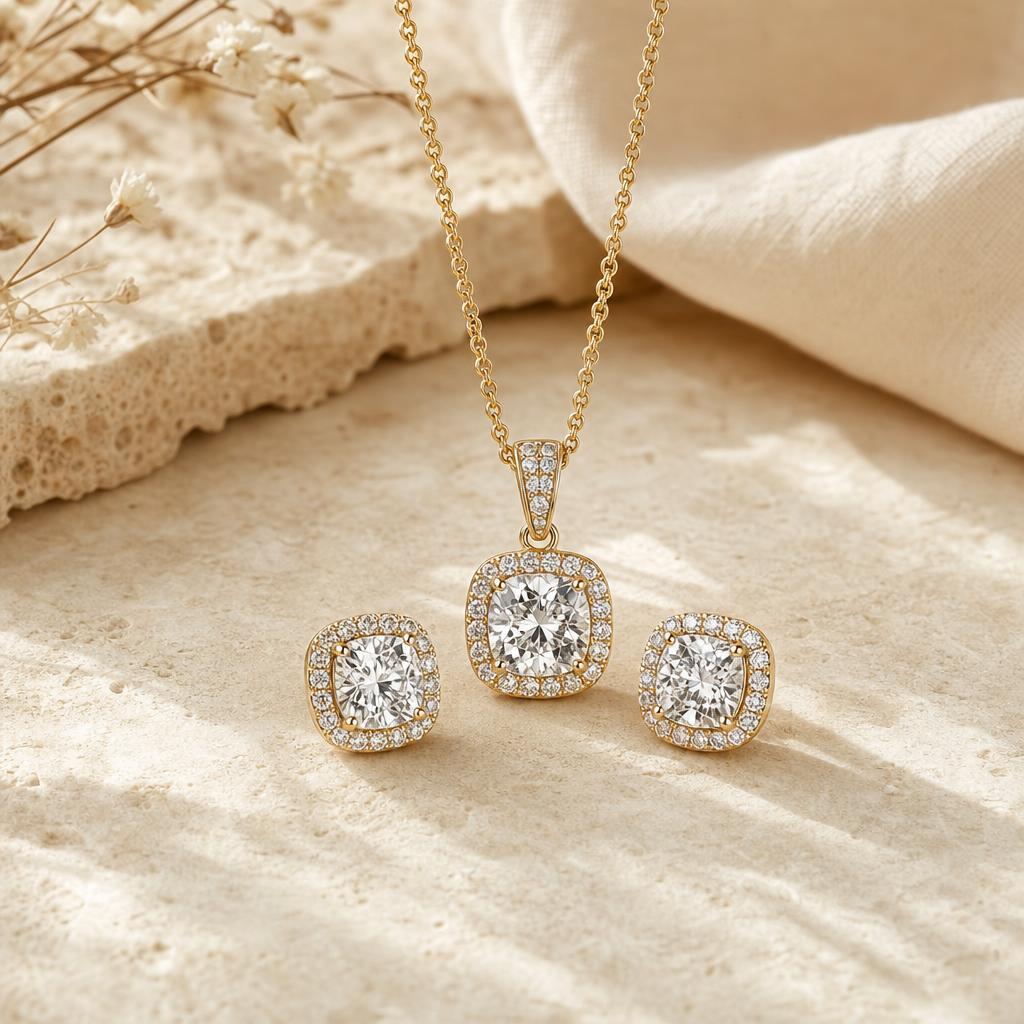
Matching Earrings and Necklace Sets: How to Tell a Real Set From Three Random Pieces
There is a drawer in most homes holding a "set" that was never really a set: a necklace from one trip, earrings from a gift, a ring that arrived on a different birthday. They share a color of metal and nothing else. A real set is a decision about proportion, stone, and finish, made once, and it shows the moment you put it on.
If you are shopping for a matching earrings and necklace set, the real question isn't whether to match. It's what, precisely, you are matching. Start with the pairs below, then we'll get into how to read any set for yourself.


What Makes a Real Set Different From a Pile of Pieces
Most "sets" are defined by the retailer: two or three items in one box, a shared name, a shared photo. That is packaging, not design. A set that actually works shares three things, and you can check each one in under a minute.
1. One stone, one proportion
The stone shape is the signature. An oval pendant with oval studs reads as one thought. An oval pendant with round studs and a princess-cut ring reads as three. The size relationship matters just as much: studs should be a clear step smaller than the pendant, so one piece leads and the others support it.
2. One metal tone, one finish
Rhodium-plated silver sits cool and bright; 18k gold plating sits warm. Mixing them can be a deliberate move, and we've written about why your ring doesn't have to match your necklace. But inside a single set, the tone should be unmistakably the same. Finish counts too: a high-polish pendant beside brushed hoops looks accidental rather than chosen.
3. A clear hierarchy
Every strong set has a lead and a supporting cast. The pendant carries the look; the earrings echo it at a smaller scale. If every piece competes for attention, the whole thing reads as clutter rather than a considered look.
The one-minute test: lay the pieces on a plain surface and squint. If your eye lands on one piece first and the others feel like its echo, it's a set. If your eye bounces between them, it's a pile.
Reading the Set: A Quick Buying Checklist
You don't need a jeweler's loupe. You need five questions, asked in order.
- Is the stone the same? Same cut, same stone type, same quality of sparkle. Moissanite beside a dull glass-look stone shows immediately in daylight.
- Is the base metal the same? A 925 sterling silver pendant with a mystery-metal earring post is where irritation and tarnish start.
- Do the clasps and backs match the quality? A secure clasp and proper earring backs tell you whether the whole set was built to be worn.
- Could each piece stand alone? The best sets are really three good pieces designed to agree. If one would embarrass you solo, skip it.
- Will you wear it apart? A set you only wear together is half a purchase.
That last question is the one most buyers skip. We unpack it in our look at what actually gets worn together, and what doesn't.

The Ophelia Ring
An oval hidden-halo ring with a pavé band. It looks like $15,000 or higher, and it's the natural anchor for an oval-led look when you want the full trio.
Shop The Ophelia Ring →Why the Three-Piece Version Is Different
A necklace and earrings share a face-frame: they sit near each other and are seen together. A ring lives on your hand, in a different visual field. That's why a ring doesn't need to be a literal match. It needs to be a relative of the other pieces. Same stone shape and same metal tone does it. If you're weighing whether a full three-piece set is ever worth it, the answer is usually yes when all three pass the checklist, and no when the ring is there to round out a box.
Building a Set Instead of Buying One
The smartest buyers we hear from don't buy sets at all. They pick a lead piece, then add the supporting pieces that share its stone and tone. This is how you get a matching earrings and necklace set that looks bespoke, because it effectively is. You can see the logic in our guide to building your own jewelry set across silver and gold.
It also gives you control over the one thing a pre-boxed set hides: scale. A bold pendant paired with petite studs is a look. A bold pendant paired with equally bold earrings is a lot.

The Belle Necklace
A pendant that leads a look quietly. Set in 925 sterling silver and nickel-free, it's built to be worn daily and holds its own beside the Belle Stud Earrings.
Shop The Belle Necklace →
The Stella Stud Earrings
A clean stud that works as the supporting half of a set or as a daily staple on its own. Hypoallergenic, nickel-free, and made to stay in rotation.
Shop The Stella Stud Earrings →Three Mistakes That Turn a Set Into a Pile
Matching size instead of matching idea
The most common error is buying earrings the same visual weight as the pendant. Both pieces then sit at your collarbone and jaw like twin spotlights. Scale the earrings down and the pendant gets room to breathe, and the whole look reads as expensive rather than loud.
Ignoring the neckline you actually wear
A pendant is framed by whatever sits behind it. A crew neck, a collared shirt and a deep V each change which pendant length and which earring style works. Before you commit to a set, picture the three outfits you reach for most. If the set only works with one of them, you've bought an occasion piece, not a staple.
Treating the ring as an afterthought
A ring added to round out a bundle rarely earns its place. If you want a ring in the look, choose it first. It's the piece other people notice in conversation, so it should be the one you'd pick even if the set didn't exist. Then let the necklace and studs inherit its stone shape.
Which Stone Shape Should Lead?
Oval elongates, so it's the natural choice for a pendant that wants to draw the eye down a neckline. Round is the most flexible and the easiest to repeat across all three categories without looking repetitive. Pear and marquise are more distinctive, which means they work best when you let them lead and keep everything else simple. If you're unsure, go round for the studs, because earrings sit closest to your face and benefit from the most forgiving shape, then choose the pendant and ring to suit.
Whatever you choose, the stone should do the talking. Gemiros pieces are set in 925 sterling silver with moissanite or simulated diamond that is indistinguishable from a diamond and passes diamond testers, so the only question left is proportion. That's a style decision, and it's yours.
On Price: A Set Should Be Judged Piece by Piece
Retailers like to bundle, because a bundle disguises weak pieces behind a strong one. Judge every item as if you were buying it alone. Our read on what matching should actually cost comes down to a simple rule: the set earns its premium only if each piece passes on its own. Anything less is paying for a box.
Quick Takeaways
The Short Version
- A real set shares a stone shape, a metal tone, and a clear hierarchy.
- Lead with one piece; let the others echo it at a smaller scale.
- Check the metal, clasps, and earring backs, not just the sparkle.
- Judge each piece alone before you judge the bundle.
- Building your own set often beats buying one pre-matched.
Frequently Asked Questions
Should your necklace and earrings match?
They should agree, not be identical. Matching stone shape and metal tone gives you a cohesive look; matching size does not. The earrings usually read best a step smaller than the pendant.
What is a set of matching jewelry called?
A parure, in traditional jewelry vocabulary, though most retailers today simply call it a jewelry set or a necklace and earring set. Two pieces is a demi-parure.
Are matching jewelry sets in style?
Yes, in their modern form. Strict, identical sets feel dated; coordinated sets, where each piece shares a stone and tone but can stand alone, feel current.
Where can I find matching earrings and necklace sets?
Look for retailers that show each piece's specs: metal, stone, and closures. At Gemiros, pieces such as the Ophelia, Leighton, Belle, and Stella appear across necklaces and studs, so you can build a pair from one design family.
A set is worth owning when it makes the choices you'd otherwise have to make every morning. Pick the lead, match the stone and tone, keep the hierarchy clear, and the rest is simply getting dressed.


