

Matching Jewelry Sets: What Actually Gets Worn Together (And What Doesn't)
There is a version of "jewelry set" that means three pieces shrink-wrapped together in a plastic box, designed to be opened once and worn maybe twice. And there is a smarter version — pieces built to coordinate, bought with intention, that end up doing most of the work in your rotation. The second one is worth understanding before you buy anything.
Gemiros doesn't sell boxed sets. What it sells is a catalog built so that a pendant and its matching studs actually read as one idea when you put them on together — which, it turns out, is the entire premise the idea is supposed to deliver anyway. Here's what that looks like in practice, and which pieces earn a permanent spot in daily rotation versus which ones are better saved for one big night.


What Actually Counts as a Matching Jewelry Set
Walk into a department store and "jewelry set" usually means three or four pieces made from the same mold, packaged together, priced as a bundle. That's one definition. But the more useful one — the one that actually changes how good your jewelry looks day to day — is simpler: a set is any combination of pieces that share a language. Same metal tone, a related shape or motif, a similar scale. They don't have to come in the same box. They just have to agree with each other.
That distinction matters because it changes how you shop. Instead of hunting for a single pre-matched bundle — which locks you into whatever that one manufacturer decided belonged together — you can build a matching jewelry set piece by piece, choosing exactly which necklace and which earrings actually deserve to live on your body at the same time.
The Necklace-and-Earring Pair: Still the Easiest Place to Start
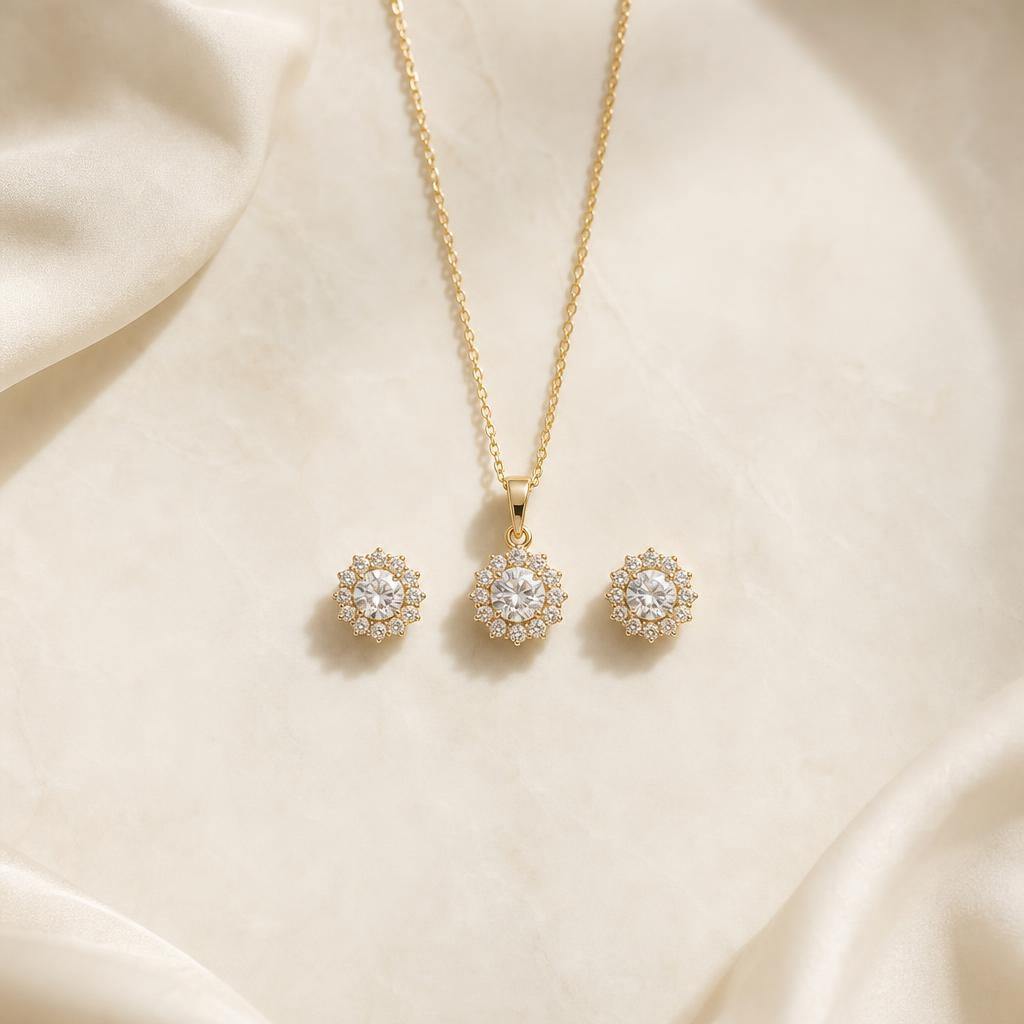
If you're building toward a coordinated look for the first time, start with a matched pendant-and-studs pairing rather than trying to match three or four categories at once. It's the lowest-risk combination — a pendant and its studs sit in completely different zones of your face and neckline, so even a close match reads as intentional rather than matchy in the try-hard sense. The Belle pieces above are a literal example: same halo detailing, same sterling silver base, designed from the start to be worn together without a second thought.
The heart-motif Sweetheart pair works the same way, just with a softer, more romantic silhouette. Neither pairing requires you to think twice about whether the metal tones clash or the proportions compete — that decision was already made when the pieces were designed.
Worth knowing: A matched necklace and earring set doesn't mean identical stones or identical shapes. It means a shared design language — the same halo, the same cut, the same metal — repeated at two different scales.
What Gets Worn Together — And What's Better Kept Separate
Not every piece in your jewelry box needs a match, and treating every purchase as part of a set is its own trap. Here's a more realistic way to sort what you own.
Worn together, almost always
- A pendant and its matching studs. This is the safest, most reusable pairing — office to dinner, no outfit-planning required.
- Two pieces in the same metal tone. Even unrelated designs read as coordinated once the metal matches.
- A delicate necklace with equally delicate earrings. Scale consistency does more visual work than shape consistency.
Better worn on their own
- Two statement pieces at once. A bold pendant and dramatic earrings usually compete rather than complement.
- Mismatched metal tones, forced together. Silver and gold can work as an intentional mixed-metal look, but not when one piece is simply the "wrong" tone for the other.
- An occasion-only piece paired with an everyday one. A bridal-weight necklace next to simple studs reads as unfinished, not layered.
Building Your Own Set Instead of Buying One Pre-Matched
There's a real case for skipping the pre-boxed bundle entirely. When you build your own set — choosing the necklace and the earrings as two separate decisions, rather than accepting whatever a manufacturer bundled together — you end up with pieces you'd have chosen individually anyway. That's a meaningfully different outcome than a set purchased purely for the convenience of one checkout.
It also solves the biggest complaint about boxed jewelry sets: you almost never love every piece in the box equally. Buying a sterling silver necklace and earring set as two intentional purchases means every piece earns its place, instead of one ring or bracelet sitting untouched in a drawer because it came free with the pieces you actually wanted.

The Morgan Pendant Necklace
A clean, light-catching pendant in 925 sterling silver — the kind of piece built to anchor a set rather than compete for attention. Indistinguishable from a diamond, and priced so you can actually build the set around it.
Shop The Morgan Necklace →
The Morgan Stud Earrings
Designed to sit alongside the Morgan necklace without a second thought — same finish, same scale logic, same reason to wear it every single day. 925 sterling silver, hypoallergenic, nickel-free.
Shop The Morgan Studs →The Three-Piece Question: Do You Need a Ring In the Mix Too?
A necklace, earring, and ring set is the more ambitious version of this idea, and it's worth attempting only once the two-piece pairing already feels effortless. A ring draws attention to your hands specifically, which means it doesn't need to match your neckline pieces in shape — it only needs to match them in metal tone and general polish level. Think of the ring as agreeing with the set rather than repeating it.
This is also where an affordable jewelry set earns its keep as a strategy rather than a compromise: building three coordinated pieces gradually, one purchase at a time, gets you to the same finished look as a single expensive bundle — minus the piece you never would have chosen for yourself.
✦ Pro tip: If you're layering a ring stack alongside a necklace-and-earring pair for the same event, keep the ring's metal tone identical to the other two pieces. It's the fastest way to make three separately-purchased items look like they were designed as one.
How to Tell If a Piece Actually Belongs in Your Set
Before adding anything new to a set you're building, run it through three quick questions:
- Does the metal tone match exactly? Not "close enough" — sterling silver and white gold plating can look nearly identical in a photo and noticeably different in person.
- Is the scale proportional? A tiny pendant with oversized statement earrings rarely reads as a set — it reads as two separate decisions.
- Would you wear the pieces separately and still like them? The strongest sets are made of pieces that already stand on their own.
Quick Takeaways
- A coordinated set doesn't need to come from one box — it needs a shared metal tone, scale, and design language.
- Start with a matched pendant-and-studs pairing before attempting a three-piece combination with a ring.
- Building your own set piece by piece almost always beats a pre-bundled one, because every piece is a decision you actually made.
- Two statement pieces worn together usually compete rather than complement — save one for its own moment.
Frequently Asked Questions
What do you call a set of matching jewelry?
A coordinated necklace-and-earring pairing is often just called a "set," though the more formal, old-fashioned term for a matched jewelry grouping is a "parure" — historically a full suite of necklace, earrings, bracelet, and sometimes a ring, all designed together.
What is the 2:1:1 rule in jewelry?
It's a simple styling guideline for layering: two necklaces, one ring, one pair of earrings (or some close variation of that ratio) tends to look intentional rather than overloaded. It's less a rule than a starting point — the goal is to keep one category from visually overwhelming the others.
Can you wear earrings and a necklace at the same time?
Yes — in fact, a necklace and earrings are the single easiest jewelry combination to wear together, since they occupy different areas of the face and neckline rather than competing for the same visual space. This is exactly why it's the recommended starting point for building a set.
What is a three-piece jewelry set called?
Most retailers simply call it a "three-piece set," typically a necklace, earrings, and either a bracelet or ring. Historically, this smaller grouping (as opposed to a full parure) was sometimes called a "demi-parure."
Are matching jewelry sets still in style?
Yes, though the styling has shifted. The dated version — head-to-toe identical pieces from one box — has given way to a more deliberate approach: pieces that share a metal tone and design logic without being carbon copies of each other. That's the version worth building toward.
The easiest way to end up with a jewelry collection you actually reach for isn't to buy more — it's to buy pieces that already agree with each other. Start with one confident pairing, wear it until it feels like a habit, and let the rest of the collection build itself from there, one intentional piece at a time.


