

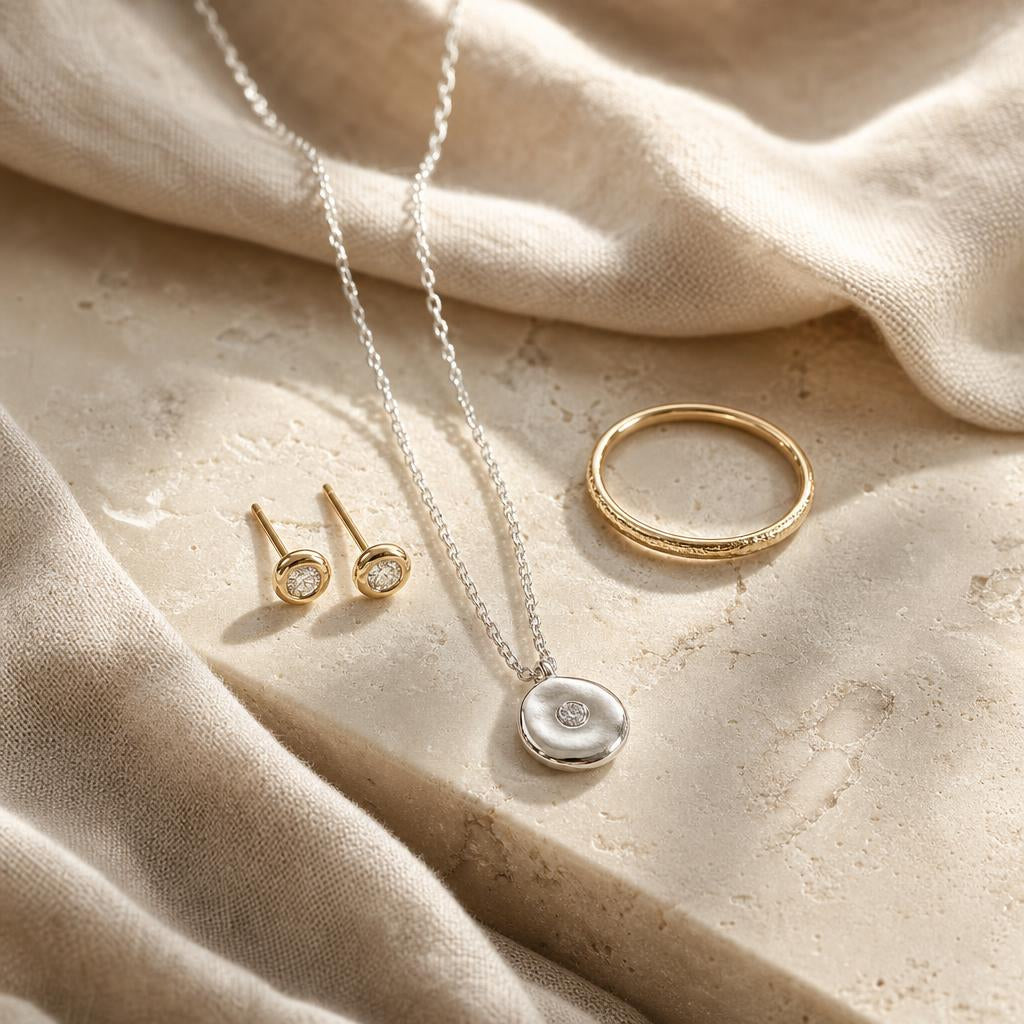
Build Your Own Jewelry Set: Mixing Silver and Gold Jewelry on Purpose
The jewelry store sells you a "set" because it's easier to sell three pieces in one box than to teach you how to choose them. You don't need the box. You need a rule or two, and the confidence to break the one that was never really a rule.
A pre-matched necklace-and-earring set solves a problem you may not have: not knowing what goes with what. Build the set yourself, and you end up with pieces that work in every combination, not just the one the packaging arranged for you. Here are four pieces that show how that looks.


Why a pre-matched set is the wrong starting point
A boxed set is designed around the retailer's convenience. The pendant and the studs share a stone shape, a metal and a finish because that is the cheapest way to produce and photograph them together. It tells you nothing about how you actually dress, which pieces you will reach for on a Tuesday, or whether you wear your earrings every day and your necklace twice a month.
The woman who builds her own set starts from the opposite direction. She picks the piece she will wear most, then adds around it. The result is a collection where every piece has a job, and none of them is there because it came in the box.
Start with one anchor, then add an echo
The simplest working formula has two moves. First, choose an anchor: the one piece you would wear without thinking. For most women that is a pair of studs or a single pendant. Second, add an echo: a piece in a different category that repeats one quality of the anchor, whether that is the stone shape, the setting, or the metal tone.
A six-prong round solitaire stud and a bezel solitaire pendant are not identical, and they are not meant to be. They share a round stone and a quiet, single-stone logic, so they read as a pair the moment you wear them together. That is the difference between coordinated and matched: coordinated pieces recognize each other, and matched pieces just repeat each other.

The Aria Moissanite Necklace — Gold
A round moissanite in a smooth bezel on an 18k gold-plated 925 sterling silver setting. A clean, low-profile pendant that works as the anchor of a gold-leaning look.
Shop The Aria Necklace →Mixing silver and gold jewelry without it looking accidental
The old rule said to pick one metal and commit. It was written for people who owned one ring and one watch. Once you are building across three categories, a single-metal rule just limits what you can wear. What matters is that the mix looks chosen, and a few habits make it read that way.
- Pick a lead metal. Let one tone carry roughly two-thirds of what you wear and use the other as the accent.
- Repeat each tone at least twice. A single gold ring among silver pieces looks like a mistake. Gold on your hand and gold at your neckline looks like a decision.
- Spread both metals around the body. Silver at the ears and gold at the neck, with a ring in each, beats all the gold on one side and all the silver on the other.
- Let the stones do the bridging. A sparkling stone reads as neutral, so pavé pieces and solitaires sit comfortably beside either metal.
If you want to see the same idea worked out on the hand, our guide to mixing gold and silver rings goes finger by finger, and the principle carries straight across to the rest of your jewelry.
✦ Pro tip: Our silver-tone pieces are 925 sterling silver with rhodium plating, and our gold pieces are 925 sterling silver with 18k gold plating. Because the base is the same, the two tones sit at the same weight and finish, which is exactly what makes them easy to mix.

The Forever Ring — Gold
A slim pavé band in 18k gold plating. Worn beside silver-tone earrings and a silver-tone pendant, it becomes the accent that ties the whole look together.
Shop The Forever Ring →Repeat the stone, vary the shape
Metal is only half of what makes a set feel like a set. The other half is the stone. Moissanite is indistinguishable from a diamond and passes diamond testers, so you can repeat it across every category and it will read as one family, whatever the setting.
That frees you to vary everything else. A solitaire pendant, a pair of pavé huggie hoops and a slim pavé band all carry the same brilliance in three different silhouettes. If you are layering more than one necklace, the order matters as much as the pieces, and we cover it in what to layer first, chain or pendant.
Keep scale consistent, even when everything else changes
The quickest way to make a mixed look feel deliberate is to keep proportions in the same family. Delicate pieces with delicate pieces, bolder pieces with bolder pieces. A fine chain paired with studs of a similar visual weight reads as a set. A fine chain beside oversized hoops reads as two outfits.
You can break this on purpose. One bold piece, whether an oversized pendant or a wide band, works as a focal point if everything around it stays quiet. Two bold pieces start to compete.

The Stella Stud Earrings
Round solitaire studs in 925 sterling silver. A strong everyday anchor, quiet enough to sit beside a gold pendant or a gold band without competing.
Shop The Stella Studs →Build in stages, not all at once
The advantage of assembling your own set is that you never have to buy it all at once. Start with the anchor you will wear every day. Add the echo when you know which quality of the anchor you want to repeat. Add the accent in the other metal last, once you have seen how the first two pieces behave on you.
This is the same logic behind a good jewelry capsule wardrobe: a handful of pieces that each work with all the others, rather than a drawer of pairs that only work with their partner. If you want the full framework, we've laid out the five pieces a capsule collection actually needs.
Worth knowing: Sizing is in whole ring sizes only, and Gemiros doesn't offer resizing, so settle your ring size before you plan the rest of the set around it. Everything else in this guide (earrings, pendants, chains) is size-free, which is part of why they make such good starting points.
When a pre-matched set is actually fine
It isn't always wrong. A set is a sensible choice when you are buying for an occasion and want everything to arrive together, or when you are gifting and want the coordination handled for you. Even then, treat the set as a starting point. Wear the pendant with your own studs, and the studs with your own chain, and you will find the set was always more flexible than the box suggested. We also look at what "matching" should actually cost if you are weighing a set against building one.
Quick Takeaways
- Start with one anchor piece you'd wear every day, then add an echo that repeats its stone, setting or metal.
- Choose a lead metal, repeat each tone at least twice, and spread both across ears, neck and hands.
- Repeat the stone to unify a look, and vary the silhouette to keep it interesting.
- Keep scale consistent: delicate with delicate, bold with bold, or one deliberate focal point.
- Build in stages. A set you assemble yourself works in every combination, not only the one the box arranged.
Frequently asked questions
Is it okay to mix gold and silver jewelry?
Yes. The key is to make it look chosen: lead with one metal, repeat the second metal at least twice, and spread both across your ears, neck and hands. Sparkling stones help bridge the two tones.
Is it okay to wear matching necklace and earrings?
Absolutely, as long as they're coordinated rather than identical. Pieces that share a stone, a setting or a metal tone look intentional. Pieces that are exact copies of each other can look more formal than you want for everyday wear.
How many pieces do I need to build a jewelry set myself?
Three is enough to start: an everyday pair of earrings, one pendant, and one ring or band. Each should work alone and with the others. You can add an accent in a second metal once you know how the first three wear.
Do I have to match my ring to my necklace?
No. A ring, a pendant and a pair of earrings only need to share one quality, such as the stone, the setting style or the metal tone. Matching all three at once is what makes a look feel stiff.
The point of building your own set isn't to follow a different set of rules. It is to stop needing them. Pick the piece you love most, add the one that answers it, and let the rest follow. That is what a collection built by someone who knows exactly what she's doing looks like.


