

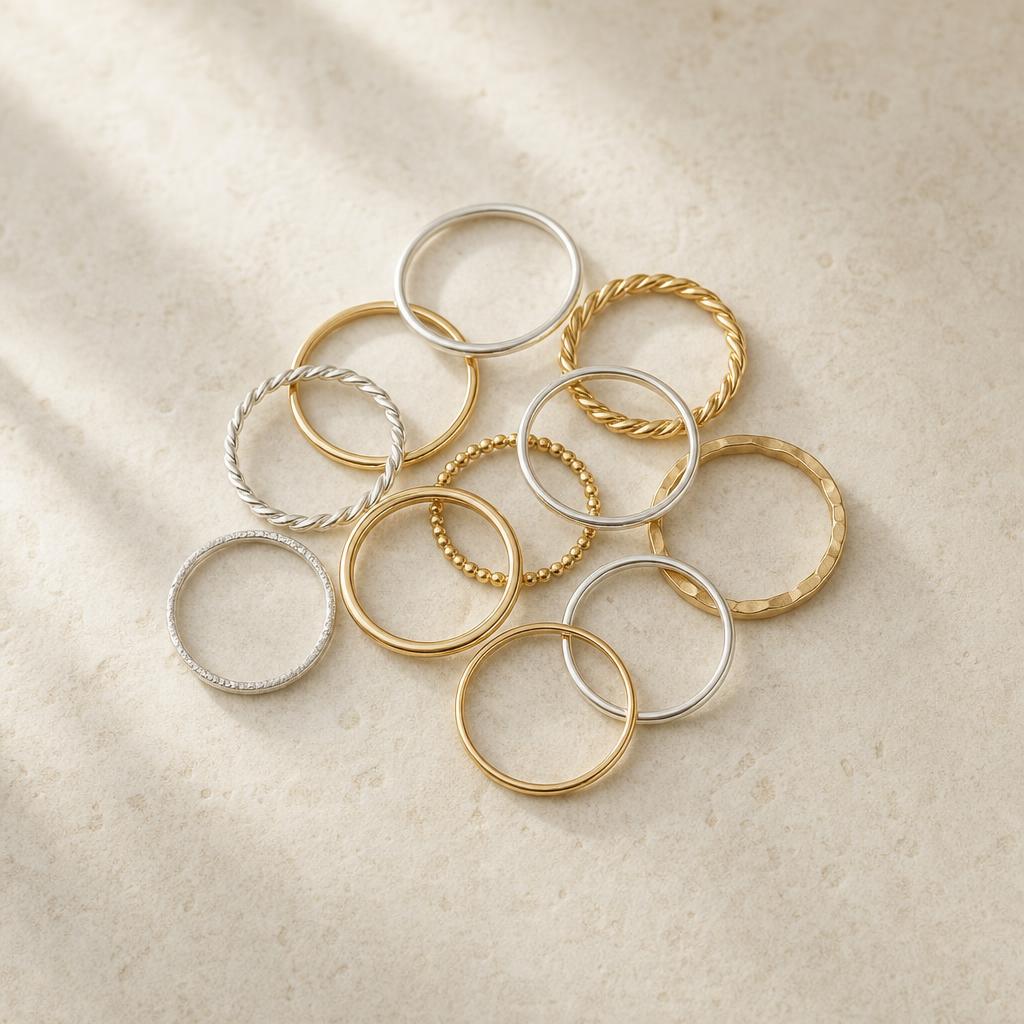
The Layered-Metal Look: How to Mix Gold and Silver Rings
There was a rule, once, about metal. Gold with gold. Silver with silver. Never let the two touch, or your hand would read as an accident instead of a decision. That rule is gone — and the women wearing a gold ring next to a silver one aren't breaking a code, they're the ones who noticed it stopped applying a while ago.
Mixing metal tones on your hand isn't a workaround or a compromise between two rings you couldn't choose between. Done with intention, it's its own aesthetic — one that says your jewelry box isn't organized around a single metal you swore loyalty to at twenty-two. Here's how to actually do it, and four rings that make the layering easy.


Can you mix gold and silver jewelry together?
Yes — and it isn't even a close call anymore. The old idea that a woman had to commit to one metal family for life was never really about taste. It was about jewelry counters that wanted to sell you a matching set, not about what actually looks intentional on a hand. A gold ring and a silver ring worn together read as curated, not confused, the moment there's a reason behind the pairing instead of an accident behind it.
That reason is easier to build than it sounds. You don't need a stylist or a color wheel. You need one dominant tone, one accent tone, and a piece somewhere in the mix that visually explains why the other two are allowed to be in the same room.
How to wear mixed metal jewelry without it looking accidental
The difference between "intentional" and "I couldn't decide" comes down to three habits, and none of them require buying anything you don't already like.
Pick a dominant tone, then let the second one accent it
A hand wearing three gold rings and one silver ring reads as a gold hand with a deliberate cool note. A hand wearing two of each reads as undecided. Let one metal carry roughly two-thirds of what's visible — the rest of your rings, plus anything on your wrist or ears that's in frame with your hand — and let the other metal show up once or twice, not evenly.
Repeat each tone at least twice
A single silver ring dropped into an otherwise all-gold hand can look like a fluke unless something else nearby echoes it — a second silver band, a watch case, an earring. Repetition is what turns a stray metal into a decision. This is the same logic behind a good ring stack: nothing sits alone without a reason.
Use a bridge piece
The fastest way to make two metals look like they belong together is to wear one ring that already contains both. A pavé band with rhodium-finished stones set into a gold shank, or a ring stacked directly against its own opposite-tone twin, does the work of convincing the eye that the pairing was chosen — because, in that one piece, it literally was.
✦ Pro tip: Start small. Wear one metal on most fingers and let a single ring in the opposite tone sit on just one hand, one finger, for a week. It's the easiest way to find out whether you actually like the contrast before you build a whole stack around it.
Why the "one metal for life" rule stopped making sense
Most women didn't inherit a single metal preference — they inherited a jewelry box. A rose gold gift from one birthday sits next to a platinum-finished ring bought on a whim, next to a yellow gold piece that was a hand-me-down. Buying only ever one metal tone going forward doesn't make that box more cohesive. It just means half of what you already own goes unworn.
Mixing tones on purpose solves the actual problem: it lets every ring you already love earn a place on your hand again, instead of getting sorted into a drawer because it doesn't match this year's metal. That's a more useful skill than metal loyalty ever was, and it's a more accurate read on how she actually shops — a little at a time, from whatever caught her eye, not from a single collection bought all at once.

The Forever Ring — Rose Gold
The same half-eternity silhouette as the platinum and gold versions above, in rose gold — the piece that lets all three tones sit on one hand without any of them looking like the odd one out.
Shop The Forever Ring →Where to start if you've never mixed metals before
Start with two rings that already share a shape. Wearing 925 sterling silver set with pavé stones next to an 18k gold-plated band in the exact same cut removes half the guesswork — the eye already reads them as a pair because the silhouette matches, even before it registers the color difference. That's a gentler entry point than reaching for two rings that are different in every way at once.
From there, the rule that actually matters is placement, not proportion. Rings on neighboring fingers read as more intentional than rings crowded onto the same finger, because each metal gets its own moment instead of competing for the same inch of hand. A gold solitaire on one finger and a platinum-finished halo ring on the next isn't a clash — it's two statements taking turns.

The Cherish Ring
A bezel-set stacking band with a rubbed, low-profile edge — the kind of quiet, cool-toned piece that sits comfortably next to a warmer statement ring without pulling focus from either.
Shop The Cherish Ring →What doesn't work
Mixing metals fails in exactly one predictable way: when every piece is fighting for the same amount of attention. Four statement rings in four different tones on one hand isn't layered, it's loud, and not in the confident sense of the word. The fix isn't fewer metals — it's fewer statements. Let one ring be the moment. Let the rest of the mix support it quietly, the way a pavé band supports a solitaire rather than competing with it.
The other failure mode is treating the mix as random instead of built. Two tones with no repetition, no dominant side, and no bridge piece just looks like a ring you forgot to take off before putting on a different-colored one. The difference between that and a genuinely layered-metal look is almost entirely about whether there's a visible logic to it — and logic, unlike taste, is something you can actually plan.
Quick Takeaways
- Mixing gold and silver jewelry is not a fashion mistake — it's a deliberate, modern styling choice.
- Pick one dominant metal tone and let the second tone show up as a repeated accent, not a one-off.
- A bridge piece — a ring that already combines both tones, or a matching silhouette in two metals — makes the pairing read as chosen.
- Place mixed tones on neighboring fingers rather than stacking every metal onto one finger at once.
- The failure mode isn't mixing metals — it's mixing too many statement pieces with no clear lead.
Frequently Asked Questions
Can you mix gold and silver jewelry together?
Yes. The idea that metals have to match is an old retail rule, not a style rule. Choose one dominant tone, repeat the second tone at least once so it reads as deliberate, and the two will sit together without looking like an accident.
Is it tacky to wear gold and silver at the same time?
Not when there's a visible reason behind it. What actually reads as tacky is an even, random split with no dominant tone and nothing tying the two together. A clear lead metal, a repeated accent, and one bridge piece is the difference between "layered" and "mismatched."
What's an easy rule for mixing metals without overthinking it?
Let one tone cover roughly two-thirds of what's visible on your hand, and let the second tone show up at least twice rather than once. That single ratio does most of the work — it gives your eye an obvious lead metal while still letting the accent tone feel intentional instead of stray.
Is mixed metal jewelry still a real trend, or is it already over?
It's less a trend than a correction. Mixed metal jewelry moved from "rule-breaking" to standard practice over the past few years precisely because it solves a real problem — most women's jewelry boxes were never one-metal to begin with. That's not the kind of trend that reverses; it's the kind that becomes the new default.
The rings in your jewelry box were never supposed to match a single metal you chose once and never revisited. They were supposed to reflect what you actually liked when you bought each one — which, for most women, changes more than a single gold or silver commitment can hold. Wearing them together isn't a styling trick to master before your next event. It's just what happens when you stop sorting your hand by metal and start sorting it by what you actually reach for.


