

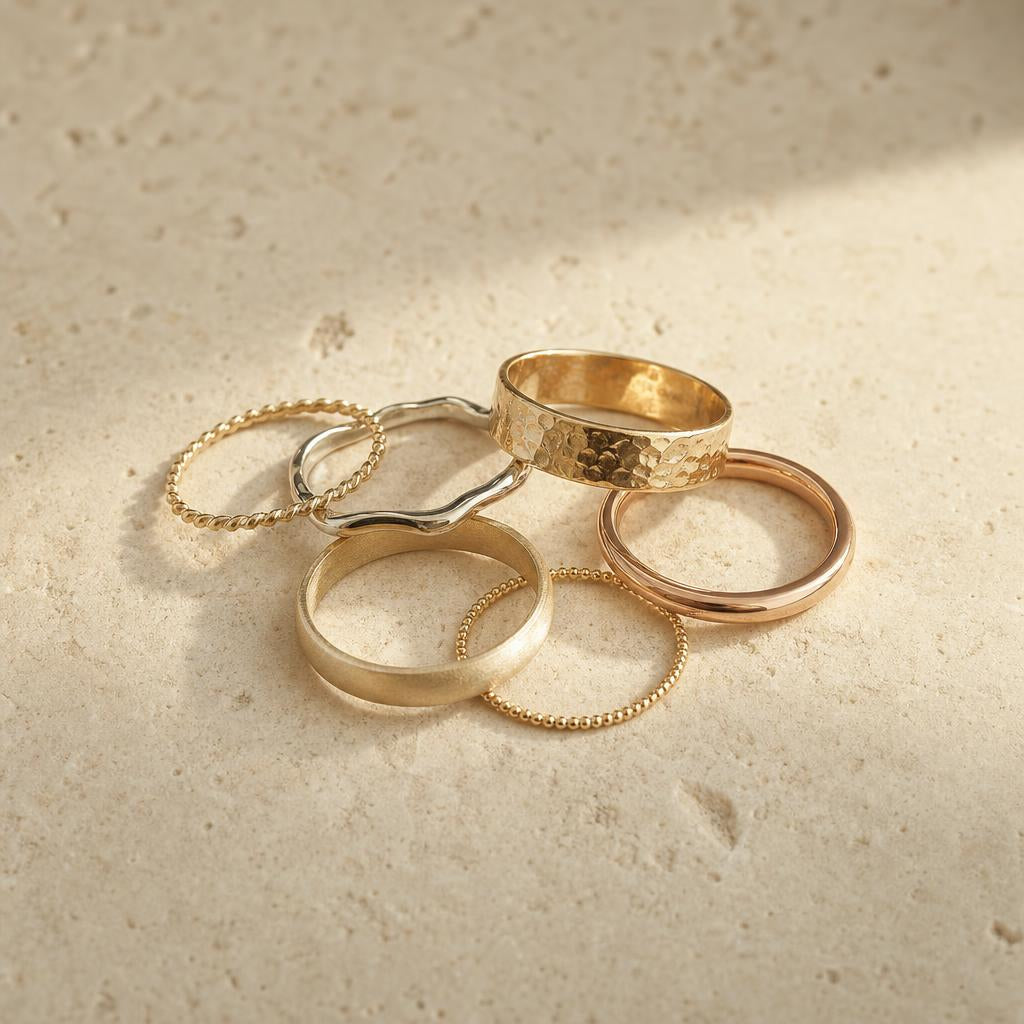
How to Wear Multiple Rings on One Hand: Sizing Logic for Adding a Wedding Band
If you already wear rings on more than one finger, adding a wedding band isn't as simple as buying your usual size and calling it done. The moment a new ring has to share hand space with the ones you're already wearing, sizing and placement stop being separate decisions — they're one decision, and getting it wrong is how a beautiful band ends up sitting crooked, catching on its neighbors, or feeling crowded within a week.
Here's the logic experienced stackers use to add a wedding band to a hand that's already doing a lot of work, without starting over from scratch.


Why Multi-Ring Hands Need Their Own Sizing Logic
A hand wearing a single ring has one variable to solve for: fit on that one finger. A hand already wearing rings on two or three fingers has a second variable most people never think about — how those existing rings affect the knuckle you have to clear to get a new one on and off, and how close together your rings sit once everything is in place. Buying a wedding band exactly the way you'd buy your very first ring skips both of those questions.
This isn't about wearing fewer rings. It's about understanding how to wear multiple rings on one hand in a way that actually holds up — comfortably, all day, without the constant adjusting that happens when sizing was an afterthought.
The Knuckle Rule Nobody Mentions
Your finger has two relevant measurements: the base, where a ring sits at rest, and the knuckle, which is almost always wider and is what the ring has to pass over to get on. On a hand that's already wearing rings, this matters more than usual, because a snug ring on a neighboring finger changes how you naturally hold your hand, and a too-tight new band makes removing rings for washing hands or exercise a genuine hassle rather than a quick habit.
If your knuckle runs noticeably wider than your finger base, size for the knuckle and expect slight movement at rest, or ask about a comfort-fit interior that eases the ring over the widest point without needing extra room throughout.
Worth knowing: Rings measured and sized in isolation, one at a time, are the most common reason a "correctly sized" band still feels off once it's sitting next to two other rings on the same hand.
Placement: Where a Wedding Band Actually Belongs
If you're already experimenting with style — how to wear rings on multiple fingers as a deliberate look rather than an accident — a wedding band changes the math slightly, because it usually has a fixed, expected position: the ring finger, stacked with or beside your engagement ring. That still leaves real decisions to make. Does it sit directly against your engagement ring, or does a thin spacer band go between them? Do your other rings, on your index or middle finger, need to shift in width or count to keep the whole hand feeling balanced rather than cluttered?
A reliable starting rule: treat your ring finger as the anchor point once a wedding band joins it, and let everything else on the hand sit slightly quieter — thinner bands, fewer stones, less height — so the eye has one clear focal area instead of competing with it.

Evermore Ring
A sleek channel-set band with a continuous, catch-free surface — an easy addition to a hand that's already wearing rings, since there's no raised edge to snag against its neighbors.
Shop Evermore Ring →Width Adds Up Faster Than You Expect
Three thin rings on adjacent fingers can visually and physically read as one wide block of metal once your hand is closed or relaxed, even though each individual band measures under 2mm. Before adding a wedding band, look at your hand as a whole rather than finger by finger. If your ring finger and the fingers beside it are already carrying noticeable width, a slimmer wedding band keeps the overall hand from tipping into "armor" territory. If your other rings are minimal, you have more room to let the wedding band be the statement piece.
Matching Metals Once You're Adding a Fourth or Fifth Piece
A single mismatched metal is easy to miss. Once a hand is wearing three, four, or five rings, an inconsistent mix of platinum, gold, and rose gold starts to read as unintentional rather than eclectic, simply because there's more surface area for the eye to compare. Before you choose a metal tone for your wedding band, take a genuine inventory of what's already on your hand — not just your engagement ring, but every other ring you wear regularly, including ones on your other hand if you tend to look at both together.
A useful working rule: let one metal tone dominate at least two-thirds of what's visible, and treat any additional tones as accents rather than equal partners. If your engagement ring and most of your existing stack are platinum, a rose gold wedding band can still work beautifully as a deliberate accent — the mistake is adding a third or fourth tone without any of them reading as the clear majority. This is also where a genuinely versatile piece earns its place: a band available across platinum, gold, and rose gold lets you match whatever your hand is already doing, rather than compromising on a design you love because the metal tone doesn't fit.
Comfort Fit Matters More With Every Ring You Add
A single ring can get away with a flat, standard interior. Multiple rings worn daily put more cumulative pressure on the skin between and around your fingers, especially where two bands sit close together. A rounded, comfort-fit interior — even a modest one — reduces friction significantly once you're managing three or four rings instead of one, and it's worth prioritizing on the wedding band specifically, since that's usually the piece worn every single day without exception.

Everlasting Ring
A continuous line of pavé stones with a smooth, rounded profile built for daily wear — designed to sit comfortably even when it's one of several rings on the hand.
Shop Everlasting Ring →How Many Rings Is Actually Too Many?
There's no universal number, but there is a workable guideline: most hands read as intentional, not cluttered, at two to three rings per hand, with at least one finger left bare so the eye has somewhere to rest. Style how to wear rings on multiple fingers however you like within that range — the point isn't a strict limit, it's making sure every ring you add still has room to actually be seen, rather than disappearing into a wall of metal.
If you're adding a wedding band to a hand that's already at that threshold, it's worth removing one existing ring rather than squeezing a fourth piece in. The wedding band should read as an addition, not a survival test for your finger.
Quick Takeaways
- Size for your knuckle, not just your finger base, if the two measurements differ noticeably
- Let your ring finger anchor the look once a wedding band joins it — keep neighboring rings slightly quieter
- Total width across the hand matters more than any single ring's width
- Prioritize a comfort-fit interior on the band you'll wear every single day
- Two to three rings per hand, with one finger left bare, tends to read as intentional rather than crowded
Frequently Asked Questions
What is the 2:1:1 rule for wearing jewelry?
It's a rough styling guideline suggesting a mix of two smaller pieces, one medium piece, and one statement piece across your jewelry, rather than several competing statement pieces at once. Applied to rings, it means letting one ring — usually your wedding band or engagement ring — lead, while the rest stay simpler.
Is it okay to wear two or three rings on one hand?
Yes — two to three rings per hand is a common, well-balanced range. The key is leaving at least one finger bare and keeping widths proportionate to each other so the hand reads as styled rather than overloaded.
Is wearing three or more rings on one hand too much?
Not inherently — plenty of hands wear three or four rings comfortably. It becomes too much when the rings start touching, catching on each other, or covering so much of the hand that no individual piece is visible.
What are the general rules for stacking rings across multiple fingers?
Keep widths proportionate, vary height and texture rather than repeating the same style everywhere, and let one finger act as the visual anchor. Beyond that, comfort and how the rings interact when your hand moves matter more than any fixed rule.
Adding a wedding band to a hand that already wears jewelry isn't a bigger version of buying your first ring — it's a slightly different problem, and now you know exactly what changes: size for the knuckle, place with intention, and let width and comfort guide how much your hand can comfortably carry.


