

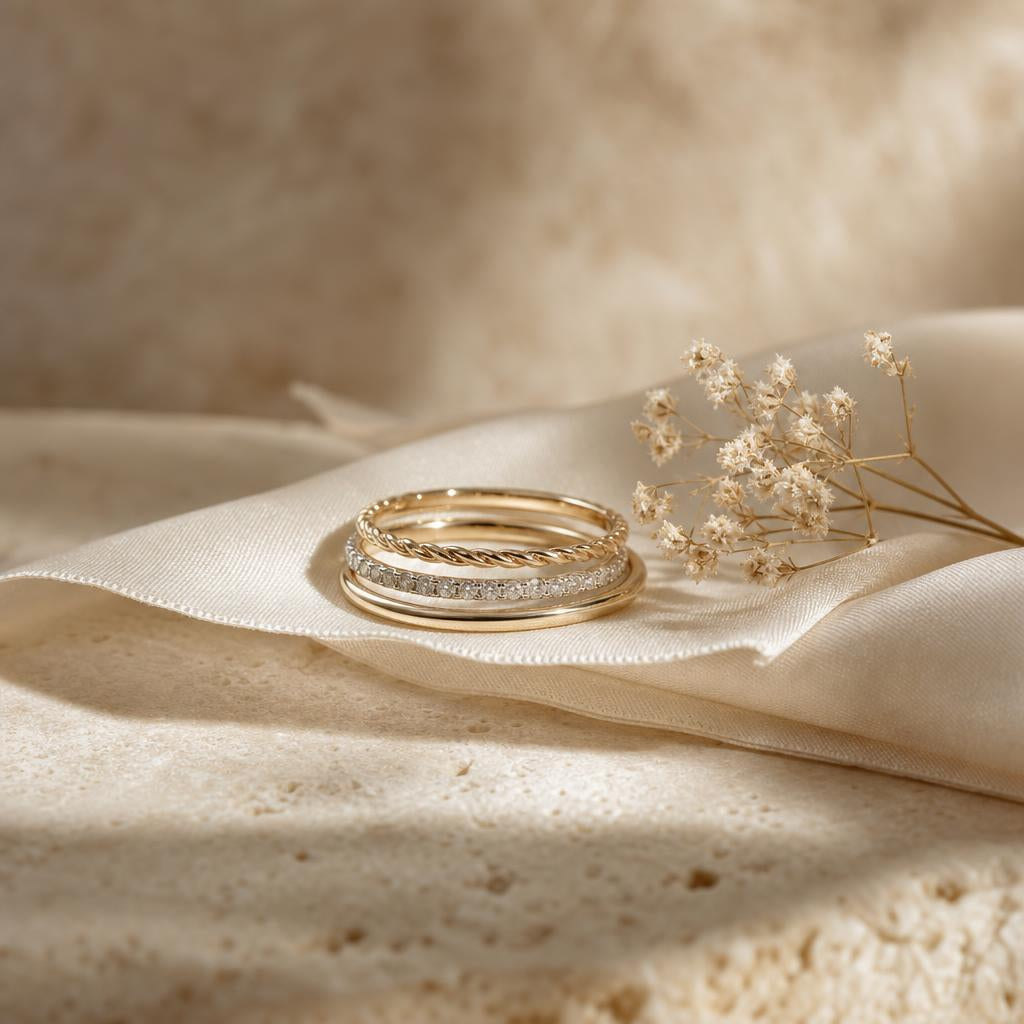
Guard Ring Jewelry: The Original Stacking Piece Making a Comeback
Every stacking trend on your feed right now — the thin bands, the layered metals, the ring that sits so close to your center stone it looks welded there — is a reissue. Decades before "stacking" was a hashtag, women were doing the exact same thing for a much more practical reason: to keep a ring from spinning, slipping, or getting scratched. They called it a guard ring, and it may be the most useful piece of jewelry history you've never heard of.
A guard ring was never meant to be decorative first. It was a plain or gently detailed band worn directly against a solitaire, holding it in place and taking the daily wear so the center stone didn't have to. What's interesting is how closely that original purpose maps onto why so many women build a ring stack today — not for tradition, but because a second band genuinely makes the first one look more finished, sit more securely, and read as intentional rather than accidental.


What a Guard Ring Actually Is
Strip away the vintage packaging and a guard ring is a simple idea: a second band, usually plainer or narrower than the ring beside it, worn to steady a stone that would otherwise shift around the finger all day. Grandmothers wore them because rings weren't sized as precisely as they are now, and a slightly loose solitaire needed something to hold it in place between resizings. Jewelers wore them into the display case for the same reason retailers still describe guard ring jewelry today — as a piece designed to frame and support an existing ring rather than to stand alone.
The name itself gives it away. It guards. Not in a dramatic sense — it's not protecting the ring from theft or damage in some cinematic way — it's doing the quiet, unglamorous work of keeping a stone centered, a band from twisting, and a setting from taking the brunt of everyday knocks that would otherwise land directly on the center stone.
Worth knowing: The instinct to add a second band next to your main ring isn't a modern invention or a TikTok trend — it's one of the oldest, most practical habits in jewelry history, and it solved a real problem long before "stacking" had a name.
Why the Guard Ring Never Actually Disappeared
It didn't vanish so much as get renamed and redistributed. What used to be called a guard ring is now split across several modern categories — stacking bands, eternity rings, wedding bands worn on their own — all doing versions of the same original job. The difference is that today's version isn't hiding a fit problem. It's a deliberate style choice, and one that happens to solve the same practical issue it always did: a ring that sits close to your main piece keeps everything from sliding around and looks considered rather than like an afterthought.
The Cherish Ring is a clean example of how that logic translates into a modern band. Its bezel setting means there's no raised prong catching on fabric or snagging your main ring when you slide it on — the smooth edge does exactly what a traditional guard ring was built to do, minus the vintage fuss.

The Cherish Ring
A rubbed-edge bezel setting reimagines the eternity band with individually held stones — smooth enough to sit flush against a solitaire without catching or shifting.
Shop The Cherish Ring →The Difference Between a Guard Ring and a Simple Stacking Band
Technically, not every stacking band is a guard ring, even though the two get used interchangeably now. A true guard ring was fitted to sit directly against a specific solitaire, sometimes even curved or notched to hug its shape exactly. A stacking band is more flexible by design — meant to move between different rings, add or subtract from a look, and work across more than one combination. That flexibility is actually the better fit for how most women build a collection today: not one ring locked to one guard for life, but a small rotation of bands that can shift depending on what else is on the hand that day.
That's part of why so many buyers researching guard rings online end up choosing a stacking band instead once they understand the distinction — it does the same visual and physical job without locking them into a single pairing.
How to Choose a Modern Guard-Style Band
If you're shopping for something that does what a guard ring traditionally did — sits close, doesn't compete with your main ring, and reads as one cohesive look rather than two separate pieces — a few details matter more than the rest:
- Width matters most. A band noticeably thinner than your main ring reads as a support piece. One that's equal or wider starts to compete for attention.
- Setting height should match or sit lower. A raised setting next to a low-profile solitaire creates a gap where dirt and catching fabric both become problems.
- Curved profiles hug better than straight ones. If your main ring has any curve to its shank, a slightly curved band will sit flush instead of leaving daylight at the sides.
- Metal tone should be intentional, not incidental. Matching exactly reads as classic; a deliberate contrast reads as considered. An accidental mismatch just reads as unplanned.
The Devotion Ring is worth a closer look here because its channel-set baguettes create a completely flat, edge-to-edge surface — nothing raised, nothing to snag, and a silhouette narrow enough to sit directly beside a solitaire without adding visual weight.

The Devotion Ring
A continuous circle of baguette-cut simulated diamonds set flush into the band — sleek, low-profile, and built to sit directly against another ring without competing.
Shop The Devotion Ring →What separates a good pairing from an accidental one
The easiest way to tell if a band is genuinely working as a guard piece is to look at the gap where the two rings meet. If there's a visible sliver of finger showing between them, or the stones angle away from each other instead of sitting parallel, the pairing isn't doing its job yet — even if each ring is beautiful on its own. Try rings on together before deciding, not just side by side in photos.
Building a Stack Around the Guard Ring Idea
Once you understand the original logic — support first, decoration second — building a stack gets a lot less overwhelming. Start with one band that genuinely functions as a guard: narrow, flush, close in tone to your main ring. From there, you can add pieces that lean more decorative, knowing your base pairing is already doing the structural work.
The Amore Ring works well as a slightly bolder second layer once that foundation is set — its row of oval stones adds presence without destabilizing a stack that's already anchored by a flush-fitting band underneath.

The Amore Ring
A bold row of oval simulated diamonds set edge to edge — the layer to add once your base pairing already sits flush and secure.
Shop The Amore Ring →And if you want something with a little more character than a straight band, The Wishbone Ring keeps the same low, flush profile a guard ring needs while adding a curved silhouette that reads as considered rather than plain — proof that "functional" and "plain" were never actually the same requirement.
✦ Pro tip: Buy your guard-style band in the same metal tone as your main ring first, then experiment with contrast pieces later. It's much easier to add a bold contrast layer to an already-cohesive base than to fix a stack that started mismatched.
Why This Matters More Than It Sounds
None of this is really about vintage trivia. It's about understanding that the ring stack you're building has a functional ancestor, which means the choices that make a modern stack look expensive and intentional aren't arbitrary — they're the same choices that made guard rings work a century ago. Sit close. Sit flush. Let one piece support the other instead of competing with it. Everything else is styling on top of a genuinely sound foundation.
Quick Takeaways
- A guard ring is a band worn against a solitaire to keep it centered and protected — the functional ancestor of today's stacking trend
- Width, setting height, and curve all determine whether a band sits flush or fights with your main ring
- A bezel or channel setting mimics the smooth, snag-free profile of a traditional guard ring
- Match metal tone for your base pairing, then add bolder layers once that foundation is set
- Try rings on together before buying — the gap between two rings tells you more than photos ever will
Frequently Asked Questions
What is a guard ring used for?
A guard ring sits directly against a main ring, usually a solitaire, to keep it centered on the finger and take on the daily wear that would otherwise land on the center stone. Historically it also helped compensate for a ring that fit slightly loose.
Are guard rings real, or just a marketing term?
They're a genuinely old jewelry category, not a modern invention. The concept predates contemporary stacking bands by generations — what's changed is that the same idea is now framed as an intentional style choice rather than a fit workaround.
Do ring guards actually work for keeping a ring in place?
Yes, when the width and profile are chosen correctly. A snug, flush-fitting band beside your main ring genuinely limits how much it can shift or spin — the same mechanical principle jewelers relied on before modern sizing made it less of a necessity.
Can any stacking band function as a guard ring, or does it need to be a specific style?
Most low-profile bands can do the job if the width and setting height are close to your main ring. Bezel and channel settings tend to work best since there's nothing raised to catch or create a gap — a solitaire or heavily domed band is harder to pair flush.
The instinct that made a woman reach for a second band a hundred years ago is the same one driving every stacking photo on your feed right now — she wanted her ring to sit right, look finished, and hold its own through an ordinary day. That's not a trend cycle. That's just good jewelry logic, worn quietly on the hand of anyone smart enough to notice it works.


