

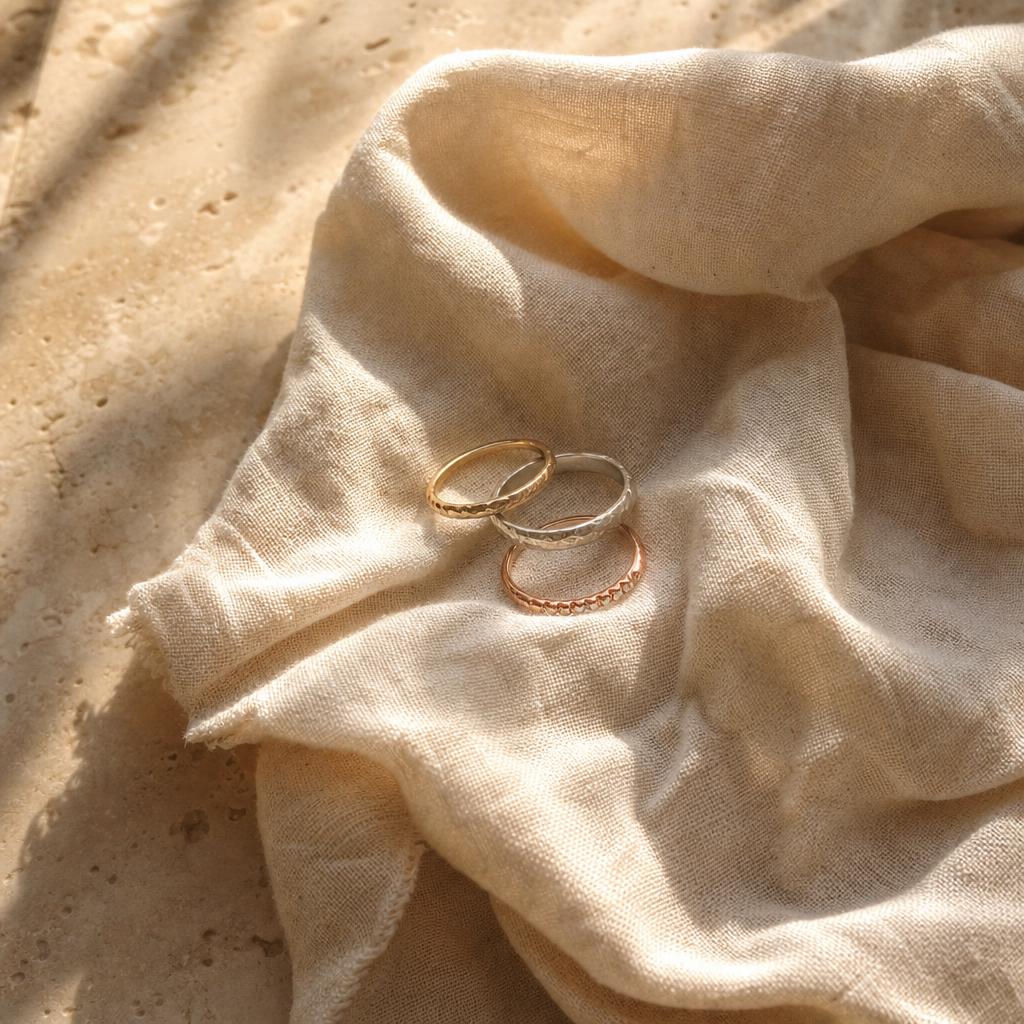
How to Style Rings for a Casual Outfit Without Overdoing It
There's a specific kind of ring that looks wrong with a Tuesday outfit — too much shine, too much occasion, too much "I got dressed for this." And then there's the kind that just works, whether you're in jeans and a white tee or actual real clothes for once. The difference usually has nothing to do with price and everything to do with which rings you reach for on an ordinary day.
Most styling advice skips straight to special occasions — what to wear to a wedding, what to wear on a first date — and leaves the other 350 days of the year to chance. So here's the part nobody writes about: how to wear rings on the days when nothing in particular is happening, and still have them look considered instead of accidental.


What "Casual" Actually Means for a Ring
Casual doesn't mean cheap-looking or plain. It means a ring that doesn't ask anything of you — you don't have to think about whether it matches, whether it's "too much" for running errands, or whether it'll catch on your bag strap while you're juggling coffee and a phone call. A genuinely casual-friendly ring has a few things in common: a lower profile that sits close to the finger, a setting that resists snagging, and a shape simple enough to read as effortless rather than event-specific.
That's a narrower list than it sounds like. A lot of rings that look casual in a product photo — thin band, single stone — actually sit high off the hand or have prongs that catch on everything from sweaters to seatbelts. The rings that hold up to real, unplanned days tend to share a quieter set of features: bezel settings, flush-fitting bands, and stones cut close rather than perched.
Worth knowing: "Low profile" isn't just a look — it's a practical spec. A bezel-set stone sits flush inside a metal rim instead of held up by prongs, which means fewer snag points and a ring that reads as quiet even when the stone itself is sizable.
The Rings That Work Hardest for Everyday Wear
If you're only going to wear one ring on a given day, it should be one that can survive whatever that day throws at it — typing, driving, carrying groceries, pulling a sweater over your head. A bezel-set ring built for stacking is designed exactly for this: the smooth metal edge protects the stone and keeps the whole piece low enough that it doesn't announce itself.
This is also where a lot of people overcorrect. In an effort to look "put together," it's tempting to reach for the biggest or most detailed ring in the box on a random Wednesday. But an oversized halo or a heavily embellished setting almost always reads as dressed-up, even paired with the most casual outfit imaginable. The fix isn't to avoid rings on casual days — it's to build a small, specific rotation of pieces that were never trying to be formal in the first place.

The Beatrice Ring
A slim pavé band that sits flush against the hand — the kind of piece you forget you're wearing until someone compliments it.
Shop The Beatrice Ring →One Ring, No Overthinking
There's a strong case for keeping it simple on days when you don't want to think about your hands at all. A single solitaire — nothing else on the finger, nothing competing for attention — is one of the easiest ways to look intentional without doing any actual styling work. It reads as a choice rather than an afterthought, which is exactly the opposite of what you'd expect from "doing less."
The trick is picking a solitaire that's genuinely simple rather than simple with a catch. A round or emerald-cut stone in a clean setting, without a hidden halo or dramatic side stones, is the version that actually functions as a one-and-done ring. It works with a blazer, it works with a hoodie, and it doesn't need a second ring to make sense.
Building a Low-Effort Stack for Jeans-and-a-T-Shirt Days
Stacking has a reputation for being fussy — something you plan out, photograph, and adjust twenty times before leaving the house. It doesn't have to be. A casual stack is really just two or three thin, flush-fitting bands worn together, chosen so none of them fight for space or catch on each other.
The easiest formula: one band with texture (a pavé line, for example), one plain band, and your main ring. Keep the widths close to each other so nothing sits noticeably higher than the rest — a wide statement band next to a hair-thin one tends to look unfinished rather than deliberate. If you want a quick gut check, put the stack on and make a fist. If nothing shifts, catches, or feels unbalanced, it's ready for a normal day.
✦ Pro tip: Put your least delicate ring closest to your palm and your most detailed piece on the outside of the stack. It protects the finer setting from the most contact and naturally draws the eye to the ring you actually want noticed.
Rings That Survive Real Life
Casual days usually involve more physical contact than dressed-up ones — bags, gym bags, car doors, keyboards. This is where setting type matters more than almost anything else. Prong settings, especially tall ones, are the most likely to snag on fabric or knock against hard surfaces. Bezel and flush settings are built to take that kind of contact without loosening a stone or bending a prong out of shape.
If you spend your casual days doing anything with your hands — cooking, working out, typing for hours — it's worth having at least one ring in rotation that's specifically chosen for durability rather than looks alone. It doesn't mean sacrificing style; a bezel-set ring can still have real presence. It just means the presence doesn't come at the cost of practicality.
When You Want a Little More Polish Without Trying Too Hard
Some casual days still call for slightly more — brunch instead of errands, a coffee date instead of a grocery run. This is where a single architectural detail, rather than a whole dressed-up look, does the job. A baguette-accented band or a subtle eternity line adds visual interest without moving into "special occasion" territory, because the shape is still restrained even if the detailing is a step up.

The Evermore Ring
Baguette-cut stones set in a clean eternity line — enough detail to feel elevated, restrained enough to still read as effortless.
Shop The Evermore Ring →This is also a useful ring to swap in when you want to go from a casual look to something slightly dressier without changing your whole hand. Add one more subtle piece to an existing stack, and the shift from "everyday" to "actually put together" happens without a full re-do.
Metal Tones and Mixing Without Overthinking It
The old rule — match every metal exactly — has mostly fallen away, and casual styling is where that shows the most. A silver band next to a warm gold one reads as intentional now, not mismatched, as long as the overall look stays simple. The rule that actually still matters is proportion, not color: keep band widths and stone sizes in a similar range so the mix feels like a set rather than a pile of unrelated pieces.
If mixed metals still feel risky, start small — one warm-toned piece next to two silver ones, rather than an even split. It's an easy way to test whether the combination works for your everyday rotation before committing a whole stack to it.
Quick Takeaways
- Bezel and flush settings are the most snag-resistant choices for daily wear — reach for them first on physically active days.
- A single clean solitaire is the fastest way to look intentional without any actual styling effort.
- Keep casual stacks to two or three bands with similar widths so nothing looks unbalanced or accidental.
- One architectural detail — like a baguette line — adds polish without tipping a look into "dressed up."
- Mixed metals work for everyday wear as long as proportions stay consistent across the pieces.
Frequently Asked Questions
Is it okay to wear the same ring every single day?
Yes — daily wear is exactly what low-profile, bezel-set, or flush-fitting rings are designed for. The main thing to watch is fit: a ring worn constantly should feel secure but never tight, since fingers change size slightly throughout the day.
How many rings is too many for a casual look?
There's no fixed number, but two or three tends to be the sweet spot for daily wear. Beyond that, a stack starts to need more upkeep — checking for shifting, snagging, and balance — than most casual days call for.
Do statement rings ever work for a casual outfit?
Occasionally, but they generally read as more dressed-up no matter what they're paired with. If you love a bigger piece, try wearing it alone rather than stacked — a single statement ring with nothing else on the hand keeps the rest of the look casual by comparison.
Should casual rings match my watch or other jewelry?
Not strictly. Tonal harmony matters more than exact matching — a silver ring and a gold watch can absolutely work together as long as nothing else on your hand or wrist is competing for attention.
The easiest way to make rings feel like a natural part of your everyday look, rather than something reserved for special occasions, is to stop treating jewelry decisions as all-or-nothing. A couple of well-chosen, durable pieces — worn on repeat, in whatever combination fits the day — will always look more considered than a single "occasion" ring pulled out only when something's happening. Casual doesn't mean careless. It just means choosing pieces built to keep up.


