

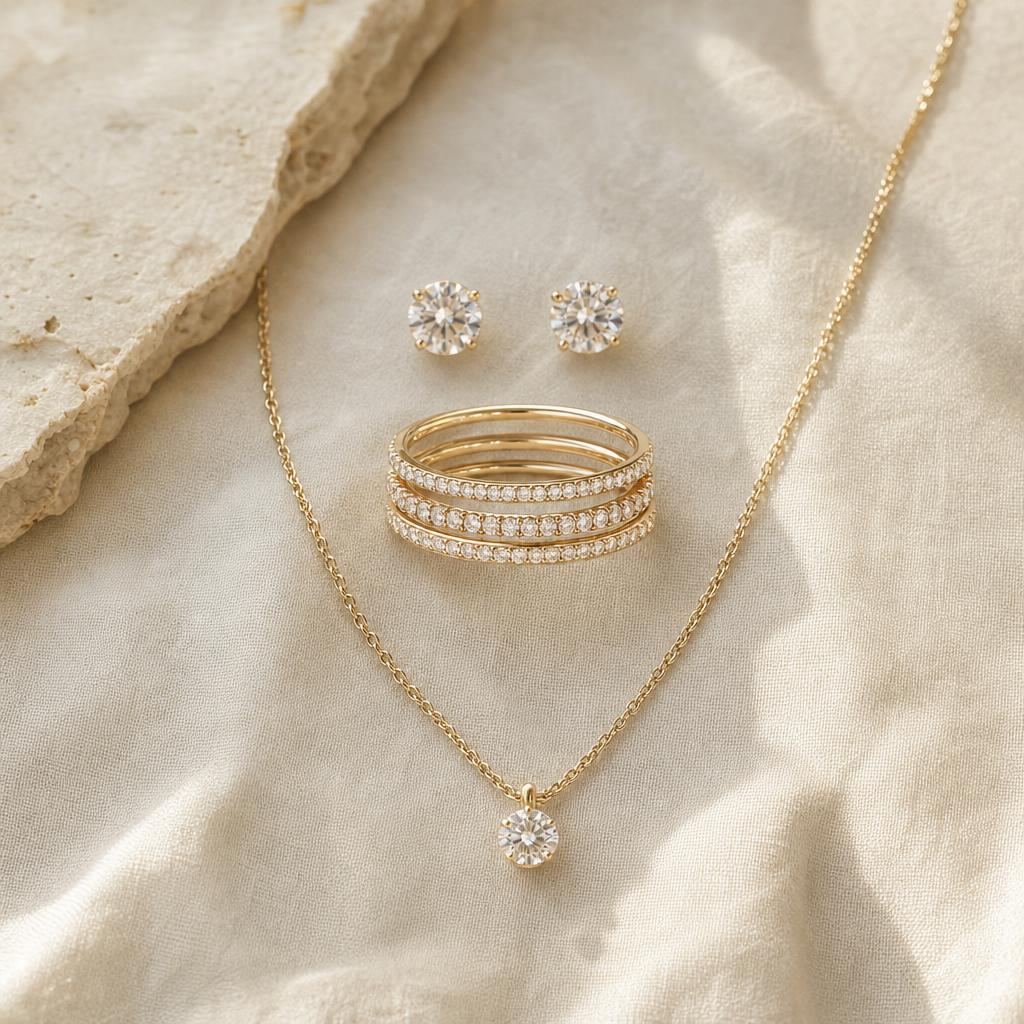
How Much Jewelry Is Too Much? Layering a Ring Stack, Necklace and Earrings in One Day
You put on the ring stack, the pendant, the studs, and then you stop in front of the mirror and ask the question every well-dressed woman asks: how much jewelry is too much? The honest answer has nothing to do with a magic number. It comes down to how many things on you are competing for attention.
Rings, a necklace and earrings are three separate conversations with the eye. Once you know how to run all three at once, you can wear the full look any day you want, and it will read as deliberate every time. Here are four pieces from the Gemiros collection that make a good starting lineup.


Stop counting pieces. Start counting statements.
The popular advice is a piece count: three items, five items, never more. It sounds tidy, but it fails the moment you wear a stack of four slim bands, which is one visual idea made of four pieces. A woman in a single oversized cocktail ring and chandelier earrings has worn two items and far too much.
So the unit that matters is the statement: any piece that asks to be noticed. Sparkle that is small, close to the skin and repeated in a pattern reads as texture. Sparkle that is large, isolated or in motion reads as a statement. Most of the rules for wearing jewelry that actually hold up come down to this one distinction.
The working formula: one lead statement, two supporting voices, everything else is texture. Texture is allowed to be plentiful. Statements are not.
Pick one lead, and let it be a different category each day
Decide which of the three zones is the star before you put anything on. If your hand is the headline, with a bold ring or a full stack, keep the necklace to a single clean pendant and the earrings to studs. If your ears are the headline, let your hands go quiet. If the necklace leads, as it would with a V-neck or an open collar, the rings step back to one or two slim bands.
This rotation is what keeps a complete look from reading as cluttered. You are never competing with yourself. And because you change the lead from day to day, a small collection stays interesting.
Layer from the hand outward
The ring stack: odd numbers and one anchor
Start with the ring stack because it is the most architectural part of the look. Three slim bands is the sweet spot: one with a continuous row of stones, one that is plainer, and one that adds a different texture. Odd numbers sit more naturally on the hand than even ones. The Everlasting Ring gives you an unbroken line of stones to build around, and a channel-set band like the Infinity Ring sits beside it without fighting for the same visual space. If you want to see more ways to pair them, we mapped out stacking combinations that look intentional.
The width question matters too. If you are weighing half eternity or full eternity as the base of the stack, a full band gives you a constant shimmer that holds up from every angle, while a half band lets the bands next to it carry more of the look.
The necklace: one pendant, or one stack, never both
Once the hand is set, move to the neck. A single solitaire pendant sits like a period at the end of a sentence. It adds sparkle without adding noise, which is exactly why it pairs so well with a stack on the hand. A round brilliant like the Éclat Moissanite Necklace has the same shape logic as a round stud, so the necklace and earrings echo each other without matching.
If you layer two or three chains, space them roughly two inches apart so each one has its own territory. Knowing what to layer first keeps the lengths from tangling into one blur, and if your chains are different metals, repeat one finish somewhere else in the look so the mix reads as chosen.
The earrings: the quietest voice in a full look
When rings and a necklace are both present, earrings should almost always be a stud or a small huggie. Small round stones at the ear frame the face and pick up the light without turning into a third statement. Save the larger drops for the days when your ears lead and everything else is minimal.

The Cherish Ring
A bezel-set stacking band. The bezel gives the stack a smooth, low-profile edge, a good contrast to a band with stones set in a continuous row.
Shop The Cherish Ring →Repeat one thing, vary everything else
A full look feels composed when one element repeats. It might be a stone shape (round in the stud, round in the pendant, round in the band), a metal tone, or a setting style. The repeat is the thread that ties three categories together. Everything else is free to vary: scale, texture, length.
That is also the answer to the old matching question. You do not need a set. You need one echo. If you have ever wondered whether your ring has to match your jewelry, the short version is that a shared shape or tone does the job that a matching set used to do, with more personality.
✦ The mirror test: Look at yourself for three seconds, then look away. If you can name more than one piece you noticed, remove the one that is not the lead.
A few combinations that work
| Lead | Hands | Neck | Ears |
|---|---|---|---|
| Hands | Three-band stack | One small pendant | Studs |
| Neck | One or two slim bands | Pendant plus a second chain | Small studs |
| Ears | A single band | Bare, or a very fine chain | Larger drops or huggies |
| Nothing (everyday) | One band | One pendant | Studs |

The Lume Moissanite Necklace
A four-prong round moissanite solitaire in a floating design. It reads as a clean point of light, which makes it an easy neck piece when your hands or ears are leading.
Shop The Lume Moissanite Necklace →The comfort check nobody mentions
Too much jewelry is not only a visual problem. It is a practical one. If you are untangling chains, pushing rings around your fingers or catching a pendant on a sweater, the look is working against you. Pieces that sit flush and stay put, like slim bands and small solitaires, let you forget you are wearing them. That is a better test of a good outfit than any rule.
Gemiros pieces are nickel-free and hypoallergenic, so a full look is one you can leave on all day. Moissanite passes diamond testers, so the sparkle holds up to close inspection.

The Vivara Moissanite Huggie Hoop Earrings
Pavé moissanite huggies that hug the lobe. They bring a line of sparkle to the ear without competing with a stack or a pendant.
Shop The Vivara Huggie Hoops →Build the look in the order you will wear it
If you are starting from scratch, buy in the order that gives you the most outfits. Begin with the stack base and one band to pair with it. Add a single pendant. Add studs. That is a complete look at its smallest, and every piece you add after that expands what you can do rather than repeating it. For a lighter version of the same idea, the clean-girl ring stack shows how far two or three slim bands can go.
Quick Takeaways
- Count statements, not pieces. A stack of slim bands is one idea.
- Choose one lead zone (hands, neck or ears) and keep the other two quiet.
- Repeat one element, such as a stone shape or metal tone, instead of matching a set.
- Use the mirror test: if you notice more than one piece, remove one.
- If a piece tangles, snags or shifts, it is too much for that day.
Frequently asked questions
How much jewelry is too much for a woman?
It is too much when more than one piece is competing for attention. Pick one lead, keep the other two zones quiet and let slim, close-fitting pieces act as texture.
What is considered excessive jewelry?
Several large statement pieces worn at once, such as a cocktail ring, a bold collar and chandelier earrings together. Practical signs include constant adjusting, tangled chains and snagged fabric.
What is the 2:1:1 rule for jewelry?
Stylists cite several shorthand ratios for balancing a look, and none of them is universal. The lead-and-support formula above gives you the same balance without needing to memorize a ratio.
What jewelry can be worn daily?
Pieces that are comfortable and secure: slim bands, a small solitaire pendant and stud earrings. Nickel-free, hypoallergenic pieces suit sensitive skin.
Can I wear rings, a necklace and earrings all on the same day?
Yes. Choose one lead, repeat one element across the three, and keep the supporting pieces small. Done that way, it looks like a complete outfit rather than too much.
The smartest version of more
You do not need permission to wear all three, and you do not need a rule to tell you when to stop. You need a lead, an echo and a mirror. Build the look once and it works every morning after.


