

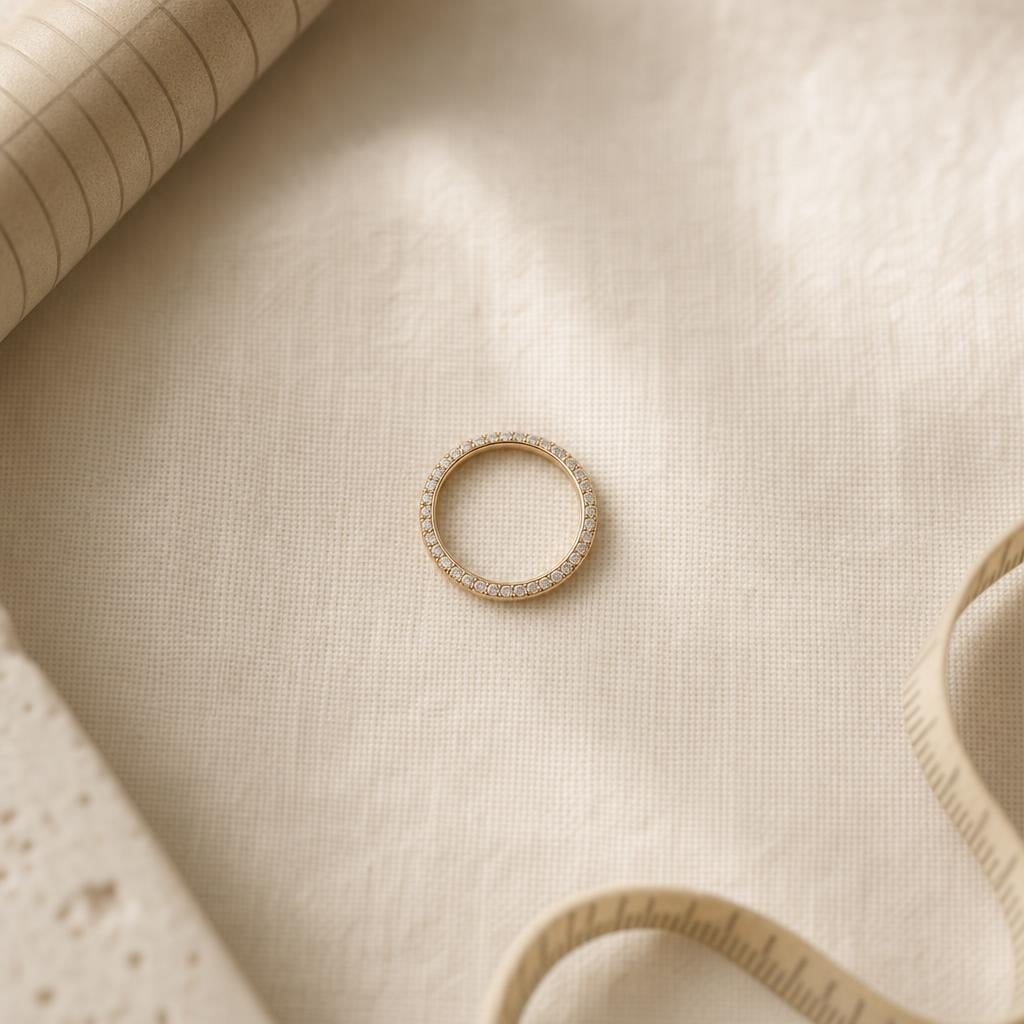
The Half-Size Ring Debate: What to Do When You're Between Sizes
You measure your finger, land squarely between a 6 and a 6.5, and then discover the ring you love only comes in whole sizes. It's a strangely common moment — and it derails more ring purchases than almost any other sizing issue, mostly because nobody explains why it happens or what to actually do about it.
Half sizes aren't universal, and there's a real reason for that, not just an oversight. Once you understand why some jewelers skip them entirely, the workarounds start to make a lot more sense — and most of them are simpler than you'd expect.


Why Half Sizes Aren't Always an Option
Most fine jewelry brands — Gemiros included — stock rings in whole US sizes, typically running from a 5 up through a 9. That's not an accident or a gap in the catalog. Producing a ring in half sizes essentially doubles the number of variants a brand has to manufacture, hold in inventory, and keep in stock across every single style. For a brand with dozens of designs, that multiplies fast, and it usually means thinner inventory spread across twice as many SKUs — which in practice leads to more sizes going out of stock, not fewer sizing headaches.
There's also a fit reality worth knowing: the difference between a whole size and its neighbor is only about 0.4mm in diameter. That's a genuinely small gap, and it's exactly why the workarounds below are so effective — you're rarely bridging a large distance, just a small, manageable one.
Worth knowing: A 0.4mm difference between whole sizes sounds tiny, but on a knuckle-sensitive hand it can be the difference between a ring that glides on comfortably and one that needs real effort to get past the first joint. Small gap, real impact — which is exactly why it's worth solving properly rather than just picking "closest size" and hoping.
What "Between Sizes" Actually Means for You
If you've measured and landed between two whole sizes, you're not dealing with a rare problem — it's one of the most common outcomes of at-home sizing, because fingers don't measure in tidy round numbers. The real question isn't whether you're between sizes; it's which direction makes more sense for the specific ring you're buying, and that depends heavily on the setting.
A slim solitaire band behaves differently than a wide eternity band. A ring with a lot of metal at the base of the finger — like a stacking piece designed to sit flush against another ring — has less room to be forgiving than a simple, single band. That's part of why sizing a stack needs its own logic entirely; the rings around your engagement ring often carry tighter tolerances than the engagement ring itself.

The Everlasting Ring
A continuous line of pavé simulated diamonds designed to sit flush against another band — a style where getting the size right matters more than usual, since there's no gap to hide a slightly loose or tight fit.
Shop The Everlasting Ring →The Fixes That Actually Work
None of these require finding a jeweler who happens to stock half sizes. They're practical, inexpensive, and mostly things you can do the moment your ring arrives.
- Ring sizers and adjusters — small silicone or metal inserts that clip discreetly onto the inside of the band, tightening the fit by a fraction of a size without any permanent change to the ring.
- Sizing beads — tiny metal balls a jeweler solders to the inside of the band, a slightly more permanent version of the same idea, best for a ring you know you'll wear long-term at that size.
- Professional resizing — for solid metal bands, a jeweler can often stretch or compress the shank itself, though this works better for some settings than others.
- Sizing up and living with a sizer — for most people, ordering the larger of the two whole sizes and adding an inexpensive sizer if needed is the simplest, most reversible option.
✦ Pro tip: When you're between sizes, size up rather than down. A ring that's slightly loose can be tightened cheaply and reversibly with a sizer or adjuster. A ring that's genuinely too tight is a much harder problem — and on some settings, not one that resizing can fully solve.
Sizing Up vs. Sizing Down: What Changes
| Choice | What Happens | How to Fix It |
|---|---|---|
| Size up (larger whole size) | Ring sits slightly loose, may spin or slide toward the knuckle | Silicone sizer, sizing beads, or an adjustable spacer — all quick, low-cost, reversible |
| Size down (smaller whole size) | Ring may not clear the knuckle, or feels tight and leaves a mark | Limited options — sometimes professional stretching, sometimes not resizable at all depending on the setting |
This is really the whole case for sizing up when you're stuck between two whole sizes: a loose ring is an easy problem with several affordable solutions, while a tight ring is a harder problem with fewer of them. It's not a universal rule for every situation, but it's the safer default when you don't have another way to confirm the exact fit.

The Devotion Ring
A circle of baguette-cut simulated diamonds with a structured, architectural profile — a style where a well-fitted silicone sizer works especially well, since the flat-edged band keeps its shape rather than shifting.
Shop The Devotion Ring →Ordering Online Without Half Sizes
Buying online without visiting a store adds another layer to this — you don't have the option to try on a neighboring size in person before deciding. A few things help close that gap:
- Measure more than once, ideally on a day when your hands aren't unusually warm, cold, or swollen.
- Measure the exact finger the ring is going on, not a similar-feeling one — sizes can genuinely differ finger to finger on the same hand.
- If you land between sizes, order the larger whole size and keep a sizer on hand as a backup, rather than guessing down.
- Check the brand's return or exchange policy before you buy, so a wrong-size order isn't a dead end.
What About Resizing Later?
Resizing is always worth asking about, but it isn't guaranteed to work the same way on every ring. Bands with a continuous row of stones, like eternity styles, are harder to resize than a plain shank because there's no stone-free section of metal to stretch or cut without disturbing the setting. A simple solitaire band, by contrast, usually has more flexibility. This is worth knowing before you buy, not after — it changes whether "I'll just get it resized" is actually a safety net or just a hope.
Quick Takeaways
- Most rings come in whole sizes only — this is standard, not a flaw in the brand you're buying from.
- The gap between whole sizes is small, usually around 0.4mm, which is why simple fixes work so well.
- When between sizes, size up — loose is easy to fix, tight is not.
- Silicone sizers and sizing beads are the two most reliable, low-commitment fixes.
- Eternity and stacking styles have less resizing flexibility than plain solitaire bands, so get the size right the first time if you can.
Frequently Asked Questions
Why don't more jewelers offer half sizes?
Mostly inventory logic — offering half sizes roughly doubles the number of variants a brand needs to stock per style, which stretches inventory thinner across more SKUs. Combined with how small the actual fit difference is between whole sizes, most brands find it isn't worth the added complexity.
Should I size up or down if I'm between two whole sizes?
Size up. A slightly loose ring can be tightened cheaply and reversibly with a sizer, spacer, or sizing beads. A slightly tight ring has far fewer good fixes, and forcing it over the knuckle repeatedly can be uncomfortable or even damage the ring over time.
Do ring sizers actually work, or are they just a temporary patch?
They work well for genuinely small gaps, which is exactly the kind of gap a half-size gap usually is. They're not meant to fix a ring that's a full size too big, but for bridging that in-between space, a good silicone sizer or set of sizing beads is a legitimate, long-term-usable solution — not just a stopgap.
Can every ring be resized to fit exactly?
No. Plain bands with no stones around the shank are usually the easiest to resize. Eternity bands, pieces with stones set all the way around, or bands with a distinct architectural profile are more limited — sometimes only resizable within a narrow range, sometimes not at all without disturbing the setting.
The half-size gap feels like it should be a bigger problem than it actually is. In practice, it's one of the most solvable sizing issues out there — a small, predictable gap with a handful of reliable, inexpensive fixes. Measure carefully, size up when in doubt, and keep a sizer on hand, and the whole-sizes-only reality of most ring shopping stops being a dealbreaker and starts being a minor, five-minute detail.


