

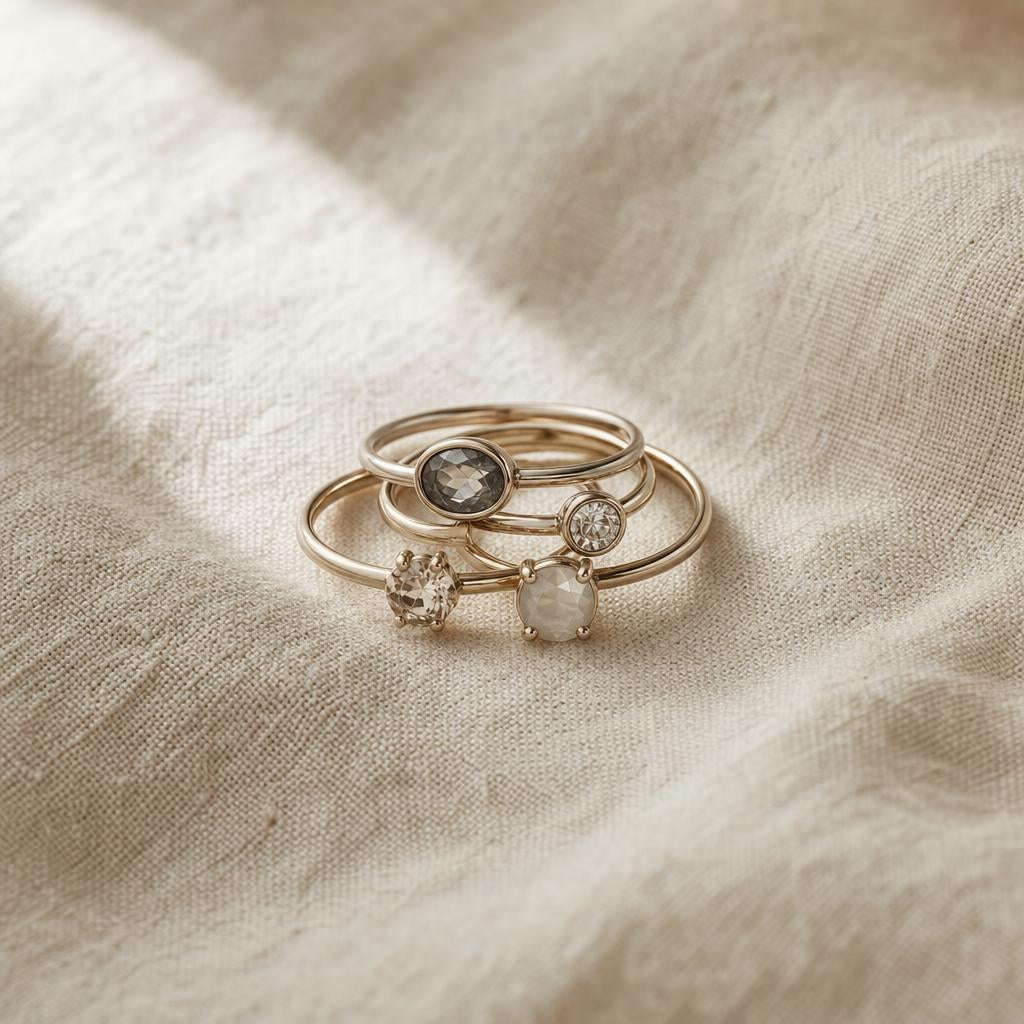
The Greige Ring Aesthetic: How Dainty Stacking Rings Build a Quiet, Neutral Look
There's a particular kind of ring collection that never announces itself. No single piece screams for attention — and that's exactly the point. Call it quiet, call it neutral, call it "greige" if you want the shorthand: it's the ring wardrobe built to work with absolutely everything you own, every single day, without you having to think about it twice.
It's not a trend so much as a correction — a move away from rings that only make sense with one outfit, one occasion, one mood. The greige ring aesthetic borrows its name from the interior design world's favorite non-color (grey plus beige, warm and cool at once), and applies the same logic to what you put on your hands: pieces so well-balanced they disappear into your look instead of competing with it.


What "greige" actually means on your hand
In design, greige exists because pure grey can feel cold and pure beige can feel dated — so the two get blended into something that reads as neither, and works with both. Rings work the same way. A greige ring isn't beige-toned or literally grey; it's a piece with no single dominant "mood" strong enough to clash with anything else you're wearing. Sterling silver and platinum-toned settings do this naturally. So do smaller stones, cleaner lines, and settings that don't need a matching outfit to make sense.
The woman building this kind of collection isn't playing it safe. She's made a calculated decision: rings that work everywhere are rings she'll actually wear every day, which means they earn their place in her jewelry box in a way a single showpiece never will. That's not a compromise. That's just better math.
Why quiet doesn't mean boring
There's a persistent myth that a quiet ring is a ring you settled for — something chosen because a bigger, louder piece wasn't in the cards. That's backwards. A quiet ring is a design decision with real intention behind it: less visual competition, more focus on craft, and a piece built to earn its place through wear, not through how it photographs on day one.
Gemiros rings in this register aren't muted because the sparkle is weaker — they're indistinguishable from a diamond up close, cut and set to catch real light, not staged studio light. The Solis Ring's round-cut center still throws serious brilliance; it's simply mounted in clean, low-drama pavé instead of a halo built to shout. Quiet is a setting choice, not a compromise on the stone itself.
Worth knowing: Sterling silver and platinum-plated settings are the neutral base of the greige aesthetic — they read cooler than yellow gold and warmer than stark white metal, which is exactly why they pair with almost anything already in your jewelry box.
Loud rings vs. quiet rings: what actually changes
The difference between a statement ring and a greige ring usually comes down to three or four decisions, not one dramatic choice. Here's the shorthand:
| Element | Statement Ring | Greige / Quiet Ring |
|---|---|---|
| Setting | Halo, hidden halo, three-stone | Solitaire, pavé, bezel |
| Metal tone | High-contrast yellow gold | Sterling silver, platinum tone |
| Band width | Wide, sculptural | Thin, low-profile |
| Best worn | Alone, as the focal point | Stacked or solo, every day |
Neither column is objectively better — a statement ring absolutely has its place. But if the goal is a ring you reach for without thinking, the right-hand column is the one worth building around.
Building the look: stacking rings as the foundation
If one ring can be quiet, a stack of them multiplies the effect — as long as you build it with restraint. Dainty stacking rings are the actual mechanism behind the greige aesthetic: thin, low-profile bands that add texture and dimension without adding visual noise. Instead of one ring doing all the talking, three or four do it in a whisper.
The trick is choosing pieces that were designed to sit together, not just next to each other. The Everlasting Ring's continuous line of 3mm stones gives a stack real substance without a single showy element. The Forever Ring below does the opposite job — half the sparkle of a full eternity band, worn solo or slid in as the quiet middle layer of a stack.

The Forever Ring
A 2.0mm half-eternity band that pairs with nearly any ring you already own, or holds its own worn alone. Understated by design, not by accident.
Shop The Forever Ring →Silver stacking rings in particular do a lot of quiet work here — they don't fight for attention against a warmer gold piece, and they photograph consistently in every kind of light, which matters more than people expect once you're wearing the same rings daily instead of for one event.
Mixing metals without breaking the quiet effect
The greige aesthetic doesn't require every ring to match exactly — it requires every ring to agree with each other. A sterling silver solitaire and a platinum-plated stacking band read as the same neutral family, even though they're not identical, because neither one pulls warm or cool hard enough to clash. The mistake isn't mixing tones; it's mixing a very warm yellow gold piece directly against a very cool white piece with nothing in between to bridge them.
A simple rule that holds up in practice: if you can't decide whether two rings match, put a neutral-toned piece between them in the stack. It does the visual work of a buffer, and the whole hand reads as one considered decision instead of three separate purchases worn at the same time.
The bezel effect: durability that also happens to be quiet
Bezel settings are having a real moment in the greige conversation, and it's not just aesthetic — a rubbed-edge bezel setting is genuinely more durable day to day than an open prong, because there's no raised metal to catch on sweaters, gym equipment, or a car door. The look happens to be quiet as a side effect of being practical.

The Cherish Ring
Individually bezel-set stones create a smooth, low-profile "bubble" effect around the finger — secure, snag-resistant, and quietly dimensional stacked or worn alone.
Shop The Cherish Ring →Solitaire as the anchor piece
Every greige ring collection needs one anchor — a single stone that can stand alone on a bare hand and still hold interest without a halo or a supporting cast of side stones. This is where a clean solitaire earns its keep. The Ovia Ring's oval center does exactly this: enough presence to read as intentional, not so much that it demands a matching everything-else.
This is also where minimalist jewelry logic pays off long-term. A single well-chosen solitaire outlasts trend cycles precisely because it was never chasing one — it's the piece you can wear to a Tuesday desk job and a Saturday dinner without changing anything about it.
Building a capsule jewelry collection around one aesthetic
The greige approach is really a capsule philosophy applied specifically to rings: a small, deliberate set of pieces chosen because they work together, rather than a drawer full of one-off purchases that each only make sense with one outfit. Think in terms of roles, not just pieces — one solitaire, two or three stacking bands, maybe one bezel piece for texture. Everything after that is optional.
The payoff is real: getting dressed stops being a negotiation with your jewelry box. You reach for the same handful of rings because they were built to go together, and every combination reads as considered rather than accidental.
Quick Takeaways
- Greige rings work with everything because no single piece dominates the look — sterling silver and platinum tones are the neutral base.
- Quiet doesn't mean lower quality: Gemiros settings are indistinguishable from a diamond up close, just mounted to minimize visual noise.
- Thin stacking bands do the heavy lifting — texture and dimension without added visual volume.
- Bezel settings pair durability with a naturally low-profile look.
- One solitaire anchor plus two or three stacking bands is enough to build a full capsule.
Frequently Asked Questions
What does the "greige" ring aesthetic actually mean?
It means choosing rings with no single dominant color, cut, or setting strong enough to clash with anything else you wear — the ring equivalent of a neutral that goes with every outfit. Sterling silver and platinum-toned settings, smaller stones, and clean lines are the usual building blocks.
What is a capsule jewelry collection?
A capsule jewelry collection is a small, curated set of versatile pieces designed to work across every outfit and occasion, instead of a large collection where most pieces only suit one look. Applied to rings, it usually means one solitaire, a couple of stacking bands, and maybe one textured piece — nothing more is required.
Are dainty stacking rings hard to keep in order when you take them off?
Not if you buy pieces from one deliberate collection rather than a dozen unrelated sources — consistent band widths and matching metal tones mean any combination looks intentional, so there's no "correct" order to remember.
Does sterling silver count as a neutral metal for this look?
Yes — sterling silver and platinum plating are the coolest-toned, most neutral options in the Gemiros collection, which is why they anchor the greige aesthetic. They read calmer than yellow gold and less stark than polished white gold, sitting comfortably between the two.
Can I mix silver and gold-toned rings in the same stack?
Yes, as long as one piece isn't fighting the other for attention. A neutral-toned ring — sterling silver or platinum plating — placed between a warmer and cooler piece usually solves any clash, letting the whole stack read as intentional rather than mismatched.
A quiet ring collection isn't the absence of a point of view — it's a very specific one. It says you'd rather wear something every day than save it for occasions that come around twice a year, and that a ring earns its place through how often you reach for it, not how loudly it announces itself the first time someone sees it. That's not settling. That's just smarter.


