

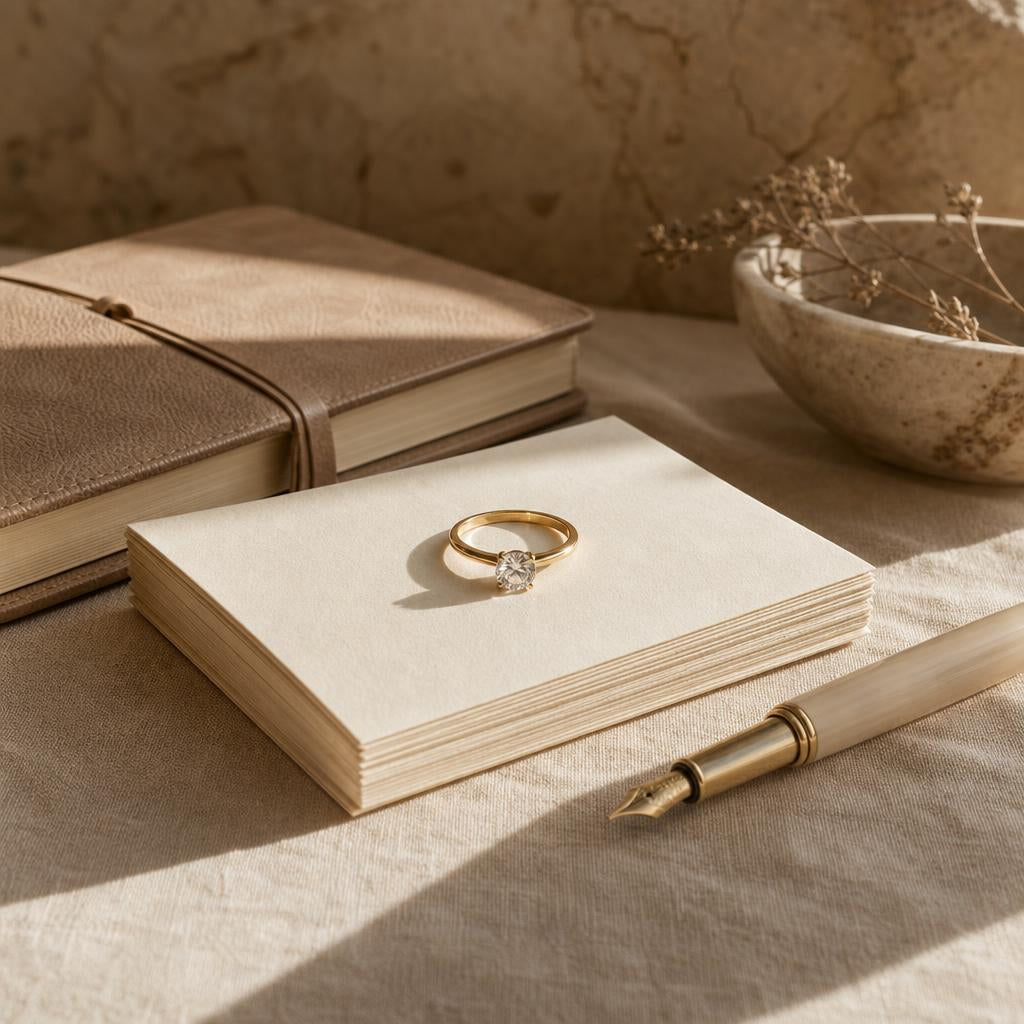
The Engagement Ring Salary Rule Is a Myth: What Partners Get Wrong About Ring Budgets
Somewhere between the proposal fantasy and the actual purchase, you ran into a number. Two months' salary. Three months'. A rule that sounds official enough to plan a budget around — except it isn't a rule at all, and building your engagement ring budget on it might be the first mistake you make.
The good news: once you know where that number actually came from, the rest of the decision gets a lot clearer, considerably less stressful, and a lot more about her than about a stranger's marketing copy.


Where the Engagement Ring Salary Rule Actually Came From
Here is the part almost nobody tells you when they repeat the two- or three-month rule like it's inherited wisdom: it was invented by an advertising agency. De Beers commissioned the line in the 1930s, refined it into "A Diamond Is Forever" by 1947, and spent decades reinforcing the idea that love could be measured in payroll cycles. It worked so well that people still recite it at bachelor parties as though it came from a financial advisor instead of a diamond cartel's marketing department.
No lender would tell you to size a purchase around a slogan. No financial planner recommends spending a fixed percentage of income on a single non-liquid item because a jewelry company said so ninety years ago. The rule survived because it was designed to survive — not because it was ever good advice.
Worth knowing: The "two months' salary" line was a marketing campaign run by a diamond company decades before either of you were born — not a financial guideline, and not a measure of how much someone loves you.
The Three Things Partners Actually Get Wrong
Once the salary rule is off the table, most of the real mistakes partners make have nothing to do with the number itself. They're about what the number is standing in for.
Mistake One: Confusing Price With Value
A higher price tag doesn't automatically read as more thoughtful — it just reads as more expensive, and those are different things. What actually communicates consideration is a ring that fits her hand, her style, and the life she already lives. A cushion halo picked because she's mentioned loving cushion cuts for a year says more than a bigger stone picked because it cost more.
Mistake Two: Guessing Instead of Researching Her Style
The biggest risk isn't spending too little — it's spending confidently on the wrong style. Save the sizing math for later and start with what she actually wears daily: the metal tone already in her jewelry box, whether she leans toward a quiet solitaire or something with more pavé sparkle, whether she's ever paused on a ring in a store window. This is research anyone can quietly do over a few weeks.
Mistake Three: Ignoring What She'll Actually Wear Every Day
An engagement ring gets worn more than almost anything else she owns — through typing, cooking, gym bags, and years of daily life. A setting that photographs dramatically but snags on everything isn't a gift, it's a maintenance problem. Low-profile settings and secure prongs matter more, long-term, than raw carat size.

The Ophelia Ring
An oval center stone in a hidden halo pavé setting, styled to look like it costs $15,000 or higher — because a bigger number was never the part that made a ring feel considered.
Shop The Ophelia Ring →Is There an Engagement Ring Price Rule Worth Following?
If a price rule has to exist at all, it should be built around comfort, not comparison: what can be spent without touching savings meant for something else, without financing a purchase into a source of quiet stress, and without turning the proposal into a debt she'll eventually find out about. That's a genuinely useful engagement ring price rule. A percentage of a stranger's average salary is not.
Skip the Engagement Ring Budget Calculator: A Simpler Framework
Skip the spreadsheet. Ask three questions instead: What can be spent without borrowing? What does she actually wear, based on real research, not guesswork? And does the ring's construction — the setting, the metal, the stone — hold up to the answer honestly? A 925 sterling silver ring set with a moissanite or lab-created stone is indistinguishable from a diamond to the naked eye and passes diamond testers, which means the "does it look right" question is already solved before the budget conversation even starts.

The Maxima Ring
A breathtaking cushion-cut center stone in a hidden halo pavé setting — proof that a ring can look substantial and dramatic without the number behind it dictating how she feels wearing it.
Shop The Maxima Ring →How Much Should a Guy Actually Spend on an Engagement Ring?
Enough to feel settled about it, and not a cent more just to hit a number someone else decided sounded impressive. That's the honest answer, and it's also the one that holds up a year later, when the bill is long paid and all that's left is whether the ring still looks and feels right on her hand. Partners who research this well tend to land in the same place: a single well-chosen stone reads as more considered than a bigger one picked in a hurry, regardless of what either one cost.
✦ Pro tip: If you genuinely don't know her ring size, her taste in metal tones, or her preferred stone shape, that's the gap worth closing before the budget conversation — not after.
What Actually Matters More Than the Number
Setting security, metal quality, and whether the stone is cut well enough to catch light matter more than the carat count on a receipt. A well-cut moissanite in a secure setting will out-sparkle a poorly cut, overpriced stone every time, and nobody — including a jeweler — can tell the difference by looking. That's not a compromise. It's the entire reason quiet luxury has become its own category instead of a consolation prize.
None of this is about spending less for its own sake. It's about redirecting the budget conversation away from a decades-old slogan and toward the two things that actually determine whether a ring gets worn every day for the next fifty years: whether it fits who she is, and whether it was built to last.
That shift in focus also tends to make the actual shopping easier. Once the salary math is off the table, choosing between a solitaire and a halo, or a classic band and something with more presence, becomes a question about her — not a math problem with a stranger's ninety-year-old assumptions baked in.
Quick Takeaways
- The two- or three-month salary rule was a 1930s ad campaign, not financial advice — there's no reason to budget around it.
- A higher price doesn't automatically read as more thoughtful; fit, style, and daily wearability do.
- Spend what's comfortable without financing regret, then put the rest of the budget toward setting security and cut quality.
- 925 sterling silver with moissanite or a simulated diamond is indistinguishable from a mined diamond to the eye and to diamond testers.
Frequently Asked Questions
What is the engagement ring salary rule, and where did it come from?
It's the idea that an engagement ring should cost two or three months of the buyer's salary. It originated as a De Beers advertising campaign in the 1930s and '40s, not as financial or cultural tradition, and it has no basis in what actually makes a ring meaningful.
Is the two- or three-month salary rule still followed today?
Some buyers still reference it, but most financial guidance now treats it as outdated marketing rather than a real benchmark. Modern couples are far more likely to set a comfortable budget based on savings and shared priorities than a percentage of income.
Do engagement rings have to be expensive?
No. A well-constructed ring in 925 sterling silver with a moissanite or lab-created stone delivers the same visual impact and durability as a far pricier piece, without the markup tied to the mined-diamond supply chain.
Is $3,000 enough for an engagement ring?
It can be more than enough, or unnecessary altogether, depending on the ring. A carefully chosen setting and a well-cut simulated diamond can deliver a striking, daily-wearable ring for a fraction of that, with the difference going toward the honeymoon, the home, or simply staying debt-free.
How much should a guy spend on an engagement ring?
Whatever is comfortable without financing the purchase into ongoing stress — and ideally, that amount should go toward a ring that matches her actual style rather than the biggest stone the budget can technically stretch to.
The number was never the point. The ring that gets worn every single day — through the dishes, the flights, the decade of ordinary Tuesdays in between — is the one that was chosen for her, not for a rule written before either of you were born.


