

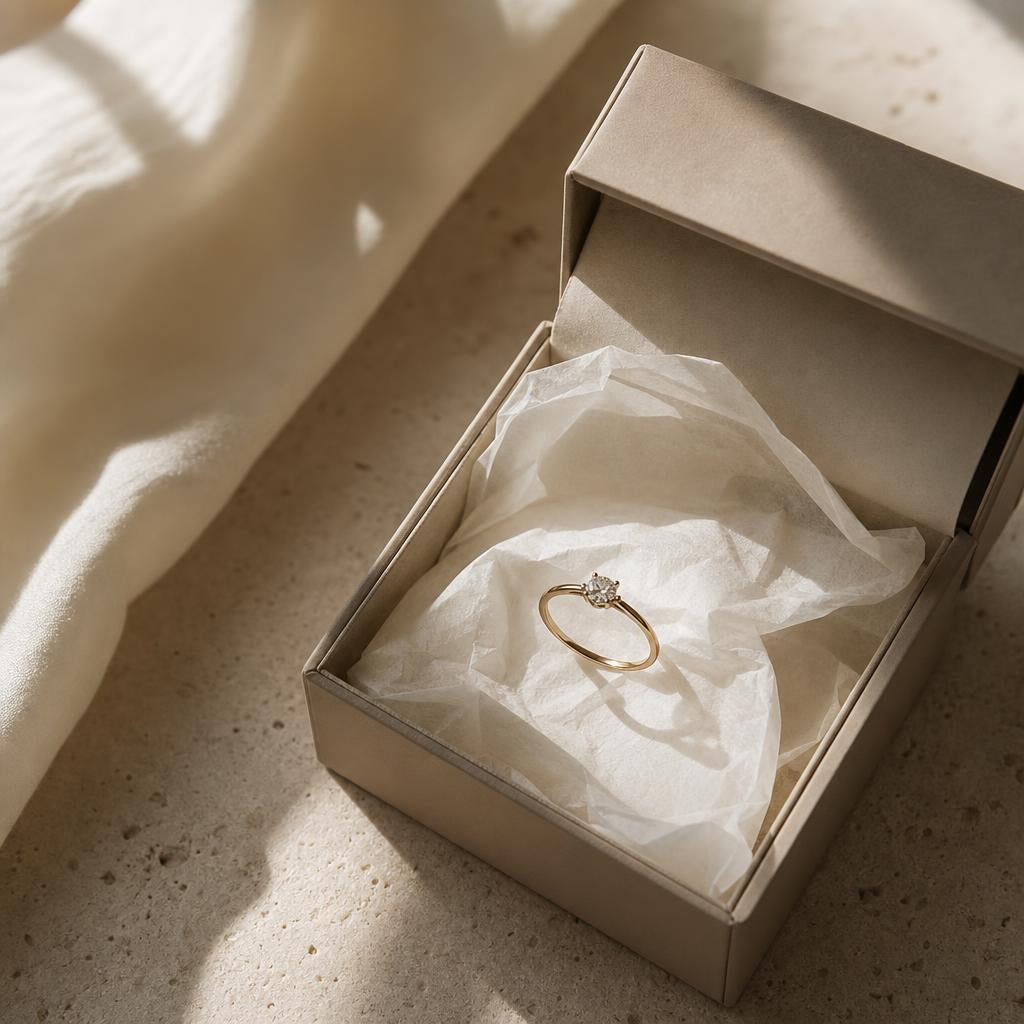
Engagement Ring Return Policy: What to Check Before You Buy Online
Before you add a ring to your cart, you already know to check the price and the size chart. Almost no one checks the return policy — and that's exactly the page most jewelers are counting on you to skip.
It's a five-minute read that can save you weeks of frustration if a ring doesn't work out. Here's what an honest engagement ring return policy actually looks like, what the fine print at bigger jewelers tends to hide, and what to check before you buy from any online ring shop — Gemiros included.


What Actually Happens When You Return an Engagement Ring
Most people assume returning a ring works like returning a sweater: you didn't love it, so it goes back. In practice, an engagement ring return policy is one of the more restrictive categories in online retail — and understanding why makes you a sharper shopper, not a more anxious one.
Jewelry sits in a strange middle ground between "final sale" and "easily returnable." A sweater can be re-shelved after a wash. A ring that's been resized, engraved, or worn for a week is a different physical object than the one that shipped — which is exactly why most retailers draw a hard line around alterations, and why the condition the ring arrives in matters as much as the calendar.
Worth knowing: The single biggest reason a return gets rejected isn't timing — it's condition. A ring that's been resized by an outside jeweler, engraved, or visibly worn is treated differently than one that's unworn in its original packaging, regardless of how many days have passed.
The Fine Print Big Box Jewelers Don't Lead With
Search around and you'll find plenty of horror stories about jewelry returns gone wrong — not because these policies are secretive, but because they're long, and almost no one reads past the headline number. A few patterns show up again and again once you actually read the terms:
- Documentation requirements. Some retailers require the original grading certificate to be returned intact with the ring — misplace it, and the return can be denied or docked a fee.
- Mandatory inspection schedules. A number of "lifetime warranty" programs quietly require you to bring the ring back to the original store every six months. Miss one appointment, and the warranty — not just the return window — can be voided entirely.
- Resizing voids the return. If a ring is resized, even by the same jeweler, it's frequently reclassified as final sale.
- Store credit instead of a refund. Some "returns" are actually exchange-only once you're past a short initial window.
None of this makes those retailers wrong to have these terms — jewelry margins and logistics genuinely require some structure. But it does mean the smarter move is reading the actual policy page before you buy, not skimming a banner that says "free returns" and assuming the rest works the way you'd guess.
What to Check Before You Buy From Any Online Ring Shop
Whether you're shopping Gemiros or anywhere else, run through this list before checkout. It takes less time than picking a ring size, and it's the difference between an informed purchase and an unpleasant surprise.
✦ Pro tip: Search the retailer's site for "returns" or "refund policy" directly — don't rely on a customer service chatbot's summary. Policies change, and the live policy page is the only version that's actually binding.
- The actual return window in days — not "hassle-free," an actual number, stated on the policy page itself.
- Who pays for return shipping — free returns and free outbound shipping are two different promises.
- What voids eligibility — engraving, resizing, and wear are the three most common disqualifiers.
- Whether it's a refund or store credit — especially past the initial window.
- Final sale categories — many jewelers, Gemiros included, treat earrings as final sale for hygiene reasons, even when rings are returnable. Category matters, not just the brand.
- Sizing and resizing policy — Gemiros ships in whole sizes only and doesn't offer an in-house resizing service; if you need a different size than what you ordered, a local jeweler is the recommended route, and it's worth knowing that third-party resizing work can affect warranty coverage before you have it done.
The Camilla Ring is a good example of why "check before you buy" matters more on a vintage-inspired piece — a twisted, milgrain-detailed band is harder to size externally without disturbing the finish than a plain shank, so it's worth confirming fit carefully at checkout rather than planning to resize later.

Camilla Ring
A round-cut halo on a twisted band, finished with pavé detailing — vintage character with a modern, everyday-wearable weight.
Shop Camilla Ring →Can You Exchange an Engagement Ring?
Almost always, yes — but an exchange and a return are handled differently. A return sends money back to you. An exchange swaps the piece for something else, usually within the same or a slightly longer window than the pure refund period. If you're not sure whether you want a full refund or you'd rather try a different style, ask which window applies to which outcome — the engagement ring exchange policy and the refund policy on the same page can genuinely have different deadlines.
This is where starting small can work in your favor. A simple stacking piece like the Eternity Ring is a lower-commitment way to get a feel for how a retailer's exchange process actually works — the packaging, the response time, the tone of the customer service reply — before you commit to a piece you're planning to wear every day.

Eternity Ring
A pavé stacking band that works alone or layered — an easy way to test a retailer's process before a bigger purchase.
Shop Eternity Ring →Warranty vs. Return Policy: Two Different Promises
These two get conflated constantly, and mixing them up is how buyers end up disappointed for the wrong reasons. A return policy is a short window — days or weeks — for sending the piece back if it isn't right. A warranty is a much longer promise that covers craftsmanship: if a prong loosens or a setting has a manufacturing defect, the warranty is what covers the fix.
Gemiros backs every ring with a one-year warranty against craftsmanship defects. It isn't a substitute for a return window, and it isn't insurance against loss or damage from everyday wear — but it is a straightforward promise with no hidden six-month inspection requirement attached to keep it valid. Read that distinction on any site you're comparing: an engagement ring warranty that requires a recurring in-store visit to remain active is a different commitment than one that doesn't.
Worth knowing: A return window protects the purchase decision. A warranty protects the piece over time. You want clarity on both before you buy — not just the one the marketing page leads with.
Why This Matters More When You're Buying Online
In a physical store, you can ask a salesperson to walk you through the return process before you pay. Online, that entire conversation is replaced by a policy page — which means it's worth reading with the same attention you'd give the ring photos. This isn't about assuming the worst of any retailer. It's about being the kind of buyer who reads the terms instead of trusting the banner, because that's the buyer who never gets surprised.
Quick Takeaways
- Check the actual number of days in the return window — not just the marketing headline.
- Confirm who pays for return shipping and whether refunds are cash or store credit.
- Resizing, engraving, and wear are the most common reasons a return gets denied.
- A warranty and a return policy are different promises — read both separately.
- Final sale categories (like earrings) can differ from a retailer's ring policy, so check by category.
Frequently Asked Questions
Can you typically return an engagement ring?
Yes, most online jewelers — Gemiros included — accept returns within a defined window, provided the ring is unworn and in its original condition. The specifics vary by retailer, so always confirm the exact window and requirements on the current policy page before you buy.
Can you return a ring if you simply don't like it?
In most cases, yes. A ring not being "the one" is one of the most common reasons for a return, and reputable retailers plan for it. The requirements are usually about condition and timing, not the reason for the return itself.
How long do you typically have to exchange an engagement ring?
It depends entirely on the retailer, and it's worth checking directly rather than assuming — an engagement ring exchange policy and a straight refund policy on the same site don't always share the same deadline.
How long does a ring warranty typically last?
This varies widely — anywhere from one year to a lifetime, depending on the retailer and what the warranty actually covers. Gemiros backs every ring with a one-year warranty against craftsmanship defects. Always check what voids coverage, not just the length of it.
Is a ring warranty actually worth paying attention to?
Yes — it's what protects you after the return window has already closed. A warranty won't cover loss or accidental damage, but it should cover manufacturing defects like a loose prong or setting issue, ideally without requiring a recurring in-store inspection just to stay valid.
Can you trade in a ring for a different one later?
Some retailers offer formal trade-in or upgrade programs; others don't, and instead treat any post-window change as a new purchase. Gemiros doesn't currently run a trade-in program, so if you're deciding between two styles, it's worth using the exchange window to get it right the first time rather than planning to trade up later.
None of this is meant to make ring shopping feel like reading a legal contract. It's meant to make it feel like something you're in control of — because you are. The women who buy for themselves and never think twice about it aren't the ones who got lucky on a return policy. They're the ones who checked it first.


