

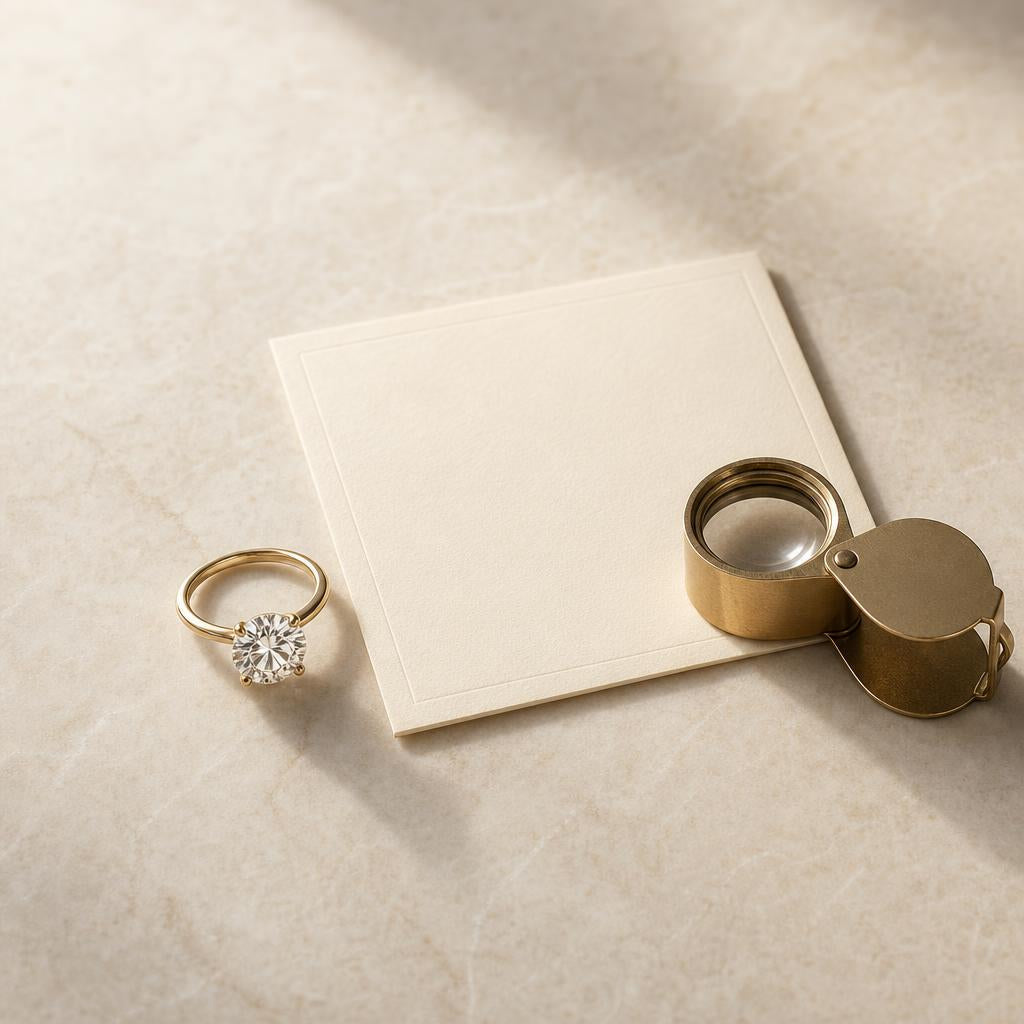
Certified Moissanite: What Buyers Should Actually Expect
Type "certified moissanite" into Google and you'll fall down a rabbit hole fast — GRA reports, GIA comparisons, forums arguing about whether the whole thing is a scam. If you're shopping for a simulated diamond ring and just want a straight answer about what certification actually means, here it is: no jargon, no scare tactics, just what's real and what's marketing.
Before we get into the specifics, here's a quick look at a few Gemiros styles worth knowing — a useful reference point as we talk through what actually makes a stone trustworthy.


What "Certified Moissanite" Actually Means
Somewhere along the way, "certified" became the word every moissanite listing leans on to sound trustworthy. But certified by whom, exactly? That's the question most listings never actually answer, and it's the one worth asking before you read another word of copy.
Unlike mined or lab-grown diamonds, moissanite has no single global grading authority. There's no equivalent of the GIA sitting at the center of the industry, issuing the same report on every stone, everywhere, the same way every time. Instead, "certified" usually means a report from one of a handful of smaller labs — most commonly one called GRA.
The GRA Report — And Why It Isn't the GIA
GRA stands for Gemological Research Association (sometimes written as Gemological Research Academy, depending on the source). If you've shopped for loose moissanite stones online, you've almost certainly seen a GRA report — a small card with a photo, a report number, and a handful of specs.
Worth knowing: A GRA report is a specification sheet, not an appraisal. It documents a stone's measurements, color, and clarity — it does not assign the stone a monetary value the way a GIA diamond report does.
What a GRA Moissanite Report Actually Shows
At its best, a GRA report records the stone's shape, dimensions, carat weight, color grade, and clarity — essentially a factual snapshot of the physical stone in front of you, similar to a receipt with more detail. It's a reasonable record to have. What it is not is an independent authority verifying quality the way GIA does for diamonds.
Why GRA Reports Get Faked (And What To Actually Check)
Because GRA reports are relatively easy to produce, they get faked — a lot. Search around and you'll find entire threads dedicated to spotting counterfeit cards. That's not a reason to panic; it's a reason to understand what you're actually looking at. A report number that can be verified against the issuing lab's own database matters more than the report existing at all. A card with no verifiable number is, functionally, just a nicely printed piece of paper.
Moissanite Isn't a Lab-Grown Diamond — Here's What Actually Separates Them
This is where a lot of the confusion starts. Moissanite and lab-grown diamonds are both created in a lab, and both get lumped together in casual conversation — but they're chemically nothing alike. A lab-grown diamond is pure crystallized carbon, identical in composition to a mined diamond, which is exactly why it gets graded by GIA or IGI using the same 4Cs standard applied to natural stones. Moissanite is silicon carbide — a completely different mineral that happens to throw an extraordinary amount of light.
That chemical difference is also why moissanite doesn't go through the GIA or IGI pipeline the way a lab-grown diamond does. It isn't a diamond, so it isn't graded as one. That's not a mark against it — it's simply a different material with its own identity, the same way sapphire isn't graded on the diamond scale either.
What "Diamond Simulant" Actually Means
Moissanite and cubic zirconia both fall under a category gemologists call a diamond simulant — any material that visually reads as a diamond without sharing its chemical structure. It's a technical term, not a euphemism, and it's worth knowing because it explains why the certification conversation is so different for these stones. A stone in this category is judged on how convincingly it performs — its fire, its brilliance, how it holds up on the hand — not on carbon purity or geological origin, because that was never the point.
Gemiros' Signature Simulated Diamonds are set in 925 sterling silver with rhodium, 18k gold, or rose gold plating, and every product listing tells you exactly what you're getting: the stone type, the metal, the setting. No GRA card required to know what's in front of you, because the specs aren't hidden behind a report in the first place.

The Belle
A 1.3ct round brilliant center in a sparkling halo, set on a half pavé band — the kind of everyday sparkle that doesn't need a card to prove itself.
Shop The Belle →What Actually Matters More Than a Certificate
If you're buying a simulated diamond ring to wear — not a loose stone to resell — a certificate isn't really the thing protecting you. A few questions matter far more:
- Does the listing tell you exactly what the stone and metal are? Not "diamond alternative," but the actual material — moissanite, cubic zirconia, 925 sterling silver, and what it's plated with.
- Does the piece pass a diamond tester? Moissanite's thermal and electrical conductivity reads close enough to a real diamond that most basic testers can't reliably tell the difference — which is exactly why the question "will anyone know?" answers itself.
- Is there an actual warranty behind it? A card in a box means nothing if the company disappears the moment something needs replacing.
Gemiros pieces are backed by a one-year warranty, hypoallergenic and nickel-free construction, and stones sourced from the same supplier tier used by other established names in the category. That's the kind of transparency worth far more than a laminated card with a serial number nobody checks.

The Everlasting
A continuous line of round brilliant stones on a slim 3mm band — the kind of piece you wear daily, not the kind you keep in a box with paperwork.
Shop The Everlasting →So Should You Look For a GRA Report?
If you're buying a loose stone to have custom-set by a jeweler, a verifiable GRA moissanite report is a reasonable thing to ask for — it at least confirms the stone's basic specs match what you were told. But if you're buying a finished ring from a brand that already tells you the stone, the metal, and the setting up front, a GRA card doesn't add information you don't already have. It just adds a piece of paper.
The smarter question isn't "is this certified?" It's "does this company actually tell me what I'm buying, and will they stand behind it after I've worn it every day for a year?" That's the standard worth holding every ring to — sterling silver stacking bands, statement pieces, everyday solitaires, all of it.
Quick Takeaways
- "Certified moissanite" usually refers to a GRA report — a spec sheet, not an appraisal, and not the same authority as a GIA diamond report.
- Moissanite is silicon carbide, not crystallized carbon, which is why it isn't graded on the same scale as lab-grown or mined diamonds.
- Moissanite and cubic zirconia are both judged on brilliance and durability, not carbon origin.
- A verifiable report number matters; an unverifiable card is just paper. GRA reports are commonly faked.
- Full material transparency, a real warranty, and diamond-tester performance matter more day-to-day than a certificate in a box.
Frequently Asked Questions
Does moissanite need a certificate?
No — moissanite has no single required grading authority the way diamonds do. Some sellers include a GRA report as a specification record, but its absence doesn't mean anything about the stone's quality. What matters is whether the seller tells you plainly what the stone and metal actually are.
Is a GRA certificate the same thing as a GIA diamond report?
No. GIA is the global authority for diamond grading, with strict, standardized criteria applied consistently worldwide. GRA is a smaller lab that issues specification records specifically for moissanite. The two aren't interchangeable, and a GRA card shouldn't be marketed as diamond-grade authority.
What's the real difference between moissanite and a lab-grown diamond?
Composition. A lab-grown diamond is pure carbon, identical to a mined diamond, which is why it's graded on the same 4Cs scale. Moissanite is silicon carbide — a different mineral entirely, with its own brilliance and fire, and its own (much lower) price point.
Is simulated diamond the same as cubic zirconia?
Cubic zirconia is one specific type of diamond simulant — moissanite is another. Both fall under the broader "simulated diamond" category, but they behave differently: moissanite is harder, throws more fire, and holds up better to years of daily wear than CZ typically does.
Do simulated diamonds actually last?
Moissanite specifically is rated 9.25–9.5 on the Mohs hardness scale, just below a diamond's 10 — durable enough for daily wear, including a ring you never take off. The metal setting matters just as much as the stone: 925 sterling silver with rhodium or gold plating holds up well with normal care and doesn't discolor skin.
At the end of the day, a certificate was never the thing that made a ring worth wearing. Knowing exactly what's on your hand — and trusting the company that put it there — is worth more than any card in a box.


