

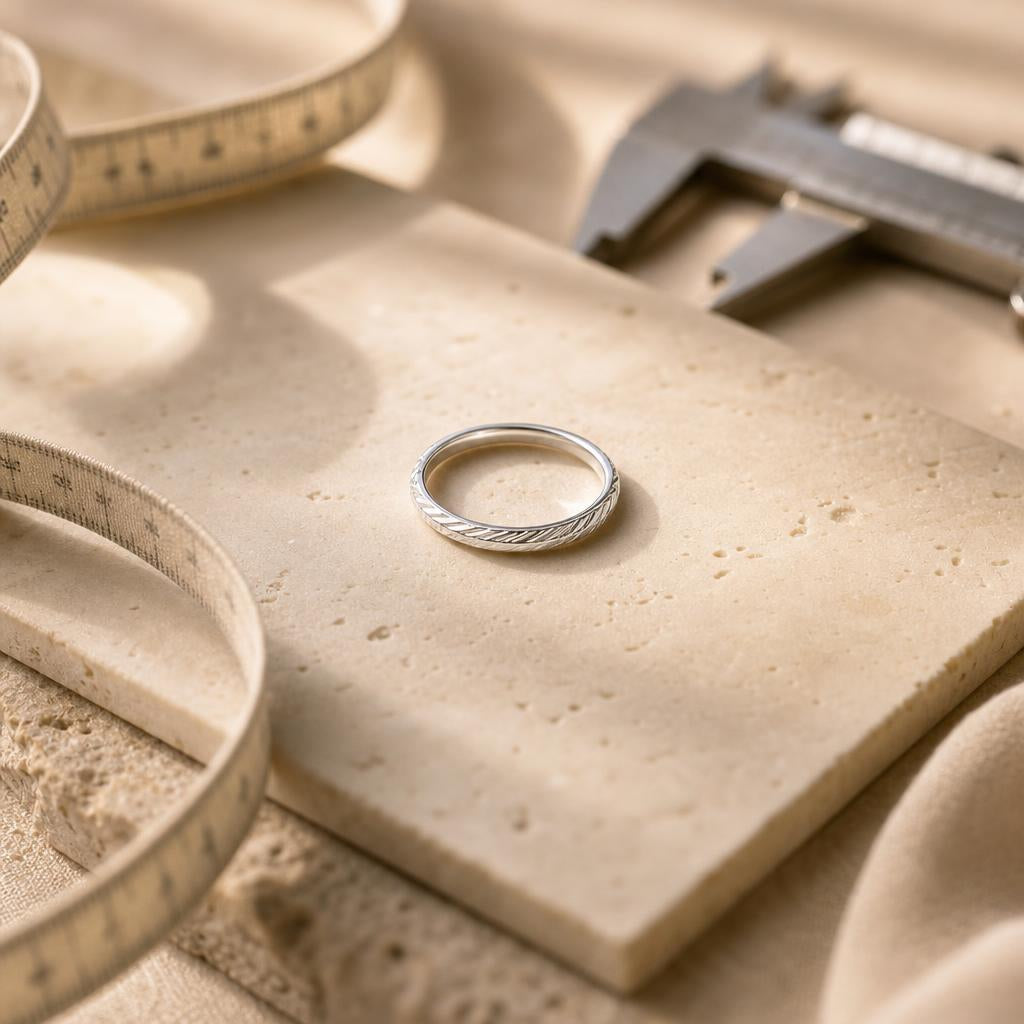
Ordered the Wrong Ring Size? What Actually Happens (And How Exchanges Work)
You open the box, slide the ring on, and something's off. Maybe it slips past your knuckle a little too easily. Maybe it stops halfway and won't budge another millimeter. Either way, the moment is the same: a small jolt of disappointment in what should have been a purely happy one.
Here's the good news — ordering the wrong ring size is one of the most common, most fixable problems in online jewelry shopping, and it happens to careful shoppers as often as careless ones. Before you panic or assume the ring is ruined, here's exactly what happens next, what your options actually are, and how to make sure it doesn't happen twice.


What "Wrong Size" Actually Means
Not every ill-fitting ring is the same problem, and the fix depends on which kind you're dealing with.
Too loose is usually the more obvious of the two — the ring spins around your finger, slides toward your knuckle when your hand hangs down, or has visibly gapped past the sizer you tested at home. Too-loose rings are also the higher-risk scenario, since a ring that can slide off easily is a ring that can fall off entirely, in a sink, a pool, or a parking lot.
Too tight tends to announce itself more gradually. It might go on fine in the morning and feel unbearable by evening once normal daily swelling sets in. A ring that leaves a deep red groove, is genuinely difficult to remove, or requires soap and cold water just to get off is too tight — not "will stretch with wear," which isn't really how rings work.
Worth knowing: A correctly sized ring should slide on with light resistance over the knuckle and then sit with a small amount of give — enough that you could just barely work it off with soap, but not so much that it turns freely without effort.
Can Your Ring Even Be Resized? It Depends on the Setting
Before you request an exchange, it helps to understand why some rings handle a size change easily and others don't — because it changes what "fixing it" actually looks like.
Solitaire and Halo Settings
Rings built around a single center stone with a plain or lightly detailed shank — solitaires, most halo settings, and side-stone designs — are the most straightforward to resize, because the band itself is a simple, mostly uniform loop of metal with no stones running all the way around it. A jeweler can cut, adjust, and reseal that band without touching the setting at the top.
Full Eternity and Bezel Bands
Bands with stones set continuously around the entire circumference are a different story. Because the sparkle wraps the whole band rather than sitting at the top, there's no plain section of metal left to cut and rejoin without disrupting the stone spacing. This is exactly why getting the size right before you order matters more with a full eternity band than it does with almost any other style.

The Beloved Ring
A vintage-inspired eternity band with stones set the full way around in a delicate milgrain edge. Because the sparkle wraps the entire circumference, this is a style worth double-checking your size on before you order rather than after.
Shop The Beloved Ring →Bezel settings sit somewhere in between. Because each stone is individually wrapped in its own metal rim rather than shared across a continuous channel, a bezel band can sometimes be adjusted in smaller increments than a pavé or channel-set eternity ring — but it still isn't as simple as resizing a plain solitaire shank.

The Cherish Ring
Each stone sits in its own individually bezeled setting, creating a bubble effect that's more forgiving to work with than a fully pavé eternity band — but still best ordered in your confirmed size the first time.
Shop The Cherish Ring →For simulated diamond rings in sterling silver specifically, most retailers — Gemiros included — handle a wrong size the same way regardless of setting type: not through resizing the physical ring, but through a straightforward exchange for a new one in the correct size. It's faster, it doesn't risk the setting, and it means the ring arrives exactly as it was designed to look.
How a Sizing Exchange Actually Works
The process is far less complicated than most first-time buyers expect. Here's the general shape of it, step by step:
- Don't force it, and don't wear it. A ring that's too tight can be difficult to remove once swelling sets in, and a ring that's too loose is at higher risk of getting lost the longer it's worn. Set it aside as soon as you suspect the size is off.
- Confirm your actual size before requesting the exchange. This is the step people skip, and it's the one that prevents a second wrong-size order. Measure again, ideally at the end of the day when fingers are at their largest, and compare against a proper sizing chart rather than guessing from how the first ring felt.
- Reach out with your order number and the correct size. Most exchanges move faster when you can specify both what you received and what you actually need — it turns a back-and-forth into a single request.
- Send back the original in its original condition. Unworn, unaltered, and ideally in its original packaging. This is standard for any jewelry exchange and protects the process for everyone.
- Receive the corrected size. The replacement ships once the return is confirmed, in the size you specified.
✦ Pro tip: Keep the original packaging until you've confirmed the new size fits. It makes the exchange faster if you need it, and it costs nothing to hold onto for a week or two.
What to Expect: Timeline and Fine Print
Exchange windows and specifics vary by retailer, so it's worth reading the policy on the site you ordered from before you order — not after. As a general pattern across most simulated diamond and fine jewelry retailers, though, here's what tends to hold true:
| What to check | Typical pattern |
|---|---|
| Exchange window | Most retailers give 14–30 days from delivery |
| Condition required | Unworn, unaltered, tags/packaging intact |
| Cost to you | Often free for a straight size exchange; return shipping varies |
| Turnaround | Typically 1–2 weeks from return receipt to replacement delivery |
| Engraved or altered rings | Frequently excluded — check before customizing |
The one detail worth flagging specifically: if a ring has been engraved, resized by a third-party jeweler, or otherwise altered after it arrived, it may no longer qualify for a straightforward exchange. If you're planning to have a ring engraved, it's worth confirming the size is correct first and saving the engraving for after.
How to Get It Right the First Time
An exchange is easy, but skipping it entirely is even easier. A few habits make the biggest difference:
- Measure at the right time of day. Fingers are smallest in the morning and largest in the evening or after exercise. Measure in the evening for a fit that accounts for natural daily swelling.
- Measure the finger you'll actually wear it on. Dominant-hand fingers often run slightly larger than the same finger on your non-dominant hand.
- Compare against a printed chart, not a guess. A ring you already own, measured accurately across the inside diameter, is more reliable than estimating from memory.
- Account for the band width and style. Wider bands and fuller settings can fit more snugly than a thin band in the same labeled size, since more metal touches more of the finger.
- When between two sizes, most people size up. A ring that's a hair loose is more comfortable day to day than one that's a hair tight — and easier to notice before it becomes a problem.
Quick Takeaways
- Too loose risks losing the ring; too tight causes discomfort and swelling issues — both are fixable, neither should be worn as-is.
- Solitaire and halo settings are the easiest ring types to size-correct; full eternity and heavily set bands are best ordered right the first time.
- A standard sizing exchange is simple: confirm your real size, send the original back unworn, and receive the corrected size.
- Most retailers exclude engraved or altered rings from exchange — confirm fit before customizing.
- Measuring in the evening, on the correct hand, against a real chart, prevents the vast majority of wrong-size orders.
Frequently Asked Questions
Will a ring stretch or loosen on its own with wear?
Not meaningfully, and not in a way you should rely on. Sterling silver and gold-plated bands hold their shape under normal wear — any perceived "loosening" is usually just your finger changing size slightly day to day, not the metal actually stretching.
How do I know if I should exchange instead of trying a ring sizer or adjuster first?
Sizers and spring inserts are reasonable for a ring that's only slightly loose and that you plan to keep as-is. If the size is off by more than half a size in either direction, or the ring is uncomfortably tight, an exchange for the correct size is the more reliable fix.
Can I exchange for a different ring style, or only the same ring in a different size?
This depends entirely on the retailer's specific policy — some allow a swap to a different style of equal value, others limit exchanges to the same design in a corrected size. Check the return policy on the site directly before assuming either way.
What if I'm buying as a surprise and can't get her actual measurement?
Order based on your best estimate and keep the packaging intact until she's tried it on — most retailers build in an exchange window specifically because this scenario is so common among first-time buyers.
Does resizing at a local jeweler void the retailer's warranty?
Often, yes, particularly on simulated diamond and gold-plated pieces where an outside jeweler's tools or process weren't designed for the specific materials used. A direct exchange keeps the original craftsmanship and warranty intact.
A wrong-size ring isn't a sign you did anything wrong — it's simply the most common hiccup in buying jewelry without trying it on first, and it's one that's almost always resolved in a week or two without any drama. Measure carefully, know what you're working with before you order, and if the fit still isn't right when it arrives, the fix is usually just one email away.


