

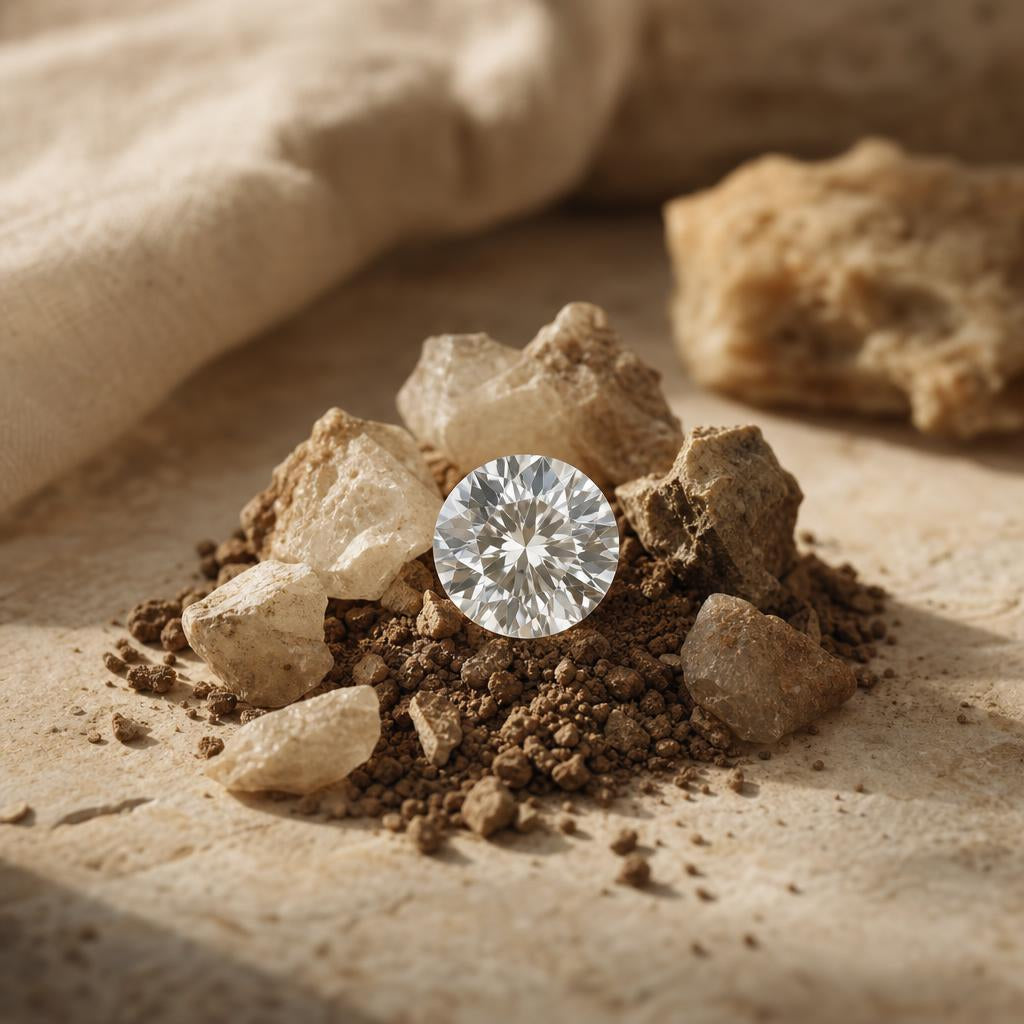
Conflict-Free Diamonds: What the Label Actually Verifies (And What It Doesn't)
"Conflict-free" is stamped on nearly every diamond retailer's homepage, printed on certificates, repeated in ad copy until it stops meaning anything at all. It sounds like a complete guarantee — proof that a stone is clean, ethical, above question. It isn't. The label checks exactly one thing, and it was never designed to check the rest.
Here's what "conflict-free" actually verifies, what it quietly leaves out, and why a moissanite or simulated diamond never has to answer the question in the first place — because it was never mined to begin with.


What "Conflict-Free" Was Actually Built to Check
The term comes from the Kimberley Process, a certification system created in 2003 after global outrage over diamonds that funded civil wars in parts of Africa. The scheme requires rough mined stones to travel in sealed, government-certified shipments so regulators can confirm one specific fact: that the profit from selling a stone didn't finance an armed rebellion against a recognized government.
That's the entire test. Not where the miners live. Not how they were paid. Not what the mining site did to the surrounding land. Just: did this stone fund a war. Today, roughly 99% of mined diamonds on the market pass that test, which is why the label shows up on almost every listing you'll find — it's a low bar that the vast majority of stones already clear.
Worth knowing: "Conflict-free" and "ethically sourced" are not interchangeable, even though retailers often use them as if they were. Conflict-free checks one narrow criterion — war financing. Ethically sourced is a broader, self-defined claim that can cover labor conditions, fair pay, and environmental impact, but there's no single universal standard enforcing it the way the Kimberley Process enforces conflict-free status.
What the Label Doesn't Ask
A stone can be fully conflict-free and still come from a mine with serious labor and environmental problems the certification was never built to catch. Miners' wages, safety conditions, and the ecological cost of extracting a gem from the earth all sit outside the Kimberley Process entirely. Journalists and human rights researchers have flagged this gap for years — the paperwork can be clean while the underlying picture is more complicated than a green checkmark suggests.
This is where the confusion around conflict free diamonds meaning tends to start. Shoppers assume the term is a complete ethical audit. It's actually a single, specific, war-financing test — useful, but narrow. Once you know that, a lot of the marketing language around mined stones starts to make more sense.
Why Simulated Diamonds Skip the Question Entirely
A Gemiros ring isn't a mined stone with a clean paper trail — it's moissanite and cubic zirconia set in 925 sterling silver, grown in a lab and cut to catch light the same way a diamond does. Because the stone was never pulled out of the ground, there's no mine, no shipment, no chain of custody, and no war-financing question to certify in the first place. It's indistinguishable from a diamond. It passes diamond testers. And it does all of that without asking anyone to trust a certification scheme with a fifty-year-old blind spot.
That's the actual advantage of buying conflict free simulated diamonds instead of chasing down sourcing paperwork on a mined stone: the entire category of concern disappears. You're not verifying an answer. You're opting out of the question.

The Astrid Ring
Asscher-cut center stone flanked by tapered side stones — an architectural three-stone silhouette with clean, deliberate lines.
Shop The Astrid Ring →Lab-Grown Isn't the Same as Simulated — And the Difference Matters Here
It's worth untangling two terms that get mixed up constantly. A lab-grown diamond is chemically identical to a mined one — same carbon structure, same hardness, grown in a facility instead of pulled from the earth. A simulated diamond, like the moissanite and cubic zirconia Gemiros uses, is a different material entirely that's cut and set to mimic a diamond's brilliance and fire. Both skip mining. Neither one needs a Kimberley Process certificate, because that system only exists to track rough stones between a mine and a cutting house.
The reason this distinction matters for the conflict-free conversation specifically: some retailers market lab-grown diamonds as the "ethical upgrade" over mined ones, which is fair as far as it goes. But a simulated stone makes the same sourcing argument at a different price point entirely, without asking you to pay diamond-adjacent prices for the privilege of opting out of a mining question. You're not buying a cheaper version of the same anxiety. You're buying a ring that was never eligible to carry that anxiety in the first place.
The Fear Under the Question
Underneath "is this diamond conflict-free" is usually a bigger, quieter worry: am I about to spend real money on something I'll regret understanding later. That's a fair instinct. It's also exactly the instinct a lab-created stone resolves outright rather than managing. There's no origin story to interrogate months after the purchase, no certificate to double-check, no news cycle that could recontextualize what's sitting on your hand. The sparkle came from a lab, not a mine, and that fact doesn't change no matter how deep you dig.
This is also where conflict-free lab created diamonds and simulated stones like moissanite start to look more alike than different, at least on this one question. Both sidestep mining entirely. The distinction that matters for a Gemiros piece specifically is that you're not paying mined-diamond prices for that peace of mind — the ring is priced like what it is: 925 sterling silver and a stone that performs like a diamond, not a rebranded version of one.

The Beatrice Ring
Round-cut center stone with milgrain detailing and a pavé band — a vintage-leaning solitaire with texture built into every edge.
Shop The Beatrice Ring →How to Read a "Conflict-Free" Claim When You See One
If you're comparing a mined stone against a simulated one and a retailer leads with "conflict-free" as the headline reassurance, it's worth asking what that specific claim is actually standing in for. A few questions cut through most of the marketing noise:
- Is this about war financing only, or something broader? If a listing says "conflict-free" and nothing else, assume it means exactly the Kimberley Process definition — nothing about labor or environment is implied.
- Who verified it, and how? Government-issued certificates carry more weight than a retailer's own internal claim.
- Does the stone need this certification at all? Lab-grown and simulated stones bypass the entire framework because there's no mine to certify.
None of this makes conflict-free certification meaningless — it did real work reducing a genuine humanitarian crisis in the diamond trade. It just means the label is a floor, not a ceiling, and it's worth knowing exactly what floor you're standing on before you let it settle a bigger question about what a ring's origin actually says about it.
Quick Takeaways
- "Conflict-free" verifies one thing: that a mined stone's sale didn't finance an armed conflict against a recognized government.
- It does not certify labor conditions, fair pay, or environmental impact — those sit outside the Kimberley Process entirely.
- "Ethically sourced" is a broader, less standardized claim than "conflict-free" — the two terms aren't interchangeable.
- Simulated diamonds and moissanite were never mined, so the entire question doesn't apply to them in the first place.
- 925 sterling silver with a lab-created stone gives you diamond-level sparkle without the sourcing question at all.
Frequently Asked Questions
What is a conflict-free diamond?
It's a mined diamond that has been tracked through the Kimberley Process certification system and confirmed not to have financed an armed rebellion against a legitimate government. It's a specific, narrow guarantee — not a general ethics seal.
Are conflict-free diamonds legit?
The certification itself is real and enforced through government-issued documentation, so the war-financing claim generally holds up. What it doesn't cover — labor conditions, wages, environmental impact — is where critics say the term oversells itself.
Are conflict diamonds still an issue today?
Far less than they were in the 1990s and early 2000s, when the crisis was at its worst. The Kimberley Process significantly reduced the trade, though researchers note enforcement gaps still exist in a handful of regions.
What does the term "conflict-free" actually mean?
It means a rough diamond was tracked from mine to market under a certification system built to block one thing: profits funding armed conflict. It says nothing about how the stone was mined day-to-day, only who ultimately profited from the sale.
Is there such a thing as an ethically sourced diamond?
Some retailers use additional, self-defined standards that go beyond conflict-free certification to address labor and environmental concerns. There's no single universal body enforcing "ethically sourced" the way the Kimberley Process enforces conflict-free status, so the claim is only as strong as the retailer making it.
Whichever direction you're leaning, the smartest move is knowing exactly what a claim promises before you let it make the decision for you. A conflict-free stamp answers one question well. A simulated diamond in 925 sterling silver makes the question irrelevant — no mine, no shipment, no certificate required, just a stone that looks the part because it was built to.


