

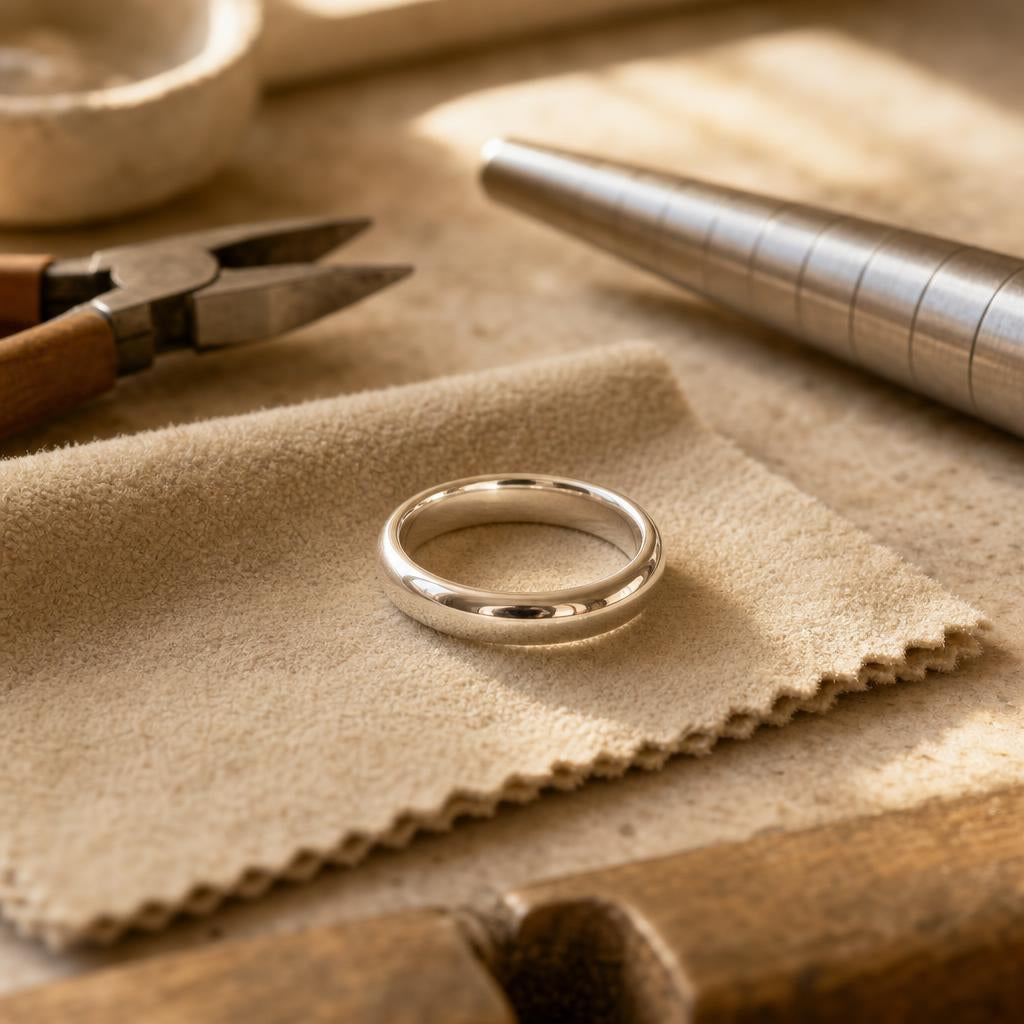
Can Sterling Silver Rings Be Resized Like Gold? What to Know First
You've fallen for a ring, ordered what seemed like the right size, and now it's either spinning loosely on your finger or leaving a faint red line by the end of the day. Before you panic, one question always comes up first: can a sterling silver ring actually be resized the way a gold one can, or are you stuck with whatever size arrived in the box?
The honest answer sits somewhere in the middle, and it has everything to do with how silver behaves differently from gold once it reaches a jeweler's bench. Before we get into the specifics, here are a few sterling silver styles worth knowing — in case a fresh size, or a fresh style entirely, is what you're really after.


Why this question keeps coming up
Gold has a reputation as the "resizable" metal, and for good reason — jewelers have been sizing gold rings up and down for centuries, and most local jewelers have the tools and experience to do it without a second thought. Sterling silver doesn't have quite the same reputation, and that makes buyers nervous. Is it fragile? Will it snap? Will resizing ruin the finish? None of those fears are entirely unfounded, but none of them tell the whole story either.
The truth is that sterling silver can absolutely be resized — jewelers do it every day — but the process, the risk, and the recommended approach are genuinely different from gold. Understanding why comes down to two things: what resizing actually involves, and what makes silver behave the way it does.
What actually happens when a jeweler resizes a ring
Resizing isn't a single universal action — it's one of a few different techniques depending on whether the ring needs to go up or down in size, and how much of a change is needed.
Sizing down
To make a ring smaller, a jeweler typically cuts a small section out of the band, then solders the two ends back together and reshapes the circle. It sounds dramatic, but for a simple band this is one of the more routine jobs a bench jeweler handles.
Sizing up
To make a ring larger, the jeweler cuts the band at one point, then either stretches the metal (for very small changes) or adds a small section of matching metal and solders it in on both sides before reshaping. Sizing up generally carries more risk than sizing down, especially past a size or two, because it asks more of the metal's structure.
Worth knowing: Most jewelers consider a resize of one to two sizes routine for most metals. Beyond that, the ring's proportions, stone settings, and any decorative detailing (like pavé or milgrain) start to matter a lot more — and the risk of damage climbs with every additional size.
How sterling silver behaves differently from gold
Silver's softness — an advantage and a liability
Sterling silver is a genuinely soft metal compared to gold alloys, which is part of why it's comfortable to wear and relatively easy to shape in the first place. That same softness means it's also more prone to distorting under the heat and pressure of a resize, particularly around delicate settings, pavé stones, or thin bands. A skilled jeweler working carefully can manage this — but it does mean sterling silver rewards a slower, more careful hand than a plain gold band typically requires.
Rhodium plating and what happens when it's cut into
Most polished sterling silver rings — including simulated diamond styles — are finished with a thin layer of rhodium plating to add extra shine and tarnish resistance. Here's the part that catches people off guard: resizing cuts straight through that plating at the seam. The solder joint will need to be re-polished and, ideally, re-plated afterward, or you'll be left with a visible seam that looks different from the rest of the band. A jeweler unfamiliar with rhodium-plated silver may skip this step entirely, which is one of the most common complaints people have after a silver resize.

The Échelon Ring
A structured, step-cut Asscher solitaire with clean, uninterrupted lines — the kind of simple band silhouette that tends to size more predictably than a heavily detailed setting.
Shop The Échelon Ring →When a silver ring should not be resized
There are a few situations where resizing sterling silver is genuinely a bad idea, regardless of how skilled the jeweler is:
- Rings with pavé or channel-set stones near the shank. The heat and pressure of resizing can loosen or crack small accent stones that sit close to the cut point.
- Rings with eternity bands or continuous stone settings. If stones run all the way around the band, there's no clean, stone-free section left to cut and resolder.
- Rings that need to go up or down more than two sizes. At that point, the proportions of the setting itself often shift enough that the ring no longer sits the way it was designed to.
- Very thin or delicate bands. Fine bands have less metal to work with, which leaves less room for error during the cut and solder.
In any of these cases, most experienced jewelers will tell you plainly that resizing isn't worth the risk — and that buying the correct size from the start, or exchanging for it, is the better route.
Silver vs. gold vs. gold vermeil: a quick comparison
| Metal | Resizing difficulty | What to watch for |
|---|---|---|
| Sterling silver | Moderate | Re-plating after resize; softness near settings |
| Solid gold (14k/18k) | Routine | Minimal — most jewelers resize gold daily |
| Gold vermeil | Not recommended | Plating layer is thin; resizing can expose the silver base underneath |
| Rose gold plated | Not recommended | Same plating concern as vermeil |
This is worth sitting with for a moment: gold vermeil and rose-gold-plated rings are actually harder to resize successfully than plain sterling silver, because the gold layer is a thin plating over a silver base rather than solid gold all the way through. Cutting and resoldering that base metal, then trying to seamlessly re-plate just the seam, is a finicky job that not every jeweler will do well.

The Majesté Ring
An elongated cushion-cut center with a hidden halo and pavé detailing beneath — a good example of a setting best sized correctly the first time rather than altered later.
Shop The Majesté Ring →What to ask before you send a ring out for resizing
If you do decide a resize makes sense — say, a simple solitaire band that's just half a size off — a few questions to a jeweler up front will save you a lot of disappointment later:
- Have you resized rhodium-plated sterling silver before?
- Does the quoted price include re-polishing and re-plating the seam afterward?
- Will the stones be checked and re-secured before the ring is returned?
- What's the turnaround time, and is there a guarantee if the fit still isn't right?
✦ Pro tip: A jeweler who resizes plated and vermeil pieces regularly will usually mention re-plating without being asked. If a jeweler seems unfamiliar with the idea, that's a sign to look elsewhere before handing over a ring you love.
Why exchanging is often the smarter move
Here's the practical reality worth naming directly: for an affordably priced simulated diamond ring, resizing isn't always the most sensible first move. Between the cost of professional resizing, the time it takes, and the small but real risk to delicate settings, many buyers find it's simpler — and often cheaper overall — to exchange for the correct size rather than alter the one they have. It's a genuine advantage of buying a ring that isn't a one-of-a-kind heirloom piece: getting the size exactly right doesn't have to be a compromise between cost and correctness.
That's also the best argument for taking size seriously before you buy in the first place. A few extra minutes measuring properly, or ordering a size you're genuinely confident in, saves the entire resizing question from ever coming up.
Quick Takeaways
- Sterling silver can be resized, but it's a more delicate job than resizing solid gold.
- Rhodium-plated silver needs to be re-polished and ideally re-plated at the seam after resizing.
- Gold vermeil and rose-gold-plated rings are generally harder to resize well than plain silver, since the gold layer is only a thin plating.
- Rings with pavé, channel settings, eternity bands, or very thin shanks are poor resizing candidates at any metal.
- For an affordably priced ring, exchanging for the right size is often simpler and more reliable than resizing.
Frequently asked questions
Can any sterling silver ring be resized?
Most simple silver bands can be resized within a size or two. Rings with pavé stones, eternity settings, or very thin shanks are much better candidates for exchange than resizing.
Does resizing damage the rhodium plating?
Resizing cuts through the plating at the seam, so the area needs to be re-polished and ideally re-plated afterward to match the rest of the band. Ask your jeweler about this step before booking the work.
Is it harder to resize gold vermeil than sterling silver?
Generally, yes. Vermeil and rose-gold-plated pieces have a thin gold layer over a silver base, which makes seamless re-plating after a resize trickier than resizing plain silver.
How many sizes can a silver ring safely go up or down?
Most jewelers consider one to two sizes routine. Beyond that, the ring's proportions and settings are more likely to shift in ways that affect how it looks and sits.
Is it better to resize or exchange an ill-fitting ring?
For an affordably priced ring, exchanging for the correct size is often the more reliable option — it avoids any risk to the setting and guarantees a factory-finished result rather than a repaired seam.
However you land on the resizing question, the goal is the same: a ring that sits comfortably enough that you forget it's there. Whether that means a careful trip to a trusted jeweler or simply exchanging for the size that was right all along, getting there is worth the extra thought.


