

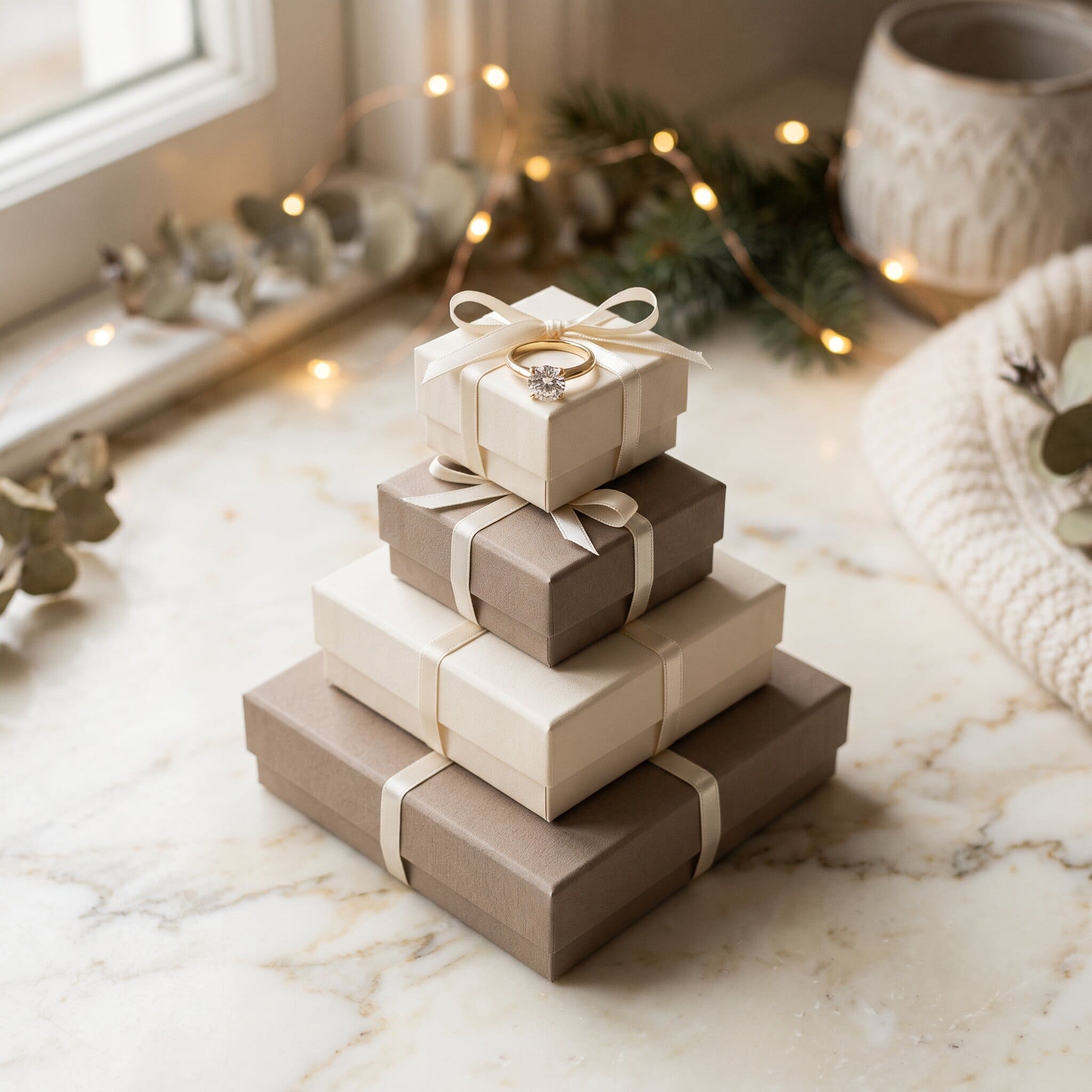
Black Friday Ring Shopping: Is It Actually the Best Time to Buy an Engagement Ring?
Every November, the big-box jewelry stores start counting down. Banners appear. Timers start ticking. "Up to 50% off" flashes across a homepage that, eleven months ago, was selling the exact same ring at what is somehow now called the "original price." If you've ever wondered whether that price was ever real to begin with, you're not being cynical — you're paying attention.
Here's the honest version of what's worth knowing before you shop this season: which pieces are genuinely worth grabbing now, which "deals" are just theater, and why the calendar matters a lot less than the marketing wants you to think.


Why Jewelry Store "Sales" Work Differently Than You'd Expect
Traditional jewelry stores build the discount into the price before you ever see it. A ring gets tagged with a number nobody is meant to actually pay, held there for months, and then "reduced" the week of Black Friday to a figure that was the real target all along. It's not a deal. It's a pricing strategy wearing a deal's clothing — and it only works if you don't know where the number came from in the first place.
That's really the question worth asking before you shop this season: what's the actual best time to buy an engagement ring, and does a single 24-hour countdown answer it — or is that just the story the countdown wants you to believe?
Worth knowing: A ring styled to read as a five-figure piece — the kind of oval brilliance that would run $15,000 or higher at a traditional jewelry store — doesn't need a single day of "urgency" to be worth buying. If the price is honest in July, it's honest in November too.
What Actually Goes on Sale (and What's Just Theater)
Not every Black Friday jewelry promotion is empty. Some retailers do drop margin on slow-moving inventory, clear last season's settings, or bundle a free chain with a purchase. The trick is telling that apart from a markup that got quietly inflated in October specifically so it could be "cut" in November. A few signs you're looking at a real discount instead of theater: the sale is on a specific, named piece rather than "storewide," the percentage off is modest — 10 to 20%, not 60% — and the retailer can tell you what the price was in June without stammering.

The Duchess
A cushion-cut center wrapped in two rings of pavé instead of one — more presence, same honest price it was last month and the month before that.
Shop The Duchess →This is exactly why so many budget engagement rings feel like an afterthought at a big-box store — they're not designed to be the finished look. They're the entry point to an upsell, the "starting at" price in the ad that gets you in the door before someone steers you toward the setting that actually costs what you budgeted for. A ring built to be complete at its real price doesn't need that maneuver.
Where the Discount Actually Comes From
Diamond markup at a conventional jeweler typically runs anywhere from 100% to 200% over the stone and labor cost — which is exactly how a store can slash a price by half and still turn a profit on the sale. None of that markup exists to protect quality. It exists to fund the showroom, the sales commission, and the eventual "door-buster" that makes you feel like you got away with something. You didn't get away with anything. You paid the discounted version of a number that was never really the price.
Moissanite and lab-created stones sidestep that entire structure. There's no century-old scarcity myth propping up the number, no diamond cartel controlling supply, no showroom overhead baked into every ring. The price reflects what the piece actually costs to make — which is why it doesn't move dramatically around a single shopping weekend. It's already where it should be.
So Is Black Friday Actually the Best Time to Buy an Engagement Ring?
For a traditional jeweler, sometimes — if you can verify the discount is real and not a manufactured one. For a brand that prices honestly year-round, the calendar matters a lot less than most marketing wants you to believe. The best time to buy is whenever the ring you actually want, in the style that actually flatters your hand, is in stock and within reach — not whenever a countdown timer tells you to feel urgent.
That said, the season is still a smart moment to build out a stack rather than buy a single statement piece. If you already own your ring and you're thinking about what goes around it, this is a good window to add a second piece without waiting for a separate occasion to justify it.

The Everlasting
A continuous line of pavé brilliance built to sit flush against a solitaire or a halo — the kind of piece that turns one ring into a stack.
Shop The Everlasting →Budget Rings, Without the Apology
Somewhere along the way, "budget" became a word people said with a wince — as if spending less automatically meant getting less. It doesn't. A ring set in 925 sterling silver with a moissanite or CZ center is indistinguishable from a mined diamond to the naked eye and passes diamond testers, full stop. No one — including a jeweler — is clocking the difference across a dinner table. The only thing a bigger number buys at a traditional store is the story attached to it, and that story was never the point of the ring.
✦ Pro tip: Before you shop any seasonal sale, decide on your style and size first — cut, setting, band width — so you're evaluating the ring on its own merits and not reacting to a countdown clock. A deal on the wrong ring isn't a deal.
This is also the moment to be honest with yourself about sizing if you're buying online without stepping into a store first. Get that step right before anything else, because no percentage off fixes a ring that doesn't fit.
Quick Takeaways
- A real discount is specific and modest — a named piece, 10 to 20% off. "Storewide, up to 60%" is usually a pre-inflated price getting "corrected."
- Honest, everyday pricing on moissanite and lab-created stones means the calendar matters less than it does at a traditional jeweler.
- The right moment to buy is when the specific piece you want is in stock — not whenever a timer says so.
- This season is a genuinely smart window for adding a stacking band to a ring you already own.
- Confirm your size and style first. A markdown on the wrong ring isn't a savings — it's a return.
Frequently Asked Questions
Is there an actual Black Friday deal on engagement rings, or is it all marketing?
Both exist. Some retailers genuinely discount specific pieces; many more inflate a price in the months before November so the "sale" price is the real one all along. Look for a named piece and a modest percentage — that's usually the signal of a real discount rather than a manufactured one.
What's the cheapest time of year to buy an engagement ring?
At traditional jewelers, late January and February tend to see genuine post-holiday markdowns, alongside the November sales window. At Gemiros, pricing doesn't fluctuate by season in the first place, so there's no calendar to game — the price you see is the price it costs to make the piece well.
What is the "three months' salary" rule, and should you actually follow it?
It's a decades-old marketing line from the diamond industry, not a financial principle — there's no rule that says a ring has to cost a specific fraction of your income to mean something. It's an old idea no one asked for. Spend what feels right for the piece and the moment, not what a slogan invented to sell more diamonds decided for you.
Is a lower price a compromise on quality?
No. A ring's visible quality comes from the cut, the setting, and the metal — not the number on the tag. Moissanite and CZ in a well-made 925 sterling silver setting reads exactly as bright, exactly as precise, as a piece that costs many times more.
Should I wait for a sale, or just buy the ring I want now?
If the price is already fair, waiting mostly costs you the chance to wear the ring sooner. Where pricing is honest year-round, patience doesn't buy you a better deal — it just delays the decision you'd already made.
The countdown timers will keep counting down every November, because urgency sells regardless of whether the discount underneath it is real. You don't need the timer. You need the ring that's actually right for you, priced honestly, whenever you're ready to buy it — this week or any other.


