

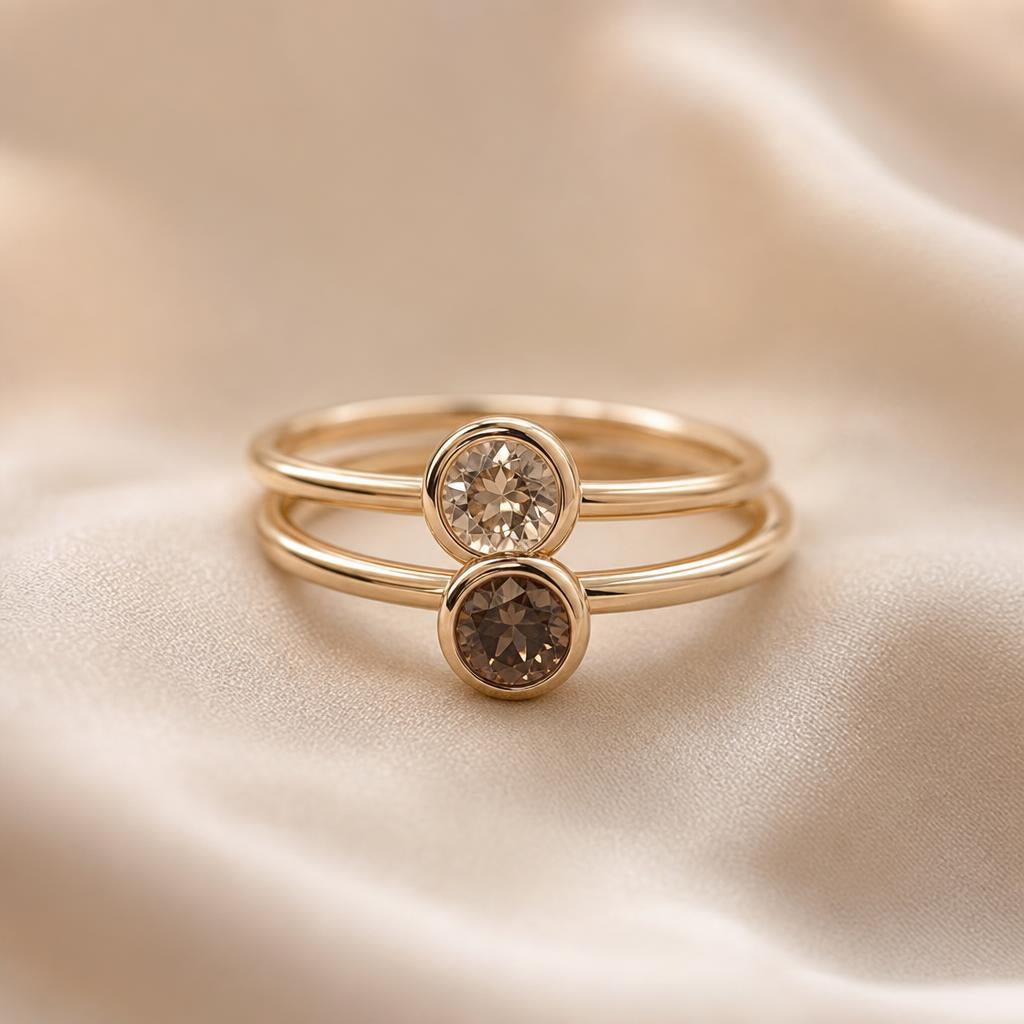
Bezel Engagement Rings and Wedding Bands: Why the Smooth Edge Makes Stacking Easier
There's a moment every bezel-ring owner hits eventually: you love how the setting looks, you're ready to add a wedding band or a stacking piece, and suddenly you're standing in front of a wall of options with no idea which ones will actually sit flush against that smooth metal edge. It's not a small question. Get it wrong and you've got a gap that catches on sweaters for the next decade.
The good news is that bezel settings are actually one of the easier profiles to stack against — you just need to understand why, and which shapes to reach for first. Here's what to look for, starting with a few pieces built for exactly this.


Why bezel settings exist in the first place
A bezel setting holds the center stone inside a thin rim of metal instead of individual prongs. The metal wraps the girdle of the stone completely (a full bezel) or partway around it (a half bezel), and there's nothing standing proud of the ring's surface to snag on anything. That's the whole appeal: no prongs to catch on gloves, wool, or the inside of a coat pocket, and no sharp points to bend or wear thin over years of daily wear.
It's also, quietly, one of the more secure ways to set a stone. A prong can loosen. A bezel physically cannot let go of the stone without the metal itself being damaged first — which is a big part of why women researching a bezel engagement ring with wedding band combination tend to be the same women asking hard, practical questions about their jewelry in general. They're not choosing bezel for the trend. They're choosing it because it survives an actual life.
The stacking question, answered honestly
Here's what actually happens when you push two rings together on the same finger: whatever sits highest on each ring determines whether they meet cleanly or leave a gap. A prong-set solitaire has peaks and valleys — the prongs stick up, the space between them dips down — so a straight wedding band pressed against it usually leaves visible daylight underneath the stone. A bezel-set ring has no valleys. The metal rim runs in one continuous, level line around the stone, which means a straight band can sit directly against it with far less guesswork.
This is why a bezel set wedding band paired with a bezel-set center ring is often the easiest stacking decision you'll make all year. Two smooth, low-relief surfaces meeting each other is about as forgiving as ring pairing gets.
✦ Pro tip: If your bezel ring sits low on the finger (a "low-profile" build), look for a stacking band with a similarly slim, unembellished profile. Two low, quiet rings read as intentional. A slim bezel ring next to a tall, ornate band can look like they belong to different outfits.
What actually pairs well — shape by shape
Not every wedding band needs to match your bezel ring's shape exactly, but a few pairings consistently work better than others.
Straight, flush-fit bands
A plain or pavé band with a straight inner edge is the most reliable option. Because a bezel setting doesn't curve outward the way a halo or three-stone ring does, you don't need a curved or contoured band to close a gap that was never going to appear. The Eternity Ring is a good example of this — a continuous round-cut pavé band that sits flat and doesn't compete with a bezel's clean lines.
Channel-set bands
Channel settings hold stones between two metal walls with nothing raised above the surface, which makes them a close structural cousin to the bezel. The two settings share the same underlying logic — protect the stone, keep the surface smooth — so they tend to sit against each other with almost no visible seam. The Infinity Ring is built exactly this way.
A second bezel
Pairing a bezel-set center ring with a bezel-set stacking band isn't repetitive — it's a deliberate, cohesive look. Some of the most requested combinations we see involve a half bezel engagement ring worn beside a second bezel band, each stone framed the same clean way. If you like the aesthetic once, doubling down on it usually reads as confident styling rather than a missed opportunity to mix things up.

The Cherish Ring
A bezel-set round stone in a slim stacking band — built to sit flush against another bezel piece or a plain solitaire without a gap in sight.
Shop The Cherish Ring →Why unusual bezel shapes still stack easily
One thing that surprises people shopping unique bezel set engagement rings is how little the "unique" part actually complicates stacking. Because the bezel does the structural work — not the shape of the stone, not the halo, not the prong count — an oval bezel, a round bezel, and an emerald-cut bezel all present the same basic stacking logic: a smooth, level edge that a straight band can meet. The stone shape changes the silhouette. It doesn't change the math.
That's different from, say, a hidden halo or a three-stone ring, where the extra metalwork around the center stone genuinely does change what will and won't sit flush. A bezel set engagement ring with side stones is the one bezel variation worth double-checking before you buy a band — the side stones can add just enough width and height to change how a straight band meets the ring. When in doubt, try the pairing in person, or order a size or two to compare before committing.
Worth knowing: Gemiros bezel and stacking pieces are set in 925 sterling silver with moissanite and CZ stones — indistinguishable from a diamond, and it passes diamond testers. There's no compromise built into the sparkle, only into the price.
A note on metal and finish
Bezels are usually cut from a slightly thicker piece of metal than a plain shank, since the rim needs enough structure to hold the stone securely. That means a bezel ring can read as very slightly bolder next to an ultra-thin band, even when both pieces are the same metal tone. It's a minor effect, and most people never notice it — but if you're building a stack with multiple thin bands, consider adding one band closer in weight to the bezel before layering in anything delicate.
Metal-matching rules stay the same as they would for any stack: sterling silver with rhodium plating reads as platinum-bright and pairs cleanly with anything in the same tone, while 18k gold plating warms the whole hand. Mixing tones deliberately can look intentional; mixing them by accident usually just looks unfinished.

The Beloved Ring
A pavé eternity band with a softer, vintage-inspired edge — a warmer alternative for stacking next to a bezel ring without going fully minimal.
Shop The Beloved Ring →What to skip if you want an easy fit
A few band styles make stacking harder against a bezel, not because they look bad, but because their construction fights the bezel's flat edge:
- Deep contour or curved bands designed to hug a raised halo will curve away from a bezel's straight edge instead of following it — you'll get a gap on the inside of the curve.
- Wide statement bands with raised centers can overpower a bezel's quiet, low profile rather than complement it.
- Anything with a high cathedral shank sits taller than a bezel typically does, which throws off the visual line between the two rings even if they technically touch.
None of these are wrong choices in isolation — they're just working against the bezel's core advantage, which is that flat, uninterrupted edge. If you already own one of these and love it, the fix is usually simple: wear it on a different finger, or accept a small visible gap and let it read as a stack rather than a seamless pair.
Quick Takeaways
- A bezel's flat, continuous rim is what makes stacking easier — there's no prong-created gap to work around.
- Straight, flush-fit bands and channel-set bands are the most reliable pairings.
- A second bezel or half bezel piece is a legitimate, cohesive stacking choice, not a repetitive one.
- Side-stone bezel rings and deep contour bands are the two situations worth double-checking before you buy.
- Match metal weight loosely — an ultra-thin band next to a substantial bezel can look mismatched even in the same tone.
Frequently Asked Questions
What type of wedding band complements a bezel engagement ring?
A straight, flush-fit band — plain or pavé — pairs most reliably, since it meets the bezel's level edge without a gap. Channel-set bands work the same way for the same structural reason. Curved or deep-contour bands, built for halo settings, are the pairing to be most careful with.
Is a bezel setting more secure than a prong setting?
Yes. A bezel wraps the stone's girdle in a continuous rim of metal, so there's no individual prong that can loosen or bend over time. It's one of the most secure ways to set a stone, which is part of why it's a popular choice for everyday, worn-constantly rings.
Do bezel settings make a stone look smaller?
Not smaller — just framed differently. A bezel covers slightly more of the stone's girdle than prongs do, so a bit less light enters from the sides. Most people find the trade-off worth it for the smooth profile and security, and a well-cut stone still reads big and bright in a bezel.
Can you stack two bezel-set rings together?
Yes, and it's one of the most cohesive stacking looks available. Because both pieces share the same flat, level edge, they sit against each other cleanly, and the repeated setting style reads as intentional rather than accidental.
Are bezel engagement rings trendy right now?
Bezel settings have moved well past trend status into a genuine staple — search interest and independent-jeweler collections have both grown steadily over the past few years. But the appeal was never really about trend timing. It's a setting built for how women actually live in their rings day to day.
A bezel setting was never the complicated choice — it's the smooth-edged, low-maintenance one. The stacking part just takes knowing what you're actually looking for: flat meets flat, low meets low, and everything else is styling preference. Once you've got that logic down, building a stack around a bezel ring stops being a guessing game and starts being one of the easier calls you'll make in your whole jewelry collection.


