

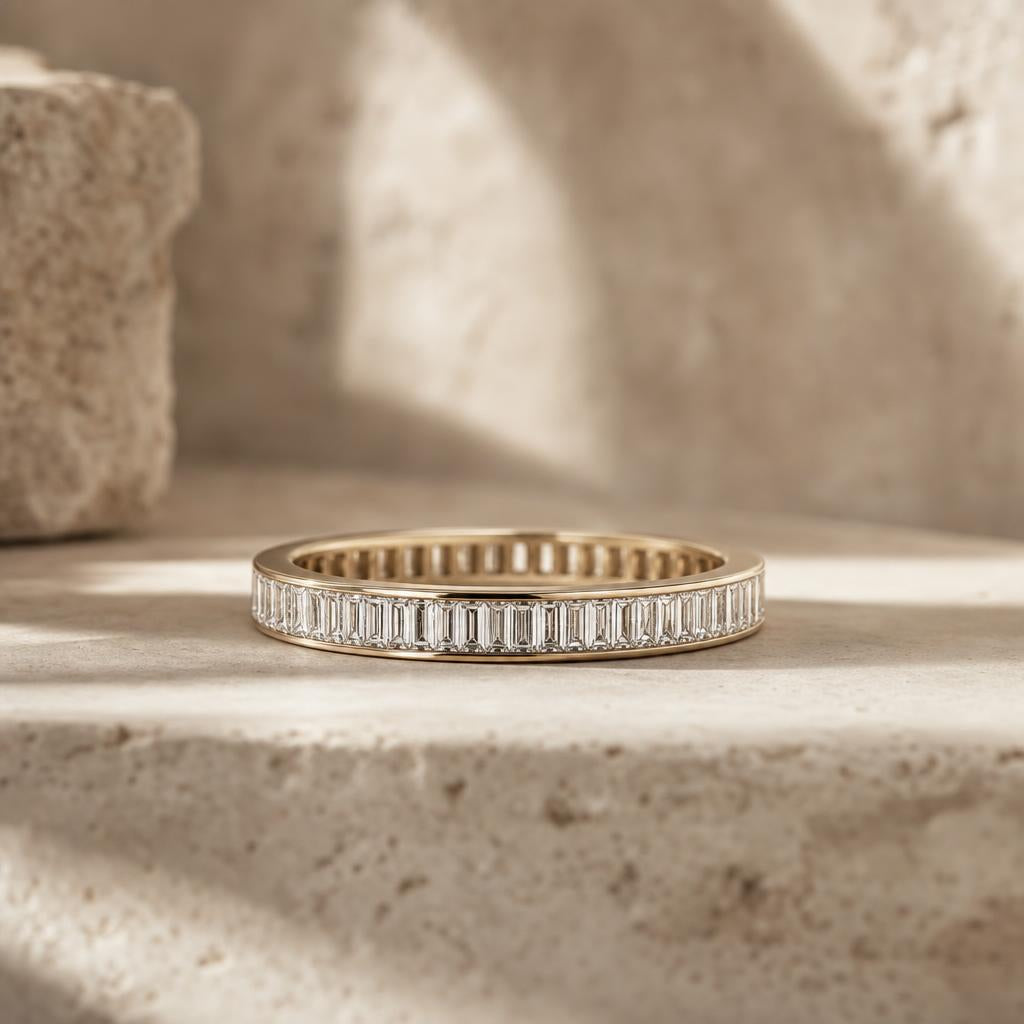
Baguette Wedding Ring: The Sharp, Architectural Stacking Piece Having a Moment
There's a particular kind of ring that doesn't announce itself with a single stone — it announces itself with a line. A clean, rectangular row of light that reads as considered rather than accidental. That's the appeal of a baguette wedding ring: it's architecture for your hand, and right now it's having a real moment.
If you've been quietly drawn to the sharper, more graphic bands showing up in your feed lately, you're not imagining the shift. Baguette-cut stones — long, rectangular, step-cut for clarity rather than fire — are moving from a supporting role into the main event. Here's where to start.


What Actually Makes a Band "Baguette"
A baguette is a cut, not a style of ring — a long rectangle with corners squared off and facets arranged in parallel steps rather than the crisscrossing pattern you'd see on a round brilliant. That step-cut geometry doesn't throw the same scattered fire as a brilliant cut. Instead it produces broad, clean flashes of light, more like a mirror catching the sun than a firework. Set several baguettes in a row along a band and you get a continuous, unbroken line of brightness — which is exactly why the shape reads as architectural rather than delicate.
Most baguette bands use a channel setting: the stones sit in a groove between two strips of metal, held in place along both long edges instead of by individual prongs. It's a practical choice as much as an aesthetic one. Channel-set baguettes have no raised prongs to snag on sweaters or hair, which makes the silhouette genuinely wearable next to a solitaire or halo engagement ring that's already doing the sparkle work on its own.
Worth knowing: Because baguettes are cut for clarity, not maximum fire, they photograph and wear differently than a pavé band. Expect a cooler, more graphic sparkle — fewer scattered points of light, more clean, continuous shine.
That's also what separates a genuinely well-made baguette band from a disappointing one. Poorly matched stones show up immediately in a channel setting — even a slight difference in size or tone breaks the clean line the whole design depends on. A band like this only works if every stone in the row is cut and placed with the same precision, which is exactly the kind of detail worth checking closely before you commit to one.
Straight, Tapered, or Curved: The Three Silhouettes
Not every baguette wedding ring is built the same way, and the differences matter more than they might look like they do in a product photo.
It comes down to how the stones are cut and set relative to one another, and each approach changes how the band sits against your hand and against whatever ring it's paired with.
A straight baguette band uses stones of identical size and shape all the way around, which gives the ring a rigid, uniform edge — the most architectural of the three options, and the one that reads as most modern. A tapered baguette wedding band narrows the stones gradually toward the sides of the ring, so the widest baguette sits at the top and the line tapers down as it moves toward the base of the finger. That taper does two things: it follows the natural curve of the hand more comfortably, and it draws the eye toward the center in a way a straight band doesn't. A curved band bends the entire row of stones to match the contour of whatever ring sits beside it, which solves the single biggest complaint about baguette bands — the gap that can open up where a straight edge meets a rounded engagement ring.

The Devotion Ring
A straight row of channel-set baguettes in 925 sterling silver — the cleanest, most architectural version of the shape, built to sit flush against a solitaire or hidden halo without competing for attention.
Shop The Devotion Ring →Pairing a Baguette Band With Your Engagement Ring
The question that comes up most is orientation — whether the rectangles should run up-and-down or side-to-side. A vertical baguette wedding band sets each stone so its long edge points toward the fingertip, which elongates the finger and keeps the band feeling narrow even when the stones themselves are substantial. Turn those same stones on their side instead, so the long edge wraps around the finger rather than up it, and you get a noticeably wider-looking band that reads bolder and more graphic from across a room.
The right call almost always comes down to what's already on your hand, not a fixed rule about which orientation is more flattering in isolation.
A baguette wedding band with engagement ring pairing works best when the two pieces don't fight for the same visual space. If your center stone already has a halo or heavy pavé shoulders, a slim vertical baguette band tends to disappear neatly underneath it. If your engagement ring is a plain solitaire with a lot of open metal on either side, a horizontal or slightly wider baguette band gives the stack something to balance against instead of looking like an afterthought.
✦ Pro tip: Try the band on the finger you'll actually stack it on before deciding on width. A baguette band that looks perfectly proportioned on its own can read as too heavy or too thin the moment it sits beside another ring.
Baguette and Round, Mixed
You don't have to commit to an entire band of rectangles. A baguette and round wedding band — alternating step-cut baguettes with small round accents, or bordering a row of baguettes with a thin line of pavé — softens the geometry just enough to feel less severe without losing the architectural line that makes the shape distinctive in the first place. It's a good middle ground for anyone who likes the idea of a baguette band in theory but worries a full row of sharp rectangles will feel too stark against a softer, curvier engagement ring.

The Evermore Ring
Channel-set baguettes carried the full way around the band for an eternity-style silhouette — a slightly bolder take on the shape, set in 925 sterling silver for everyday stacking.
Shop The Evermore Ring →What to Know Before You Buy
A baguette band's sparkle is quieter than a pavé band's, so don't expect the same scattered brilliance — that's the point of the shape, not a shortcoming of it. Every Gemiros baguette design is set in 925 sterling silver with moissanite, cut and placed to be indistinguishable from a diamond at a glance, including to a jeweler running a standard tester. Sterling silver won't discolor skin, it's nickel-free, and the metal itself doesn't tarnish the way a lesser base would — it's built to sit in a stack and stay there, not to be treated as occasional jewelry.
Gold-plated versions read differently than silver ones. A baguette ring gold finish warms the whole line of stones slightly, softening the architectural edge just a touch, while the silver version keeps the coolest, most graphic version of the look. Neither is more "correct" — it comes down to whether the rest of your stack leans warm or cool.
Scale is the other variable worth thinking through before you buy, and it has nothing to do with color.
A narrow band reads as an accent piece, easy to add to an existing stack without redesigning it. A wide horizontal baguette wedding band, on the other hand, is substantial enough to wear as a standalone statement — the kind of ring that doesn't need a partner to look finished. Think about which role you actually want it to play before deciding on scale.
Why This Shape Is Having a Moment
Sharper, more architectural jewelry has been building momentum for a while now, and it's not really about chasing a fleeting trend — it's a reaction to how much engagement and wedding jewelry has historically leaned soft, round, and interchangeable. A row of clean rectangles reads as a deliberate choice in a way a generic pavé band doesn't always manage to. It photographs distinctly, it stacks distinctly, and it doesn't disappear into a sea of near-identical round bands the way softer shapes sometimes can.
There's also a practical thread running underneath the aesthetic one. Buyers who've done their research know that a well-cut simulated stone in a thoughtfully engineered setting can look every bit as considered as a piece that costs many times more — and a baguette band, precisely because it's less common than a round pavé band, tends to draw the kind of attention that has nothing to do with what it cost. It reads as a decision, not a default.
Caring for a Channel-Set Band
Channel settings are one of the more forgiving structures to live in day to day, precisely because there are no raised prongs to catch on anything. That said, the groove that holds the stones can collect lotion, soap residue and everyday dust the same way any low-profile setting does, which can dull the shine over time if it's never addressed. A soft brush and warm water once every couple of weeks is usually enough to keep the line looking as crisp as it did on day one — no ultrasonic cleaner or harsh chemicals required.
Sizing is worth thinking through before you buy rather than after. Gemiros ships in whole sizes only, and there's no in-house resizing service, so if you're between sizes it's worth sizing up rather than down — a slightly loose channel-set band is a quick fix with a ring guard, while a too-tight one isn't something you can adjust yourself. If a size does need changing down the line, a local jeweler can typically resize a sterling silver band, though it's worth asking about warranty implications before an outside jeweler touches the piece.
Quick Takeaways
- Baguette stones are step-cut rectangles, set most often in a channel setting for a clean, continuous line of light.
- Straight bands read the most modern; tapered bands follow the curve of the hand; curved bands close the gap next to a rounded engagement ring.
- Vertical orientation elongates the finger and stays narrow; horizontal orientation reads bolder and wider.
- Mixing baguettes with round accents softens the geometry without losing the architectural line.
- 925 sterling silver with moissanite holds up to daily stacking — no discoloring, no tarnish, no half-measures.
Frequently Asked Questions
What wedding band actually goes with a baguette engagement ring?
A slim, straight baguette band in a matching orientation tends to sit flush against a baguette-cut engagement ring, since the step-cut edges line up cleanly. If your engagement ring has a halo or pavé shoulders, a curved baguette band closes any gap at the base of the stone more naturally than a straight one will.
Is it fine to wear a baguette wedding band with a different-shaped engagement ring?
Yes — the two don't need to match in stone shape to work together. What matters more is proportion: a slim vertical baguette band tends to disappear under a busier engagement ring, while a wider horizontal band gives a plain solitaire something to balance against.
What's the difference between a tapered and a straight baguette band?
A straight band uses identically sized baguettes all the way around for a rigid, uniform edge. A tapered band narrows the stones gradually toward the sides, which follows the natural curve of the finger more comfortably and draws the eye toward the center of the hand.
Are baguette bands a modern style or a vintage one?
Both, depending on the setting. The cut itself has been used in fine jewelry for decades, but the current wave of straight, channel-set baguette bands — worn as a sharp, minimal stacking piece rather than a vintage accent — is a distinctly modern reading of an old shape.
Can a baguette band be worn on its own, without a matching engagement ring?
Completely. A baguette band's clean, architectural line makes it one of the few stacking pieces that also works as a standalone ring — on the right hand, layered with other everyday rings, or worn alone as a statement in its own right.
Are baguette-cut stones as brilliant as round stones?
Not in the same way, and that's the point. A round brilliant cut is engineered to scatter light in every direction, while a step-cut baguette produces broader, more mirror-like flashes. Neither is more sparkling than the other — they're simply built to catch light differently, which is exactly why baguette bands photograph and wear with a more graphic, less scattered shine.
A baguette wedding ring isn't a trend you need to fully commit to on the first try. Start with one band, wear it beside whatever you already have, and let the line do the work — it's a shape built to hold its own. If it earns a permanent spot in the stack, you'll know within the first week of wearing it; if it doesn't, a single band is a low-stakes way to have found that out.


