

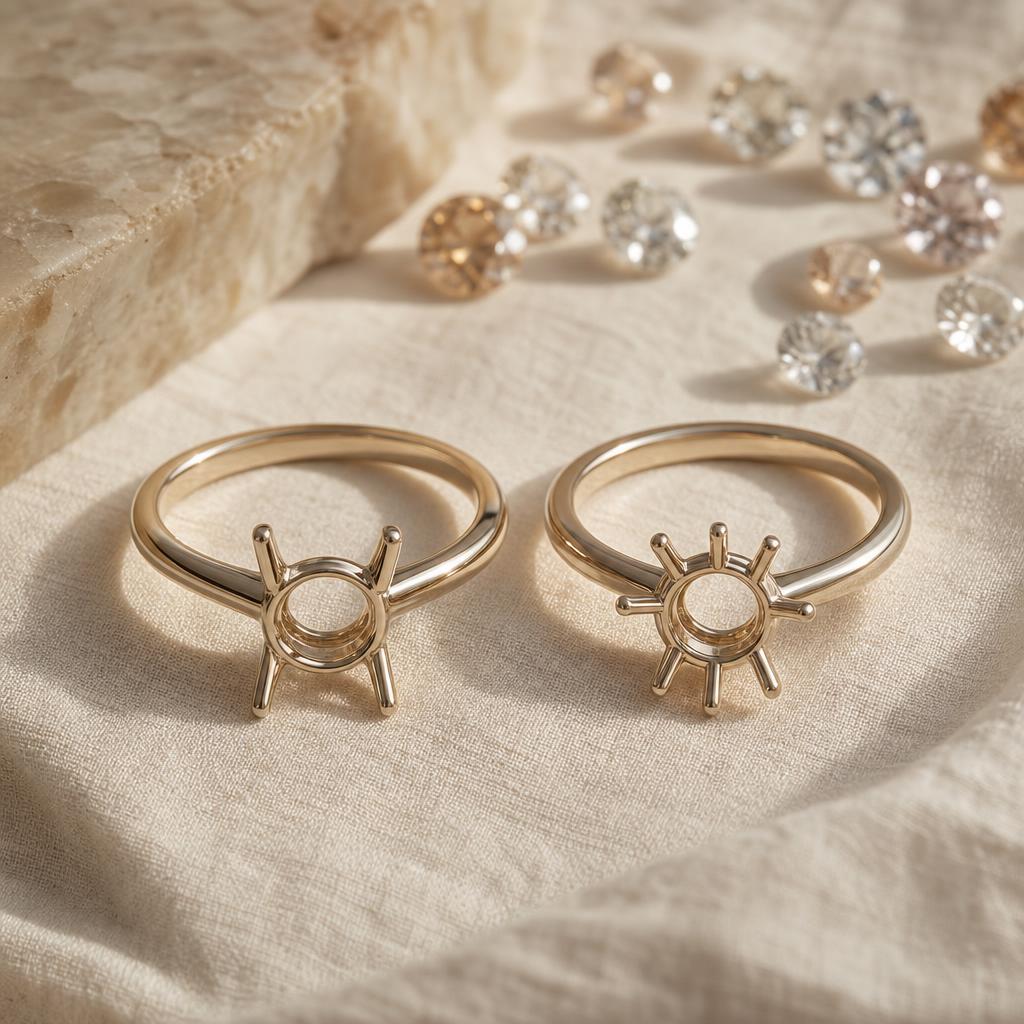
4 Prong vs 6 Prong Engagement Ring Settings: What It Means for Your Stack
Ask a woman why her engagement ring has four prongs instead of six, and most won't know the answer — it's just how the ring arrived. But prong count isn't a throwaway detail. It changes how much light reaches your center stone, how the ring photographs, and — if you're building a stack — whether your wedding band or eternity ring will actually sit flush against it or fight it for space.
If you've ever wondered why a guard ring looks perfect in a photo but gaps on your own hand, the prong setting is often the real explanation. Here's what four prongs and six prongs each do, and how to plan a stack around whichever one you have.
What a Prong Actually Does
A prong is one of the small metal claws that reaches up from the band and holds your center stone in place. Every prong setting engagement ring works on the same basic principle — the prongs grip the stone at the girdle, the widest point, and hold it steady while leaving as much of the surface exposed to light as possible. The only real variable is how many of them there are, and that number changes more than you'd expect.
4 Prong vs 6 Prong Engagement Ring Settings: The Real Difference
A four-prong setting uses the minimum number of contact points needed to hold a stone securely. With less metal covering the stone, more of it is visible from every angle — a round or square-ish stone reads slightly larger and sparkles from more directions, since there's more surface for light to enter and exit. It's the cleaner, more minimal silhouette of the two.
A six-prong setting adds two more points of contact, evenly spaced around the stone. That's not just about security, though it does add it — six points of contact mean the ring tolerates more everyday bumps before a stone loosens. Six prongs also tend to round out the shape of the setting itself, which is why the style has stayed the default for round solitaires since Tiffany popularized it generations ago.

Stella Ring
A round-cut solitaire on a classic four-prong head — maximum light, minimum metal, and a stone that reads a touch larger for its carat weight.
Shop Stella Ring →
Soleil Ring
A round-cut solitaire set on a six-prong head with a pavé shoulder — the rounder, more traditional profile, built for everyday security.
Shop Soleil Ring →Worth knowing: Prong count has nothing to do with how convincing a stone reads. Gemiros settings — four-prong or six — are built to be indistinguishable from a diamond and pass diamond testers, so the choice between them comes down purely to look and daily wear, not authenticity.
Claw Prongs vs Round Prongs — A Different Choice Entirely
It's easy to conflate prong count with prong shape, but they're separate decisions. That's a question about the tip shape, not the total number: claw prongs taper to a fine point and hug the stone in a sharper, more architectural way, while round prongs end in a smooth, bead-like dome. You can find four-prong rings with either tip style, and the same is true of six-prong settings. Round tips tend to read as quieter and more classic; claw tips catch a bit more attention and suit fancy shapes — ovals, pears, radiants — especially well.
When a Ring Calls for Double Claw Prongs
Some settings split each prong into two finer points instead of one — double claw prongs. This shows up most often on multi-stone rings and larger center stones, where a single thick prong would look heavy against softer-cornered cuts like cushion, emerald, or heart shapes. It's a detail worth noticing on three-stone rings especially, since the side stones typically need their own secure hold without crowding the center.

Juliette Ring
A pear-cut center flanked by two heart-cut side stones — a three-stone silhouette where prong placement is doing real structural work, not just decoration.
Shop Juliette Ring →How Prong Count Changes the Way a Stack Sits
This is where prong count stops being purely aesthetic. A four-prong setting sits lower and tighter to the band, with less metal flaring out at the base — a straight wedding band or eternity ring generally slides right up against it with no gap. A six-prong setting, especially one with a gallery rail or basket underneath, can sit a little higher and wider, which sometimes leaves a sliver of space between the solitaire and a flat band beside it. Neither is wrong. It just means the two settings ask something different of whatever you stack next to them. If you already know your engagement ring's prong count, that's the first thing to check before buying a band — not the metal color, not the width, but whether the base of the setting is going to clear a straight edge.
✦ Pro tip: Try before you buy where you can. A band that photographs flush online can still leave a visible gap in person once the prongs and gallery are accounted for — curved and contoured bands exist specifically to solve this.
Building the Stack: What Actually Determines Fit
Figuring out how to stack rings with an engagement ring usually comes down to three things: the width of the band you're adding, whether it's straight or contoured, and how much clearance the solitaire's prongs and base leave at the finger line. A four-prong solitaire with a low profile is one of the more forgiving bases to build around — most straight bands will sit flush without modification. A taller six-prong setting benefits from a curved or notched band that's designed to hug the shape of the head rather than press straight against it.
For a full eternity piece, the calculation is a little different again, since the band itself is doing more visual work and needs its own breathing room.

Everlasting Ring
A continuous line of pavé stones designed to sit low and flush — a straightforward stacking partner for both four-prong and six-prong solitaires alike.
Shop Everlasting Ring →Once the fit is sorted, sequencing matters less than most guides make it sound — wear your rings in whatever order feels most comfortable on your hand. What actually affects how the stack looks day to day is whether each piece clears the one next to it, prong by prong.
Quick Takeaways
- Four prongs expose more of the stone and sit lower — a cleaner look with an easier base to stack around.
- Six prongs add security and a rounder, more classic silhouette, but can sit a touch higher at the base.
- Claw prongs and round prongs are a separate choice from prong count — tip shape, not total number.
- Splitting each prong in two shows up on multi-stone and larger settings, where a single prong would look heavy.
- Before buying a wedding band, check clearance at the base of your setting — not just metal and width.
Frequently Asked Questions
Which is better, a 4-prong or 6-prong engagement ring?
Neither is objectively better — they're different trade-offs. Four prongs expose more of the stone and give a cleaner, lower profile that's easier to stack against. Six prongs add extra security and a rounder, more traditional look. Both hold a stone safely when properly crafted; the right choice depends on the silhouette you want and how you plan to wear it.
Does a six-prong setting make a stone look bigger or smaller?
Slightly smaller, if anything — the extra metal covers a touch more of the stone's surface. A four-prong setting exposes more of the stone, which is why it's often described as making the same carat weight read a little larger.
What is a double claw prong?
It's a setting where each prong is split into two slimmer points instead of one thicker one. It shows up most on multi-stone rings and larger center stones, where the extra contact points add security without the visual bulk of a single wide prong.
What's the correct order for a wedding ring stack?
There isn't one official order — tradition places the wedding band closest to the palm and the engagement ring above it, but plenty of women wear it the other way for comfort or to protect the stone. The bigger factor for how a stack actually looks is clearance at the base of each ring, not which one goes on first.
Are claw prongs or round prongs more secure?
Both hold a stone safely when well made. Round prongs are slightly more resistant to everyday wear since there's no fine point to catch or wear down over time, which is why they're often recommended for very active daily wear. Claw prongs are just as reliable but benefit from a periodic check, the same as any prong setting.
Prong count is one of those details that's easy to overlook until you're standing at the counter comparing two nearly identical rings — or trying to figure out why a band you loved online doesn't sit right at home. Once you know what to check, it stops being a mystery and starts being just another spec, like carat or cut, that you can shop for on purpose.


