

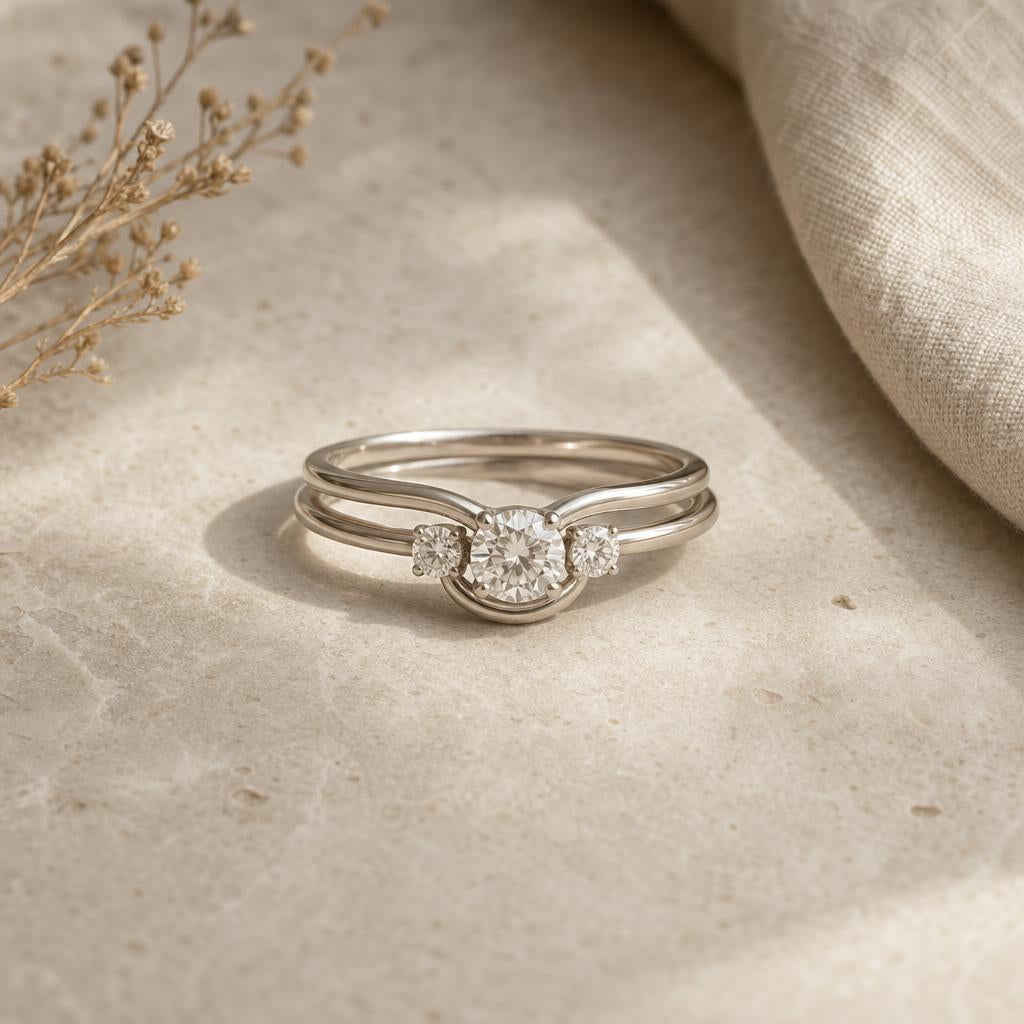
Stacking a Three-Stone Ring: Which Wedding Bands Actually Clear the Side Stones
You finally got your three-stone ring sized right, and it looks exactly the way you pictured it — until you try to slide a plain wedding band next to it and the whole thing looks off. There's a gap where the side stones flare out, or the band sits crooked, or it just doesn't sit flush no matter which way you turn it. That's not a sizing problem. It's a shape problem, and it has a specific fix.
A three-stone ring isn't built like a solitaire, and the band that pairs with it can't be chosen the same way either. The center stone is only part of the story — it's the two side stones flanking it that actually determine what will and won't sit flush against your finger.


Why a plain band doesn't just slide in next to a three-stone ring
A solitaire has one predictable footprint: a center stone sitting on a band of consistent width. A three-stone ring has three footprints in a row, and the two on the sides are almost always set lower, wider, or at a slightly different angle than the center. That's what creates the problem when you try pairing a three-stone engagement ring with a wedding band that was designed for a single stone — the plain band either hits the base of the side stone and refuses to sit flat, or it leaves a visible gap where light and space show through.
The fix isn't a wider band or a thinner one. It's a band with the right profile — one built specifically to work around the geometry your side stones create, rather than ignoring it.
The three band profiles that actually work
Curved or contoured bands. A curved wedding band with engagement ring pairings has become the default recommendation for a reason — it dips or arcs at the center, following the exact line your side stones create instead of cutting straight across it. If your center stone sits noticeably higher than the sides (common with a raised three-stone setting), a curved band closes that gap without you having to size up or down.
The trade-off: curved bands are directional. They're shaped to nest against one specific ring, which means they won't stack as cleanly with anything else you add later. If you think you'll eventually build out a fuller stack, keep that in mind before committing to a deeply curved shape.
Open or notched bands. Rather than curving around the setting, an open band leaves a small gap or notch built into the metal itself, sized to slot around the base of your side stones. It reads as a straight line from a distance but is engineered with the exact clearance your ring needs. This tends to work best when the side stones sit close to the same height as the center stone rather than dramatically lower.
Slim, flat pavé bands. If your three-stone ring has a low profile to begin with — side stones set close to the band rather than raised in their own gallery — a plain pavé stacking band can sit flush without any special shaping at all. This is the simplest option, and often the most versatile one if you plan to keep adding to the stack over time.
Worth knowing: Before you shop for a band, look at your ring from the side, not from above. How your side stones sit in profile — flush with the band, or raised above it — tells you more about which band shape will actually clear them than the carat weight ever will.
Matching the band to your ring's specific shape
The center stone shape of your three-stone ring changes what "clearing the side stones" actually requires.
Oval and pear center stones
Rings like the Empress and Orabelle set an elongated center stone with side stones angled to follow its curve. A 3 stone oval engagement ring with wedding band pairing almost always benefits from a curved profile, since the oval's rounded shoulders create exactly the kind of gap a straight band can't close. If you'd rather keep future stacking options open, an open or notched band can achieve a similar flush line without locking you into one fixed shape forever.
Asscher and emerald center stones
Step-cut stones like the one in the Astrid Ring have sharp, geometric corners rather than soft curves, and the side stones typically follow suit with the same angular lines. A curved band tends to look mismatched here — the soft arc fights the ring's straight lines. A slim, straight pavé band or a subtly notched band that respects the corners usually reads as more intentional.

Astrid Ring
An asscher-cut center with tapered side stones and Art Deco lines — a ring built for straight, architectural bands rather than curved ones.
Shop Astrid Ring →Pear and heart-cut side stones
The Juliette Ring pairs a pear-cut center with heart-cut side stones for a softer, more romantic silhouette. Because the side stones taper to a point rather than sitting evenly, a gently curved band usually clears them more reliably than a straight one — the taper leaves just enough negative space that a flat band can catch on the point rather than sliding underneath it.
What actually happens when a band doesn't clear the side stones
It's not just a cosmetic issue. A band that's fighting your ring's geometry every day wears unevenly, catches on fabric at the point where it's not sitting flush, and can loosen the fit of both rings faster than a properly matched stack would. If you've ever taken off a stack at the end of the day and noticed one ring sitting slightly twisted, this is usually why.
A three stone engagement ring stack that's actually built to fit — rather than assembled from whatever band happened to be on hand — sits quietly all day. You stop noticing it, which is exactly the point.

Devotion Ring
A continuous circle of baguette-cut stones in a sleek channel setting — the straight-line structure that pairs naturally with asscher and emerald three-stone rings.
Shop Devotion Ring →How many bands is actually too many?
A three-stone ring already reads as a fuller look than a solitaire, since it's carrying three points of sparkle instead of one. That changes the math on how many additional bands actually improve the stack versus crowd it. Most three-stone rings look most intentional with a single well-matched band on either side — or even just one. Adding a third or fourth piece can work, but only if the extra bands are noticeably thinner than the three-stone ring itself, so the eye still reads it as the anchor piece rather than one ring among several competing for attention.
Metal tone matters here too, more than it does with a simpler stack. Because a three-stone ring already has three settings' worth of metal on display — the center gallery plus two side settings — mixing metal tones across the stack tends to look busier than it does with a plain solitaire. Matching your band's metal to the ring, rather than intentionally contrasting it, is usually the safer call unless you're confident about the mixed-metal look already.
Sizing a stack, not just a ring
Gemiros rings are made in whole sizes, and that matters more once you're stacking than it does with a single ring. Two rings that each fit "close enough" on their own can feel noticeably tighter once they're worn together, especially across the knuckle. If you're between sizes, it's worth sizing the band slightly looser than you'd choose for a ring worn alone — a snug three-stone ring paired with an equally snug band is where most stacking discomfort actually comes from.
925 sterling silver holds its shape well daily, and the moissanite and simulated diamond stones across the Gemiros collection are indistinguishable from mined stones and pass diamond testers — so the only real variable left to get right is fit. That's worth spending the extra few minutes on before you commit to a band.
Quick Takeaways
- Side stones — not the center stone — determine which band shape will actually sit flush.
- Curved bands suit rings with a raised or rounded silhouette, like ovals and pears.
- Straight, notched, or slim pavé bands suit angular center stones like asscher and emerald cuts.
- A poorly matched band wears unevenly and can loosen the fit of both rings over time.
- Size the stack, not just the ring — a snug fit gets tighter once a second band joins it.
Frequently Asked Questions
What wedding band goes with a three-stone engagement ring?
It depends on your side stones. Rounded or raised side stones usually call for a curved or contoured band; angular, low-set side stones usually pair better with a straight or slightly notched band. Look at your ring in profile before deciding.
What does a three-stone ring symbolize?
The three stones are traditionally read as past, present, and future — though plenty of women choose the style simply because they love the extra dimension it gives the hand, symbolism aside.
Are three-stone rings still in style?
Yes — the shape has stayed a steady favorite because it reads as more dramatic than a solitaire while still looking deliberate and refined. It's also one of the few styles that photographs well from nearly every angle.
What is a curved wedding band called?
Curved bands are sometimes called contour bands, chevron bands, or nesting bands, depending on how dramatic the curve is. All three terms describe the same basic idea: a band shaped to follow the line of the ring next to it rather than cutting straight across.
Getting a stack to sit flush isn't about buying more rings — it's about buying the right one. Once you know what your side stones actually require, choosing a band stops being a guessing game and starts being a five-minute decision.


