

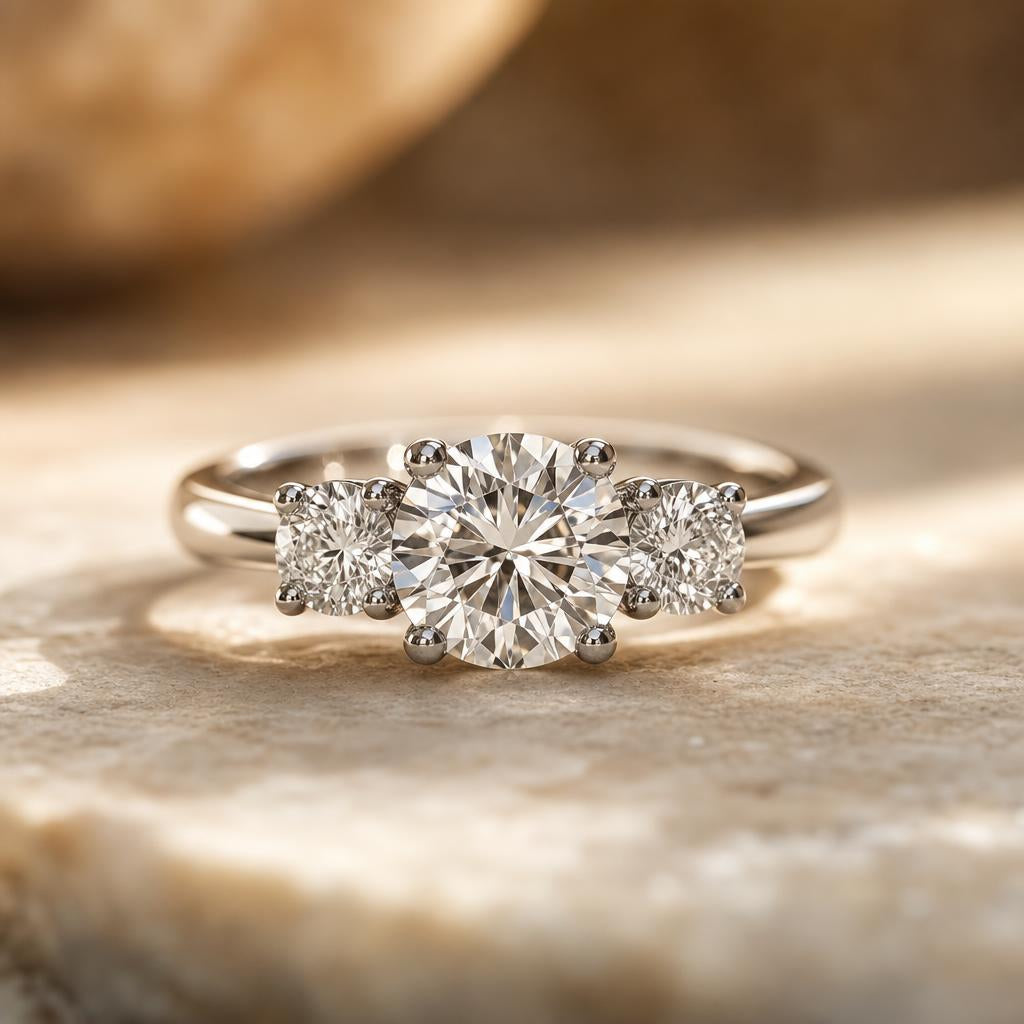
What Are Side Stones on an Engagement Ring? What They Add, and When They're Worth It
A center stone gets all the attention in most ring conversations — the carat weight, the cut, the number people try to guess. But the two smaller stones flanking it are doing more work than they get credit for: making that center stone read larger, catching light from angles a lone solitaire never will, and quietly signaling that whoever chose this ring knew exactly what she was doing.
Before we get into how side stones actually work and which pairings earn their place next to a center stone, here's a look at how Gemiros builds them — each one designed so the accents complete the center stone instead of competing with it.


What a Side Stone Actually Is
Side stones are the shaped accents set directly beside a center stone — distinct from pavé, which lines a band in a continuous trail of tiny stones, and distinct from a halo, which circles the center in a full ring of smaller ones. Side stones have their own presence. They're large enough to have a shape of their own: a heart, a baguette, a cluster, a pear. In a side stone engagement ring, the two accents aren't texture — they're a second and third design decision, chosen specifically to complement the cut of the center.
That's the detail worth knowing before you shop by shape alone. A round halo asks almost nothing of the center stone. A pair of side stones asks the center to hold its own next to two other shapes — which is exactly why the pairing matters more than people assume.
Why Two Small Stones Change How the Center Reads
The most practical reason side stones exist has nothing to do with sentiment: they change how large the center stone looks. A 3-carat center flanked by two well-proportioned accents reads bigger than the same stone sitting alone, because the eye measures the whole silhouette, not the certificate. It's also why a three-stone engagement ring catches light differently than a solitaire — three faceted surfaces instead of one means more angles throwing sparkle back at a room, not just at whoever's standing directly in front of you.
Worth knowing: a well-matched pair of side stones can make a center stone read visibly larger than its actual size — the eye is comparing proportions across the whole ring, not doing carat math.
The Shapes That Actually Pair Well
Not every side stone shape works with every center — this is where a lot of side-stone rings go from striking to slightly off. A few pairings that consistently hold up:
- Heart-shaped side stones soften a bold center. On the Statement Ring, two hearts flank a 4-carat radiant cut and take the edge off what could otherwise read as purely architectural. The Juliette Ring does the same next to a pear-cut center, leaning romantic instead of sharp.
- Baguette side stones elongate and sharpen. On the Astrid Ring, two tapered baguettes extend the already-linear asscher cut, doubling down on the Art Deco angles instead of softening them.
- Clustered side stones diffuse the sparkle instead of concentrating it. The Orabelle Ring uses this approach beside an oval center, and the result reads softer and slightly more vintage than a single sharp accent on either side.
The through-line: side stones should argue for the center stone, not against it. A soft, rounded center generally wants a side stone that curves with it. A geometric center wants an accent that keeps the same architecture going.

The Statement Ring
A 4-carat radiant-cut center with two heart-shaped side stones on a slim 2.0mm band — built for the woman who doesn't quietly enter a room.
Shop The Statement Ring →What Side Stones Do for Different Hand Shapes
Side stones don't just interact with the center stone — they interact with your hand. On shorter or fuller fingers, a pair of side stones set in a straight line tends to elongate the whole look more effectively than a halo does, because the eye travels the length of the ring rather than around a single circle. On longer fingers, that same elongation can occasionally overdo it — a clustered or rounded side stone, like the ones on the Orabelle Ring, keeps the proportions more balanced instead of stretching them further.
Band width plays into this too. A wider band under a side-stone setting reads more substantial and can visually shorten a finger slightly, while a slimmer 2.0mm band — the width Gemiros uses on the Statement and Juliette Rings — keeps the emphasis on the stones themselves rather than the metal beneath them. Neither is right or wrong; it's a question of what you're trying to balance, and it's worth trying a few shapes on before deciding which one is actually doing you favors.
The Case for a Trilogy — And When It Isn't the Move
A trilogy ring is really just a side-stone ring with a name: three stones set in a row, the center held between two flanking accents of a complementary shape. It's one of the oldest side-stone formats for a reason — it's symmetrical, it's balanced, and it doesn't rely on a halo or pavé to feel finished. If you want a ring that looks considered without looking fussy, this is usually where people land.
It isn't the right call for everyone, though. If your priority is an unbroken, minimalist line — nothing beside the center, nothing to explain — a solitaire will always do that better than a side-stone setting can. And if you're planning to stack wedding bands tight against the ring later, a wide pair of side stones can make that harder than a plain shank would. Neither of those is a reason to avoid side stones altogether. It just means the decision should account for what the ring needs to do six months from now, not only what it looks like today.

The Empress Ring
A 3.5-carat elongated oval center flanked by two tapered baguette side stones in a polished 4-prong setting — quiet dominance, not noise.
Shop The Empress Ring →Side Stones and What You Stack Around Them
Side stones don't just change how a ring looks on its own — they change what sits next to it later. A side stone wedding band, or any band you plan to wear pushed up against a three-stone setting, needs to clear the width and height of those accents, not just the center stone. That's a different sizing conversation than pairing a band with a plain solitaire, and it's worth thinking through before you buy rather than after.
None of this is a reason to hesitate on a side-stone ring — it's a reason to buy it with the full picture in mind: what it looks like alone, and what it needs to sit beside eventually.
Quick Takeaways
- Side stones are shaped accents beside the center — different from pavé (band texture) and a halo (a full ring around the center).
- A well-matched pair can make a center stone read larger without changing its actual size.
- Heart side stones soften a bold cut; baguettes sharpen and elongate; clusters diffuse the sparkle.
- A trilogy ring is a side-stone ring — three stones, one balanced line.
- If you plan to stack bands tightly against the ring later, factor the side stones' width into that decision now.
Frequently Asked Questions
What are the side stones on a ring actually called?
They're most often called side stones or accent stones. When there are exactly two of them flanking the center in a straight line, the whole setting is usually called a trilogy or three-stone ring.
How big should side stones be compared to the center stone?
There's no fixed ratio, but the accents are meant to support the center, not rival it — most side-stone rings keep each accent noticeably smaller than the center so the eye still lands on the main stone first.
Can side stones be added to a ring you already own?
That depends entirely on the setting and the jeweler doing the work — it's a custom modification, not something most rings are designed to have added after the fact. It's usually simpler to choose a ring with the side stones built into the original design.
Are three-stone and side-stone rings outdated?
No — they're one of the steadier formats in engagement and stacking jewelry precisely because the symmetry doesn't chase trends. What changes is the shape of the accents, not whether the format itself still works.
What's the difference between a trilogy ring and a side-stone ring?
It's a specific type of side-stone ring — exactly three stones set in a row. "Side stone" is the broader category, which also includes clustered accents, single side stones, or settings where the accents wrap slightly around the center rather than sitting in a straight line.
Side stones aren't an upgrade you bolt onto a ring — they're a decision made at the same time as the center stone, about what should surround it and why. Choose the shape that argues for your center instead of against it, and the two will do more for each other than either would alone.


